

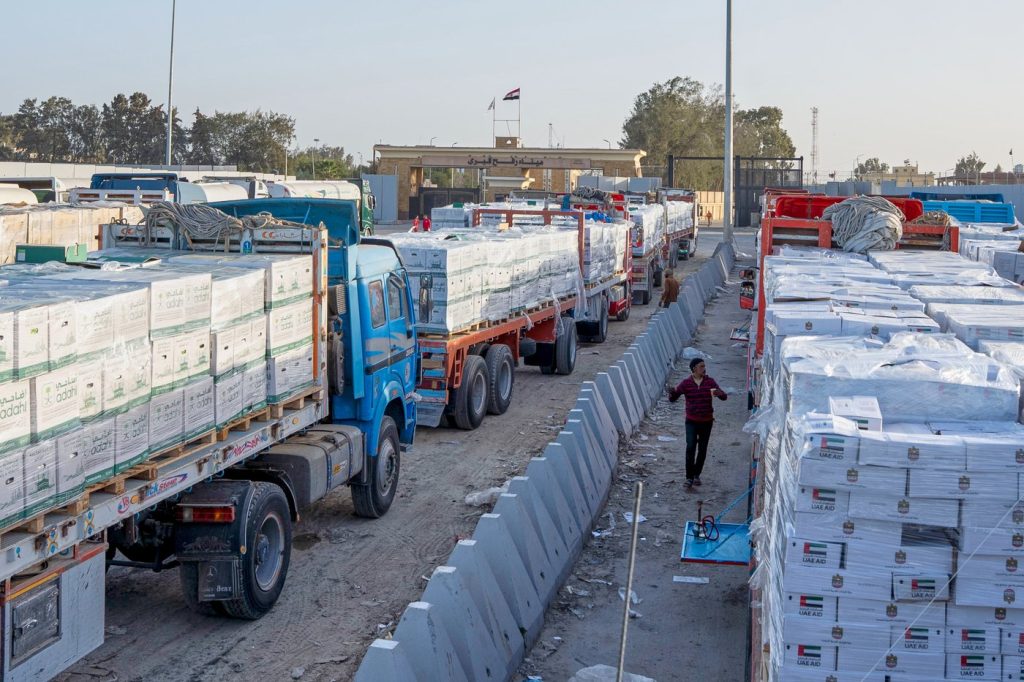
CAIRO (AP) — The Rafah border crossing between Gaza and Egypt showed renewed activity on Sunday, signaling a potential resumption of limited travel after years of isolation. This development comes as the Israel-Hamas ceasefire agreement, which began on October 10, 2023, moves forward. The reopening of this crucial crossing is seen as a significant step in the ongoing efforts to stabilize the region.
In a statement made on Sunday, Israel announced the crossing is operational on a trial basis. COGAT, the Israeli military agency responsible for humanitarian aid in Gaza, confirmed that preparations are underway for a more permanent reopening. As part of these efforts, residents of Gaza are expected to start moving through the crossing once all preparations are finalized.
Palestinian security personnel have already passed through the Egyptian gate to link up with an EU mission overseeing the movement of people. Additionally, ambulances have begun crossing through the border, according to an unnamed Egyptian official who cited the crossing's active management. The head of Gaza's new administrative committee indicated that travel in both directions would commence on Monday.
The Rafah crossing, viewed by Palestinians as a critical connection to the outside world, has remained largely closed since its control shifted to Israel in May 2024. Initial openings will only permit a limited number of individuals to cross, with no goods allowed at this time. Approximately 20,000 Palestinians in need of medical attention are hopeful for the chance to exit war-torn Gaza, while many others outside the territory aim to return home.
Zaher al-Wahidi, from the Health Ministry documentation department in Gaza, stated that they have not yet received any notifications regarding the onset of medical evacuations. Prime Minister Benjamin Netanyahu announced that Israel would permit up to 50 patients daily to leave Gaza, with each patient allowed to be accompanied by two relatives. Furthermore, around 50 individuals who exited Gaza during the conflict will be allowed to return each day.
The process for exit and entry will be vetted by both Israeli and Egyptian authorities, with supervision provided by European Union border patrol agents. Should the system prove effective, the number of travelers is expected to rise over time.
The Rafah crossing was seized by Israeli troops and closed in May 2024 under the pretext of curtailing Hamas’s arms smuggling activities. It was briefly reopened for medical evacuations during a ceasefire in early 2025. The recent recovery of the remains of the last hostage in Gaza facilitated this latest step toward easing the border restrictions.
This latest development is aligned with the second phase of last year's U.S.-brokered ceasefire agreement. The first phase encompassed the exchange of all hostages held in Gaza for numerous Palestinians held by Israel, an increase in humanitarian aid, and a partial withdrawal of Israeli forces.
The second phase introduces complexities, including establishing a new Palestinian governing committee in Gaza, deploying international security forces, disarming Hamas, and initiating reconstruction efforts in the region.
Historically, while Rafah has been the main entry point for individuals moving to and from Gaza, other border crossings have been shared with Israel. Under ceasefire stipulations, Israel maintains control over the area connecting the Rafah crossing to the primary regions populated by Palestinians. Egypt has persistently voiced concerns over possible Israeli maneuvers to exploit the crossing to displace Palestinians, emphasizing the need for it to facilitate both entry and exit.
The current ceasefire has put a temporary halt to over two years of hostilities between Israel and Hamas, which ignited on October 7, 2023, following a massive attack by Hamas in southern Israel. This recent activity at the Rafah crossing illustrates the ongoing complexities and challenges in achieving a lasting solution to the conflict.








