

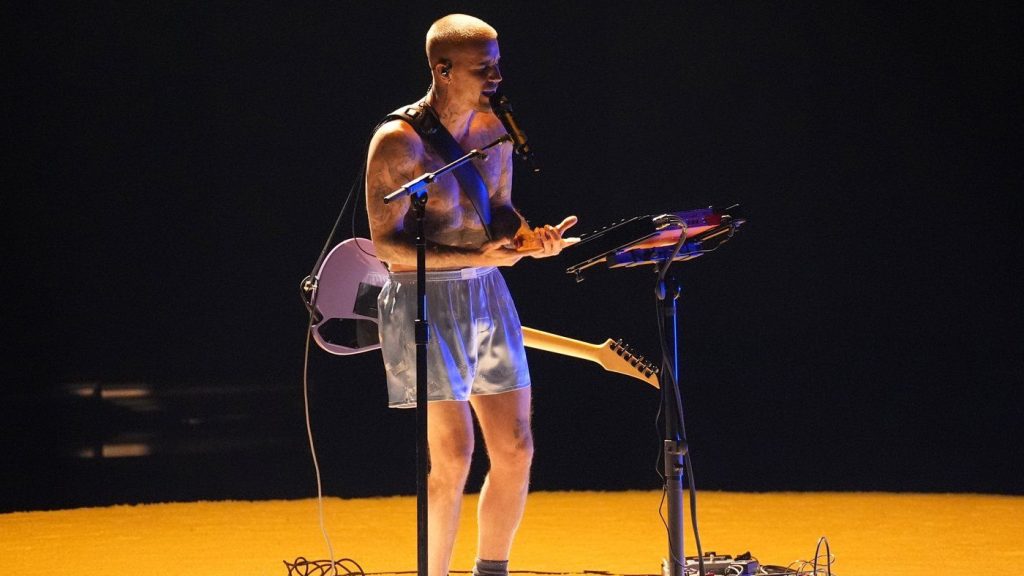
Justin Bieber made a striking return to the Grammys stage on Sunday, delivering a performance that was both stripped-down and intimate. Dressed only in a pair of boxers and socks, the Canadian pop star utilized a loop pedal to craft a backing track, incorporating a guitar and drum machine, before performing his single “Yukon.” This marked Bieber's first live performance at the Grammys in four years, following his hiatus due to Ramsay Hunt syndrome, which resulted in temporary paralysis of half his face in 2022. His wife, Hailey Bieber, was seen smiling in the audience as he sang.
Bieber received four Grammy nominations this year, including album of the year, best pop solo performance, best pop vocal album, and best R&B performance. His powerful return was a highlight of the evening, as fans and fellow artists alike celebrated his resilience and talent.
In a notable moment during the ceremony, Canadian folk legend Joni Mitchell made a rare public appearance to accept the Grammy for best historical album. She won for “Joni Mitchell Archives – Volume 4: The Asylum Years,” a box set that features unreleased material from her extensive personal archives. This particular collection focuses on songs from 1976 to 1980. The 82-year-old was escorted to the stage wearing a dazzling pantsuit adorned with sequins in gold, silver, and black.
During her speech, although she refrained from discussing political topics, Mitchell sported an “Ice Out” button—a form of protest against U.S. Immigration and Customs Enforcement that has gained traction at red-carpet events. Notably, Hailey Bieber also wore one of these buttons, emphasizing the ongoing discussions surrounding immigration policies.
Several artists at the Grammys pointedly criticized the Trump administration's immigration policies, which have faced scrutiny for their harsh enforcement. In her speech, Mitchell shared reflections on the time leading up to her 1974 album “Court and Spark,” describing how she navigated the effects of the British Invasion that diminished folk music's popularity. She recounted how her record label pressured her to work with a specific band, ultimately leading her to collaborate with the jazz band L.A. Express instead.
Mitchell humorously recalled her creative struggle while producing her 1972 album “For the Roses,” recounting how label head David Geffen initially forbade her from using a whimsical sketch as the album cover. However, he allowed the drawing to feature on a billboard, resulting in the humorous image of a donkey’s behind being displayed on Sunset Boulevard, which prompted laughter from the audience. Mitchell concluded her speech with gratitude, stating, “Well, anyway, I’m very honoured to receive a Grammy for those records. Thank you.”
Other Canadian winners at the ceremony included Halifax songwriter and producer Henry Walter, popularly known as Cirkut, who won two Grammys: producer of the year and best dance pop recording. He earned the latter award alongside Canadian sound mixer Serban Ghenea for their collaboration on Lady Gaga’s track “Abracadabra.” While accepting his award, Walter expressed appreciation for his collaborators, including Lady Gaga and Bruno Mars, saying, “You trusted me with your vision. You could have chosen anyone but you chose me.”
Additionally, Justin Gray from Toronto won a Grammy for best immersive audio album, making him the first Canadian to achieve this honor in the category. In his acceptance speech, Gray thanked everyone involved in bringing his record to life, referring to his album “Immersed,” which featured 38 artists from Toronto. He concluded with a heartfelt message to his home country, stating, “To Toronto, to Canada, we love you.”








