

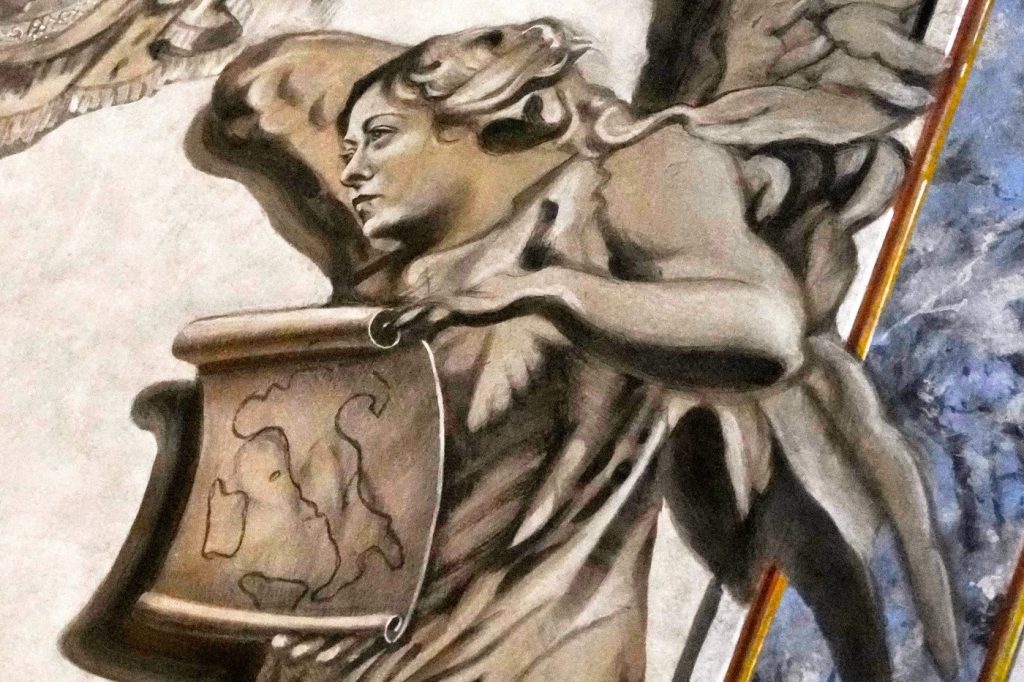
ROME (AP) – A recent incident involving a cherub resembling Italian Premier Giorgia Meloni in the Basilica of San Lorenzo in Lucina has ignited a minor scandal, prompting investigations by both the diocese of Rome and the Italian Culture Ministry. The cherub's resemblance to Meloni was highlighted after photographs were published in Italian newspapers, leading to a swift institutional response indicative of the sensitivity regarding sacred art.
The Basilica of San Lorenzo in Lucina, one of the oldest churches in Rome, is situated near the Spanish Steps and has gained renewed attention due to this episode. Curious visitors flocked to the basilica over the weekend, straining to photograph the angelic figure, which is located near the front altar in a side chapel, sometimes disrupting ongoing Mass services.
Giorgia Meloni reacted to the controversy by taking a light-hearted approach on social media, stating, “No, I definitely don’t look like an angel,” and accompanying her post with a laughing/crying emoji alongside a photo of the artwork. The basilica, originally consecrated in 440 by Pope Sixtus III, was enriched over the years through various renovations and is currently under the purview of the Interior Ministry, which oversees its maintenance.
This incident has historical undertones tied to Italy's complex past with monarchy and fascism. The cherub in question reportedly dates back to a restoration that took place in 2000, which included a bust of Umberto II, the final king of Italy. The positioning of the cherub, appearing to show deference to the king, raises concerns due to Italy's abolition of the monarchy after World War II, motivated by the monarchy's historical support for fascist dictator Benito Mussolini. Meloni’s party is said to have roots in the neo-fascist movement, further complicating the symbolism of this cherub.
After experiencing water damage in 2023, the cherub underwent restoration, during which the resemblance to Meloni came to be recognized. Rev. Daniele Micheletti, the parish priest of the basilica, acknowledged the likeness but downplayed its significance, noting that many artists throughout history have based their works on real-life figures. He referred to the works of renowned artists like Caravaggio and Michelangelo, who were known to have used people they knew in their depictions.
The Italian Culture Ministry, led by special delegate Daniela Porro, dispatched officials to assess the situation at the basilica. Their investigation seeks to understand the original appearance of the cherub created in 2000. In contrast, the restorer Bruno Valentinetti defended his work, asserting that he did not use Meloni as a model, but rather focused on restoring the original painting he created two decades ago.
Cardinal Baldassare Reina, the vicar of Rome, expressed dissatisfaction with Micheletti's relaxed attitude towards the controversy and has announced a formal investigation regarding the matter. The diocese emphasized its commitment to preserving its artistic and spiritual heritage, stating that sacred art should not be exploited or misused beyond its liturgical purpose.
This incident highlights the intersection of religion, politics, and cultural heritage in Italy, showcasing the sensitive nature of public perception towards art linked with contemporary figures in a country still grappling with its historical narratives.








