

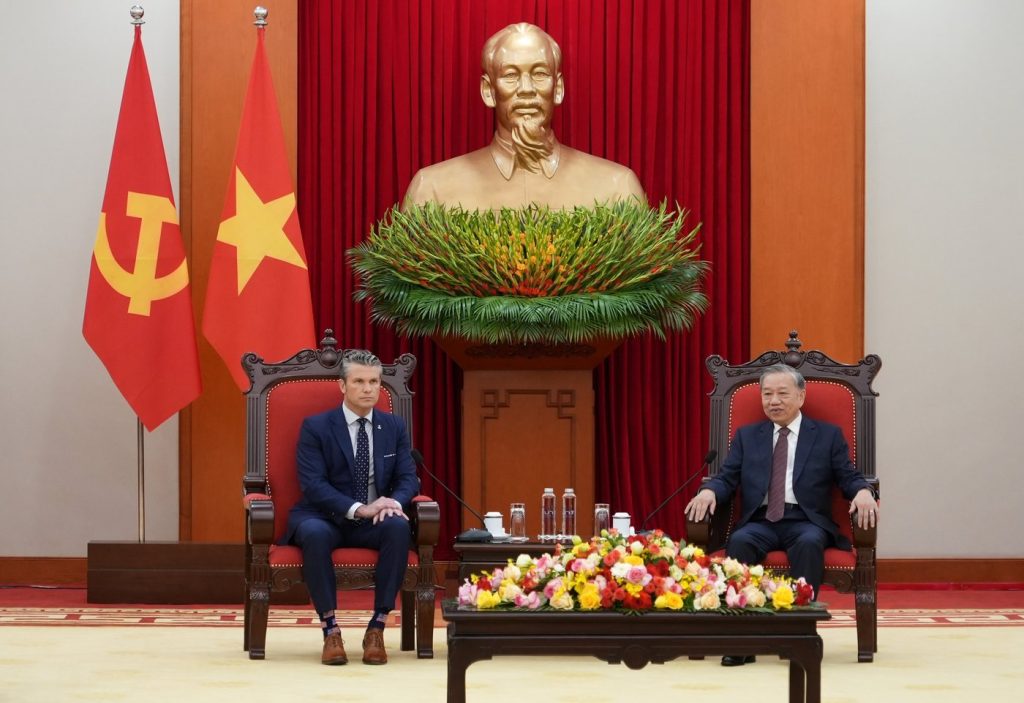
In a recent report, an internal Vietnamese military document reveals that despite elevating relations with the United States to their highest diplomatic level, Vietnam views the U.S. as a potential "belligerent" and is preparing for what it refers to as a “war of aggression.” This document, titled "The 2nd U.S. Invasion Plan," highlights concerns over American intentions and the possibility of a U.S.-backed uprising, akin to historical "color revolutions," which have threatened Communist regimes worldwide.
The analysis by The 88 Project, a human rights organization, indicates that the Vietnamese government, across various ministries, shares a consensus about the perceived threat from the U.S. The report emphasizes that the anxiety over external intervention to undermine the Communist leadership remains high among Vietnamese authorities.
Completed by the Ministry of Defense in August 2024, the original document cites that although there is currently low risk of direct conflict between the U.S. and Vietnam, there is a prevalent belief that the U.S. may provoke situations to justify military intervention. The Vietnamese military assess the evolving nature of American foreign policy over three administrations, noting a pattern of increased military alliances in Asia aimed at countering China.
In 2023, U.S. President Joe Biden signed a "Comprehensive Strategic Partnership" with Vietnam, officially raising relations between the two countries to an esteemed level similar to that with Russia and China. However, the 2024 military document underscores that while the U.S. categorizes Vietnam as a strategic partner, it is simultaneously perceived as an agent promoting liberal values that threaten Vietnam's socialist government. Ben Swanton, co-director of The 88 Project, reflected on the document's insights, stating that Hanoi sees the U.S. not merely as a partner but as an existential threat.
The internal document illustrates broader tensions within Vietnam's political landscape, particularly between the established Communist Party and the military, which harbors reservations about closer ties with the U.S. Nguyen Khac Giang from Singapore’s ISEAS-Yusof Ishak Institute notes a lingering distrust among military leaders regarding American intentions, particularly following accusations against U.S.-linked Fulbright University of inciting a color revolution.
The report also highlights that the Vietnamese military's apprehensions stem from a historical context, given the legacy of the Vietnam War, which ended in 1975. Experts assert that Vietnamese leaders are more concerned about potential internal uprisings than direct threats from neighboring China, even though tensions over territorial claims in the South China Sea persist.
Vietnam's complicated relationship with the U.S. is illustrated by disruptions caused to U.S. Agency for International Development projects under the Trump administration. Cuts to these programs contributed to feelings of mistrust, despite the U.S. being a significant trade partner for Vietnam. Scholars indicate that even progressive leaders within the Vietnamese government remain wary, believing that U.S. support could shift towards supporting internal dissent if a crisis arose.
As Vietnam navigates its diplomatic relations, the internal document emphasizes the duality of approaching the U.S. as an ally while harboring fears of interference in domestic affairs. With the appointment of To Lam as general secretary of the Communist Party, Vietnam seeks to maintain a pragmatic balance between its economic relationships with both the U.S. and China, who are its largest trading partners.
In summary, internal Vietnamese discussions reflect longstanding fears regarding external meddling in its political structure, suggesting an ongoing balancing act as Vietnam strives to secure its interests while developing deeper ties with a perceived adversary.








