

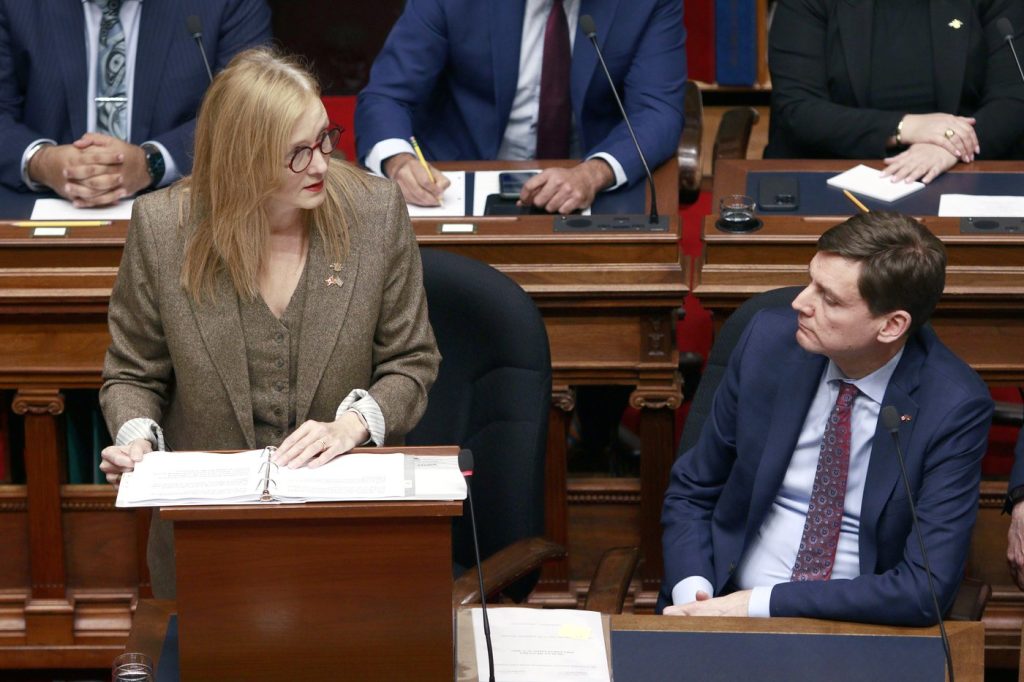
VICTORIA – The British Columbia government is preparing for significant budget changes in light of recent events, as both Premier David Eby and Finance Minister Brenda Bailey have indicated a tightening of government spending. This legislative session commenced shortly after a tragic mass shooting in Tumbler Ridge, which left nine people dead, including six children, prompting the throne speech to focus on community recovery rather than the government's broader agenda.
Finance Minister Bailey anticipates considerable backlash from the public when she presents the budget, expecting to be perceived as "the least popular person in the province for a while." However, economist Marc Lee from the Canadian Centre for Policy Alternatives suggests that while the government discusses austerity measures, the actual budget may not reflect extreme cuts. “I hope that I’m proven correct,” Lee expressed, emphasizing the need for balanced fiscal management without excessive reductions in public services.
A background briefing authorized by the premier's office indicated that although the provincial deficit is significant, the government is committed to safeguarding core services while preparing for unexpected economic challenges. The current provincial deficit is projected at $11.2 billion. Shannon Salter, deputy minister to Premier Eby, underscored the concern regarding the "unsustainable provincial budget deficit," reinforcing the urgency for fiscal reform.
Premier Eby has publicly stated that spending reductions will be necessary, and he plans to continue decreasing the size of the public sector. “We have to reduce those expenditures, and we will do so in the budget,” he remarked, assuring that essential services for British Columbians will be maintained. Bailey's previous comments at a Greater Vancouver Board of Trade event prompted criticism from the Conservative Party of B.C., with finance critic Peter Milobar questioning the management of public funds. He emphasized the need for accountability regarding the government’s historical spending patterns, which have coincided with challenges faced by families across the province.
Milobar highlighted that under Eby’s leadership, the province's finances had deteriorated despite initial surplus. He noted that the provincial debt had escalated dramatically, projecting to exceed $155 billion by the end of the fiscal year, while it was around $89.4 billion when Eby assumed office. Milobar called for a return to fiscal discipline and a credible plan to balance the budget.
While some raise alarms about the province's debt, Lee contends that such concerns are "overblown," pointing to British Columbia's relatively low debt-to-GDP ratio, which, as of late 2025, stands at 3.8 percent—second-lowest in Canada after Alberta, which is at 2.1 percent. He notes that previous government investments in infrastructure and services are significant assets that should be considered in the fiscal discussion.
As British Columbia navigates a turbulent economic landscape affected by factors such as a trade war and stagnating population growth, the debate continues regarding the appropriateness of the projected deficit levels. On Thursday, journalists inquired about potential cuts to the civil service, definitions of core services, and the possibility of tax hikes to compensate for revenue shortfalls, but were advised to await information until the budget is officially revealed.
Since the beginning of 2024, the provincial public service has reportedly decreased by over 1,500 employees, most of whom left through attrition. Data indicates that among the exits, approximately 40 percent were resignations, 18 percent involved retirements, and 34 percent were due to the completion of job terms. This ongoing restructuring highlights the government’s efforts to manage human resources in light of fiscal pressures while aiming to protect vital services for the populace.








