

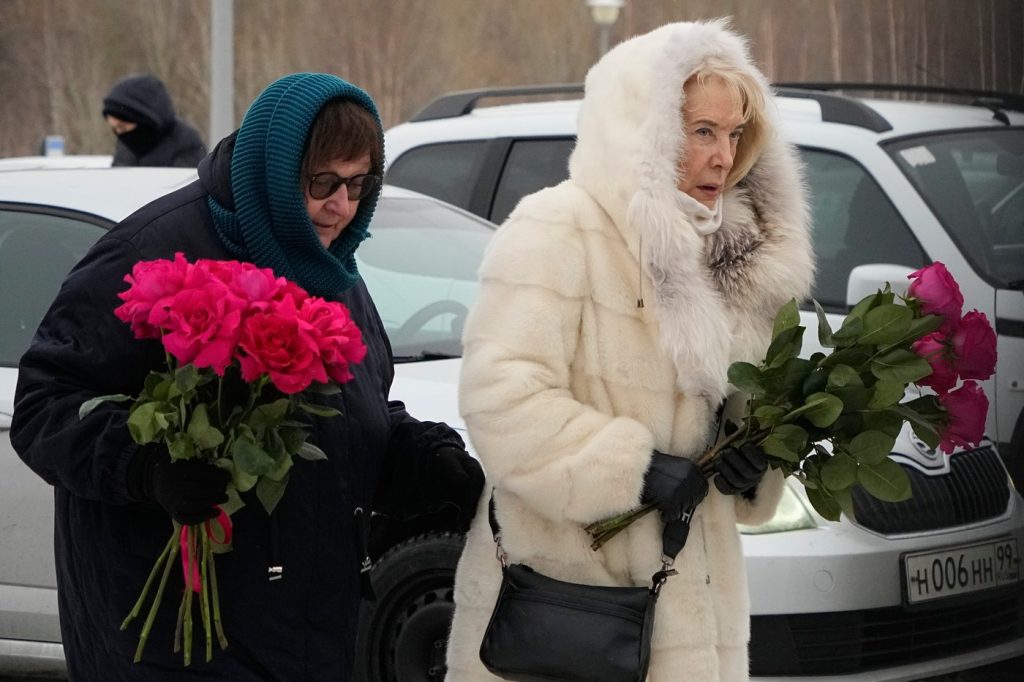
MOSCOW (AP) – Mourners gathered in Moscow on February 16, 2026, to commemorate the second anniversary of Russian opposition leader Alexei Navalny's death in custody, amidst heightened security and ongoing allegations regarding the circumstances of his demise. Navalny passed away at the age of 47 in an Arctic penal colony while serving a 19-year sentence, widely regarded as politically motivated. His death left a marked void in the Russian opposition, which has struggled to unite and effectively challenge the Kremlin without his leadership.
At the gravesite in Borisovsky Cemetery, Navalny's mother, Lyudmila Navalnaya, and his mother-in-law, Alla Abrosimova, among other mourners, laid flowers on his grave. The site was adorned with a mound of floral tributes as a small choir performed in his memory. Lyudmila reiterated her belief that her son was murdered by Russian authorities, a sentiment echoed by several European nations amidst increasing scrutiny of the Kremlin's actions. “We knew that our son did not simply die in prison,” she stated. “He was murdered.”
The Kremlin has categorically denied any wrongdoing, asserting that Navalny's death resulted from natural causes. In St. Petersburg, flowers were similarly laid at a memorial honoring victims of political repression, although access to the site was reportedly restricted by temporary barriers.
The anniversary coincided with a significant statement from five European nations, including the U.K., France, Germany, Sweden, and the Netherlands, which alleged that Navalny was poisoned with a rare and lethal toxin, epibatidine, found in the skin of poison dart frogs—substances not native to Russia. The statement claimed that the Kremlin had the “means, motive, and opportunity” to administer this poison, prompting French President Emmanuel Macron to reflect on Navalny's legacy and reaffirm his belief in the alleged premeditated nature of Navalny's death.
Macron expressed his condolences in a written tribute, stating, "Two years ago, the world learned of the death of Alexei Navalny. I pay tribute to his memory." He characterized the events surrounding Navalny's death as reflective of the Kremlin's fear of opposition, emphasizing the ongoing need for truth and justice concerning this incident.
On media inquiries regarding the allegations, a presidential spokesperson asserted that the Kremlin does not accept these claims, describing them as “biased and unfounded.” Navalny’s widow, Yulia Navalnaya, attending the Munich Security Conference, expressed her certainty about her husband's poisoning from the very beginning and called for accountability from President Putin, labeling him as a "murderer." Navalny had survived a prior poisoning attempt in 2020, which he attributed to the Kremlin, claims that have consistently been denied by Russian officials.
The Russian opposition continues to face significant challenges in the aftermath of Navalny's death. His closest allies and other prominent opposition figures are primarily operating in exile, with many receiving lengthy prison sentences in absentia and unable to return to Russia. The opposition has struggled to unite or create a coherent strategy against the Kremlin, often embroiled in internal disputes. Meanwhile, the Council of Europe's Parliamentary Assembly (PACE) has announced the formation of the Platform for Dialogue with Russian Democratic Forces, aiming to provide opposition voices a formal avenue to engage with European lawmakers, although it has also been criticized for lacking democratic electoral processes.
As the anniversary serves as a reminder of Navalny's pivotal role in articulating opposition to the Kremlin, it also underscores the systemic issues faced by dissidents and advocates for political reform in Russia, with ongoing calls for justice reflecting broader concerns about human rights and governance under the current regime.








