

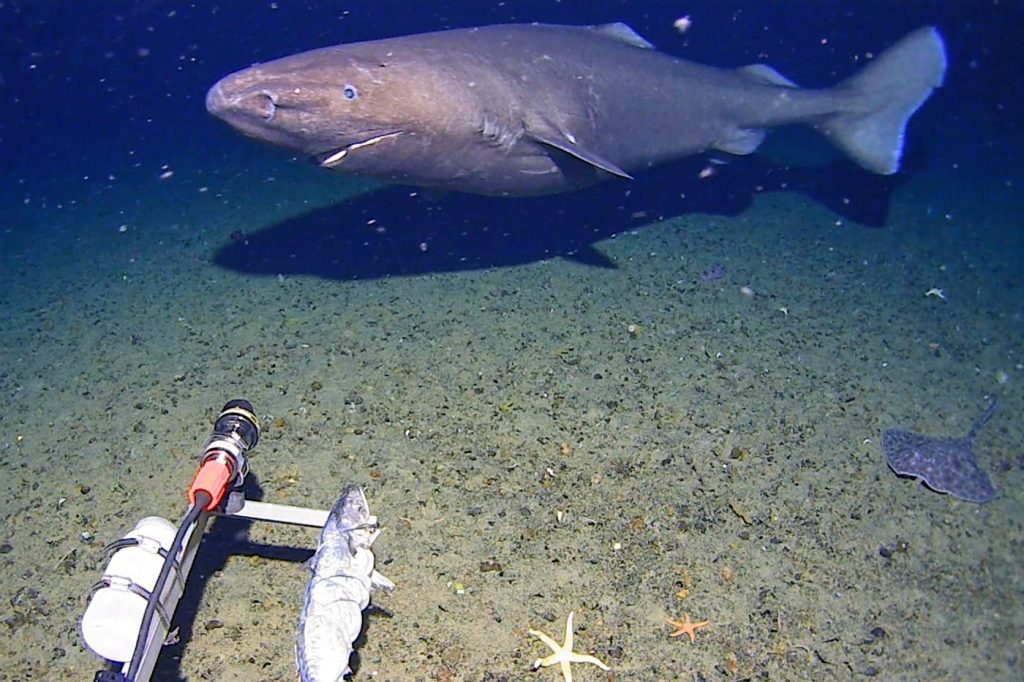
MELBOURNE, Australia (AP) — A remarkable observation of a sleeper shark was recorded deep in the frigid waters off the Antarctic Peninsula, challenging previous assumptions about shark habitats. Many marine experts presumed that sharks could not survive in the cold waters of Antarctica; however, a video captured the appearance of this substantial shark in January 2025, marking a significant discovery in marine biology.
The sleeper shark, observed by researcher Alan Jamieson, is estimated to measure between 3 and 4 meters (10 and 13 feet) in length. Jamieson noted, “We went down there not expecting to see sharks because there’s a general rule of thumb that you don’t get sharks in Antarctica.” This surprising encounter elucidates the intricacies of life in extreme environments, as Jamieson described the shark as “a hunk of a shark,” and emphasized its robust stature, likening it to a “tank.”
The observation was made by the Minderoo-UWA Deep-Sea Research Centre, which conducts research on the deepest parts of the world's oceans. The camera was deployed near the South Shetland Islands, located well within the boundaries of the Antarctic, or Southern, Ocean, defined as the area below the 60-degree south latitude line. After the remarkable footage was captured, the center granted permission for it to be published by news agencies, shedding light on a previously undocumented aspect of Antarctic marine life.
The shark was filmed at a depth of 490 meters (1,608 feet), where the water temperature was almost freezing at 1.27 degrees Celsius (34.29 degrees Fahrenheit). In the same video frame, a skate, a relative of the shark resembling a stingray, was depicted motionless on the seabed. This observation was not surprising to scientists, who were already familiar with the skate's extensive range in southern waters.
Notably, Jamieson found no preceding record of sharks being documented in the Antarctic Ocean, a sentiment echoed by Peter Kyne, a conservation biologist from Charles Darwin University, who stated that this observation could be the first of its kind so far south. The implications of climate change and the warming of ocean waters could push marine species, including sharks, into previously uninhabited cold regions. However, due to the remoteness of the Antarctic, data regarding the range changes of marine life has been severely lacking.
Kyne posited that these slow-moving sleeper sharks could have resided in Antarctic waters unnoticed until now. “This is great,” Kyne remarked. “The shark was in the right place, the camera was in the right place, and they got this great footage. It’s quite significant.” However, it is important to note that the sleeper shark population in the Antarctic Ocean might be sparse, complicating the detection efforts by researchers.
The recorded shark maintained a consistent depth of around 500 meters (1,640 feet) along a seabed that gradually descended into deeper waters. According to Jamieson, this depth represents the warmest layer among various water strata that exists beneath the surface. The Antarctic Ocean is characterized by a complex layering system, or stratification, extending to about 1,000 meters (3,280 feet) deep, where distinct water properties, such as cold, dense water from below and freshwater from melting ice above, hinder mixing.
Jamieson speculated that other sharks likely inhabit similar depths in Antarctic waters, scavenging on carcasses of marine life such as whales and giant squids that die and descend to the seabed. The lack of research cameras operating at that specific depth limits the understanding of marine life in Antarctic waters, especially considering that cameras can only function during the Southern Hemisphere’s summer months, from December to February. During the remaining 75% of the year, surveillance of these deep-sea environments is virtually nonexistent, which underscores the rarity and significance of this recent discovery.








