

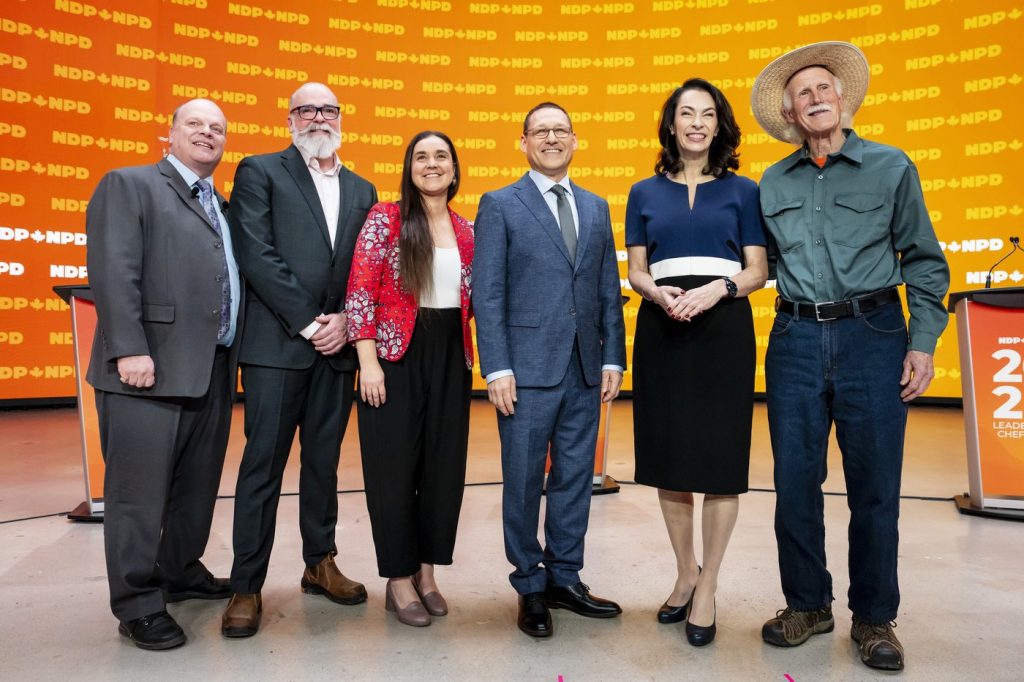
OTTAWA — The sales of memberships and payment of entry fees have been completed, and the NDP leadership candidates are gearing up for their second and final party-organized debate in British Columbia on February 19. This upcoming debate will be conducted in English, marking a shift from the first debate held in November, which was intended to be a French-language event but predominantly occurred in English due to the limited bilingualism of the candidates.
Despite sharing a common foundation of social democratic values, such as support for labor unions, the debate is an opportunity for candidates to differentiate themselves from one another. The final vote for the leadership will employ a ranked ballot system, with the new leader to be announced on March 29 during a leadership convention in Winnipeg.
Among the five candidates competing for the leadership, distinct propositions are being put forth:
Rob Ashton
Rob Ashton, a leader in the dockworker union, has outlined a national public transit strategy that includes a dedicated annual funding of $2 billion to subsidize municipal bus and train fares. He advocates for the enhancement of national transportation infrastructure through public infrastructure projects, such as buses and high-speed rail, aimed at job creation and emission reductions. As part of his platform, he emphasizes improving rail services to the Port of Churchill in Manitoba for increased export capabilities. Additionally, Ashton calls for Canada to rethink its defense procurement, advocating for reduced reliance on U.S.-controlled technology, and supports transitioning to a proportional representation electoral system, the specific form of which would be decided by a citizens' assembly.
Tanille Johnston
Tanille Johnston, the first Indigenous woman to run for NDP leadership, places reconciliation at the forefront of her platform. She is advocating for increased federal investment in infrastructure for First Nations communities, including all-weather roads, broadband internet access, and airports. Johnston has pledged that her government would eliminate long-term on-reserve boil water advisories. She also proposes a "guaranteed livable basic income" for Canadians aged 18 to 64, which would vary based on taxable income. To fund this initiative, Johnston suggests raising the corporate tax rate from 15% to 22% and aligning capital gains tax with personal income tax rates.
Avi Lewis
Avi Lewis, who is currently leading in fundraising, emphasizes tax reform in his campaign. He proposes a new one percent "wealth tax" for individuals with over $10 million in assets, escalating to a three percent tax on wealth exceeding $100 million, which he estimates would generate $40 billion annually. Lewis also intends to end government subsidies for the fossil fuel sector and eliminate the practice of hiring private consultants for government advice. He aims to reintroduce a digital services tax for social media and online advertising, which he believes could yield an additional $7 billion annually. Furthermore, his platform promotes a "human guarantee" to ensure citizens have the option to interact with a human representative instead of artificial intelligence when accessing federal services, as well as broader regulations on AI, requiring Canadian companies to disclose their AI training data.
Heather McPherson
Heather McPherson, the only sitting MP among the candidates, focuses her campaign on rebuilding the party and enhancing candidate competitiveness. She advocates for improved regional campaign infrastructure, earlier candidate nominations, and better communication between the central party and its candidates. Her plan includes the development of a green economy by prioritizing the establishment of a national electricity grid and emphasizing low-carbon power generation. McPherson seeks predictable, long-term funding for local governments and communities to develop infrastructure to cope with climate change-induced natural disasters, such as floods and wildfires, while also supporting the end of federal subsidies for oil and gas companies.
Tony McQuail
Tony McQuail, an organic farmer from Ontario, positions himself as a "green progressive" advocating for sustainability beyond mere environmentalism. He proposes leveraging his experience in regenerative farming to restore local flora on underutilized lands. His platform addresses the housing crisis by promoting affordable, communal, and sustainable housing options, and he advocates for a non-profit ride-share program to assist rural residents in accessing larger communities. Similar to Johnston, he supports the implementation of a universal basic income and echoes calls for replacing the first-past-the-post electoral system in favor of proportional representation.
This report gives insight into the varied agendas of the NDP leadership candidates as they prepare for the final debate, setting the stage for the upcoming leadership convention in March.








