

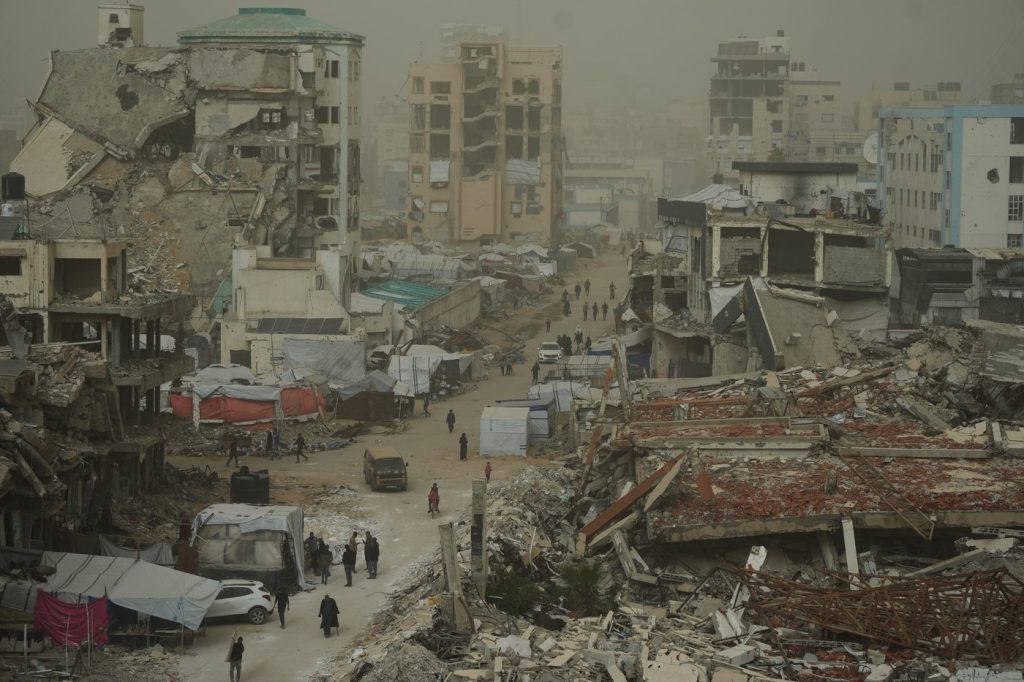
JERUSALEM (AP) – U.S. President Donald Trump’s Board of Peace is set to convene for the first time on Thursday in Washington. This meeting marks an initial test of whether this significant foreign policy initiative can receive widespread support and effectively advance the fragile ceasefire agreement in the Gaza Strip.
Trump's aspirations for the board extend from governing and rebuilding Gaza into a technologically advanced metropolis to redefining the United Nations Security Council's involvement in conflict resolution. However, these ambitions could be constrained by the current realities in Gaza, where progress toward achieving the ceasefire’s more immediate objectives remains limited.
Despite the ceasefire, Palestinians, including civilians, continue to face fatalities due to frequent airstrikes that Israel states are directed at militants. Hamas has not disarmed, international forces have yet to deploy, and a Palestinian committee, designed to replace Hamas, is currently stalled in Egypt.
Max Rodenbeck, Israel-Palestine Project Director at the International Crisis Group, stated, “If this meeting does not result in fast, tangible improvements on the ground — particularly on the humanitarian front — its credibility will quickly crumble.”
More than two dozen nations have agreed to be founding members of the board. This includes Israel and other key regional players involved in ceasefire negotiations, along with nations from outside the Middle East that support Trump or wish to gain his approval. Notably, U.S. allies such as France, Norway, and Sweden have declined to participate thus far.
Many Israelis express concerns about the involvement of Qatar and Turkey, which have historical ties with Hamas. Furthermore, Palestinians have voiced objections as their representatives were not included in the board discussions regarding the future of a territory with approximately 2 million inhabitants.
Trump, identifying himself as the board's chairman, recently announced that member countries have pledged $5 billion for Gaza's reconstruction and would contribute thousands of personnel for peacekeeping and policing. However, no financial commitments or a detailed agenda for the meeting have been unveiled publicly.
Ambitious proposals have been presented by Trump, in collaboration with his son-in-law Jared Kushner and envoy Steve Witkoff, aiming to reconstruct Gaza with robust international investment. At the World Economic Forum in Davos last month, Kushner suggested the possibility of rebuilding being completed within three years, despite U.N. predictions indicating that rubble clearance and demining could take significantly longer.
Israeli Prime Minister Benjamin Netanyahu has emphasized that no reconstruction will occur until Hamas disarms, leaving many Palestinians in enduring devastation and uncertainty. Although the ceasefire has paused major military operations, alleviated hostage situations, and enabled increased aid to Gaza, a durable resolution to the ongoing conflict that reignited following the October 7, 2023, Hamas assault remains elusive.
The ceasefire deal envisions Hamas surrendering its weapons and Israeli forces withdrawing from Gaza as international troops assemble. However, the agreement lacks a concrete timeline for these developments and leaves many questions unsettled, aiming to minimize immediate confrontations over these issues.
Both the U.S. and Israel argue that Hamas’s disarmament is crucial to advancing other areas of the agreement. Various Arab and Muslim members of the Board of Peace have accused Israel of jeopardizing the ceasefire with ongoing strikes and have urged the U.S. to exercise restraint over its close ally. These members demand disarmament from Hamas while asserting the necessity of Israel's withdrawal.
Israel insists that demilitarization includes not only heavy weapons but also ordinary firearms. Netanyahu has pointed out that Hamas would need to relinquish around 60,000 automatic rifles. Despite acknowledging the ceasefire agreement, Hamas has provided ambiguous commitments to disarm, suggesting that retaining certain weapons is necessary for maintaining order during the transitional phase.
Potential ideas being discussed include allowing Hamas to "freeze" its arms in sealed depots under international oversight or surrendering heavy weaponry while keeping some sidearms for law enforcement. However, whether Israel or the U.S. would accept such proposals remains uncertain.
The ceasefire accord also includes provisions for establishing a temporary International Stabilization Force composed of troops from Arab and Muslim-majority nations to train and assist a new Palestinian police force. The specifics of its mandate remain vague but would likely cover securing humanitarian aid deliveries and preventing arms smuggling.
Countries approached to contribute to this force have insisted that any deployment should be labeled as a peacekeeping mission, with many rejecting involvement in disarming Hamas due to the potential risks involved. Indonesia is reportedly preparing up to 8,000 soldiers for this initiative but has made it clear they will not participate in any disarmament activities.
The ceasefire agreement entails that Hamas must transfer power to a transitional committee of politically neutral Palestinian administrators, overseen by the U.S.-appointed envoy, former U.N. envoy Nickolay Mladenov. However, this committee has yet to receive Israeli permissions to enter Gaza from Egypt, and without Hamas's cooperation and a cessation of ceasefire violations, its functionality is compromised.








