

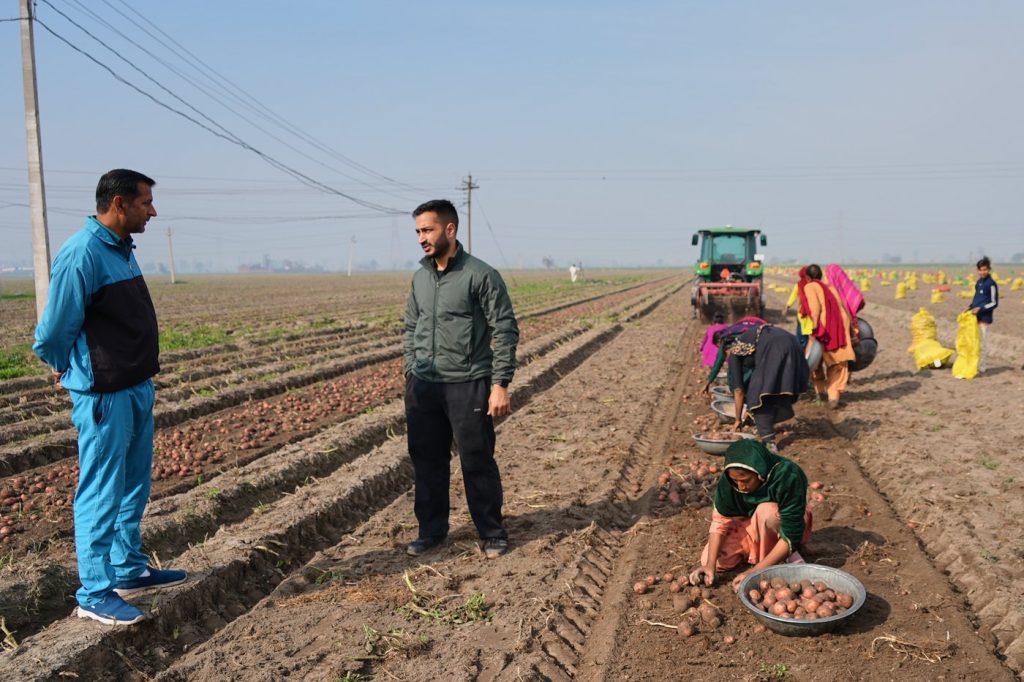
KARNAL, India (AP) – Farmer Bir Virk has embraced automation in agriculture, utilizing an AI-powered tractor that autonomously harvests potatoes on his fields in Karnal, located in northern India. By tapping an iPad mounted beside his tractor's steering wheel, Virk has transitioned his farming methods to an automatic mode, allowing the machine to operate independently, which he credits for significantly increasing his efficiency.
Conversely, in New Delhi, educator Swetank Pandey employs similar AI technology at his coaching academy, using algorithms to scan and grade handwritten exam papers from candidates aspiring to join India’s competitive civil services. Both individuals illustrate the growing trend of utilizing artificial intelligence across various sectors in India, from agriculture to education, to enhance productivity and efficiency.
As AI technology continues to gain traction globally, India is increasingly becoming a testing ground for various applications aimed at improving efficiency and reducing costs. The Indian government is actively rolling out national initiatives to fund AI research and workforce training. This commitment is underscored during a five-day AI summit in New Delhi, attended by heads of state and leading tech CEOs, showcasing India's dedication to leveraging AI capability for economic growth.
With an estimated one billion internet users, India is also becoming a focal point for global tech companies aiming to expand their AI initiatives within one of the world's rapidly growing digital markets. Recent investments, such as Microsoft's announcement of a $17.5 billion commitment over four years to enhance cloud and AI infrastructure in India, and Google's $15 billion investment that includes plans for establishing an AI hub in the country, demonstrate this trend.
Despite these advances, India's journey towards large-scale AI adoption is not without obstacles. The country still faces challenges in developing its own AI models akin to U.S.-based OpenAI and China's DeepSeek, primarily due to limited access to essential resources, such as advanced semiconductor chips and data centers, as well as the linguistic diversity of hundreds of local languages. Additionally, while tech companies emphasize AI training and reskilling, industries are witnessing job losses for those unable to adapt, as seen with Tata Consultancy Services, which laid off over 12,000 employees attributed to the rapid AI shift.
Nevertheless, early adopters like Virk and Pandey are reaping the benefits of AI's capabilities. Virk first encountered AI-driven farming technology while studying in the United States. Upon returning to India in 2021, he imported a system from a Swedish company that facilitates various farming tasks, from planting seeds to spraying fertilizers and harvesting crops. The system, which costs approximately $3,864, integrates advanced steering motors and satellite signals for precise operation and includes an AI software that logs errors and provides analytical insights via a cloud platform. Virk reports a remarkable reduction in labor time, stating that his AI-enabled tractor can maintain an accuracy of 0.01 centimeters and has halved his work duration.
In the education sector, Pandey's civil services coaching center highlights the fierce competition faced by millennials in India, as millions seek civil service positions annually. AI assists Pandey in managing the high volume of tests and evaluations, enabling his team to scan and assess tens of thousands of answer sheets in mere 20 to 25 minutes. This hybrid approach, using large language models and automation tools, facilitates rapid evaluations while allowing teachers to review the AI's outputs, thereby enhancing both efficiency and quality. Notably, Pandey asserts that AI-generated study materials often resonate more with students compared to traditional resources, thereby optimizing their learning experience.
As both sectors show promising advancements through AI integration, it is evident that the technology holds significant potential to transform traditional practices in India, paving the way for a more efficient future across various industries.








