

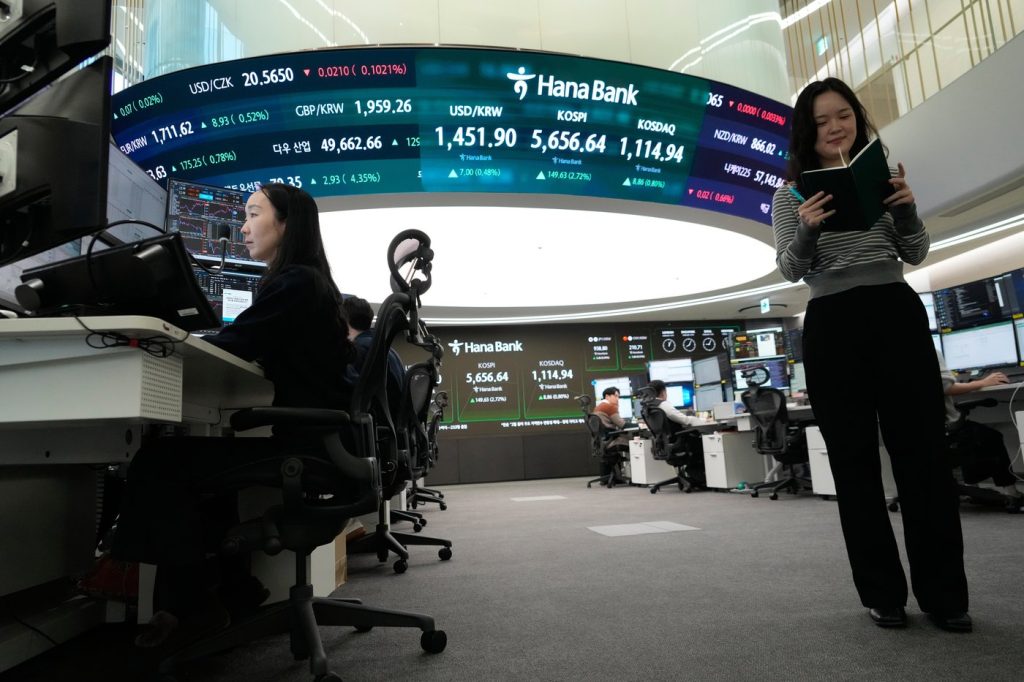
Asian shares experienced an upward trend on Thursday, bolstered by a significant rally in the U.S. market, particularly driven by the computer chip powerhouse Nvidia. Reports indicated a rising likelihood of conflict with Iran, leading to a slight decline in U.S. futures and an increase in oil prices.
U.S. President Donald Trump is reportedly contemplating military action against Iran. His administration has augmented military resources in the region while engaging in indirect talks with Tehran concerning its nuclear program. This situation has led to growing concerns that an attack could escalate into a broader conflict within the Middle East.
Markets in Greater China were closed due to Lunar New Year holidays, whereas other markets resumed trading. In Tokyo, the Nikkei 225 index climbed 0.8% to close at 57,582.93. Meanwhile, South Korea's Kospi index surged by 2.8% to 5,661.22, marking a strong return after the recent holidays. Australia's S&P/ASX 200 index advanced by 0.9%, closing at 9,088.70.
Southeast Asian markets also recorded gains, with Thailand's SET index up by 0.9%. In India, the Sensex index inched up by 0.1%, demonstrating a generally positive regional market sentiment.
During European trading the previous day, London’s FTSE 100 index increased by 1.2%, spurred by a recent update regarding U.K. inflation, which heightened expectations that the Bank of England might soon lower interest rates.
On Wall Street, the S&P 500 rose by 0.6% to 6,881.31, while the Dow Jones Industrial Average increased by 0.3% to 49,662.66. Notably, the Nasdaq composite gained 0.8%, reaching 22,753.63. Nvidia was a crucial contributor to this market uplift, with its shares climbing by 1.6% following a long-term partnership announcement with Meta Platforms. This deal will see Meta utilize millions of Nvidia chips and other equipment for its artificial intelligence (AI) data centers.
Nvidia's CEO, Jensen Huang, emphasized that "No one deploys AI at Meta’s scale." Given Nvidia's status as the highest-valued company on Wall Street, its stock had a tremendous impact on the S&P 500, acting as a primary driver of the index's gains. This performance underscores the potential benefits of AI on the U.S. stock market, though investors have also been wary of the possible downsides, resulting in notable volatility in stock prices.
Meta's stock exhibited some fluctuations, initially dropping up to 1.7% before recovering and finishing the day with a 0.6% gain. Investor concerns have arisen regarding the potential for AI to develop tools that could allow companies across various sectors—ranging from software to legal services and trucking logistics—to perform complicated tasks more efficiently and at a lower cost. Analysts have likened recent investor behavior to a “shoot first, ask questions later” mentality, leading to aggressive sell-offs in stocks perceived as vulnerable to disruption.
The robust earnings reports from numerous companies contributed positively to market performance on Wednesday, continuing a favorable reporting season for major U.S. firms within the S&P 500. Outside of earnings news, biotech firm Moderna saw a 6.1% increase in its stock after the Food and Drug Administration consented to review its flu vaccine candidate.
In the bond market, Treasury yields edged higher as positive economic reports exceeded economist expectations. The yield on the 10-year Treasury note increased to 4.08%, compared to 4.05% on Tuesday. Reports indicated better-than-expected performance in industrial production and increased orders for durable goods in December. Moreover, housing starts showed stronger-than-anticipated growth, which may influence the Federal Reserve's decisions on interest rates.
The Fed has paused interest rate hikes, but many analysts anticipate that reductions could resume later in the year, particularly after a new chair is set to take over during the summer. The minutes from the Fed's last meeting revealed that many officials desire further reductions in inflation before endorsing additional cuts this year.
While lower interest rates may stimulate economic growth and boost investment prices, they also carry the risk of exacerbating inflationary pressures. In early Thursday dealings, U.S. benchmark crude oil increased by 30 cents, reaching $65.36 per barrel, while Brent crude rose by 27 cents to $70.62. Gold and silver prices remained stable, whereas Bitcoin experienced a decline of 1.3%, settling around $67,000.








