

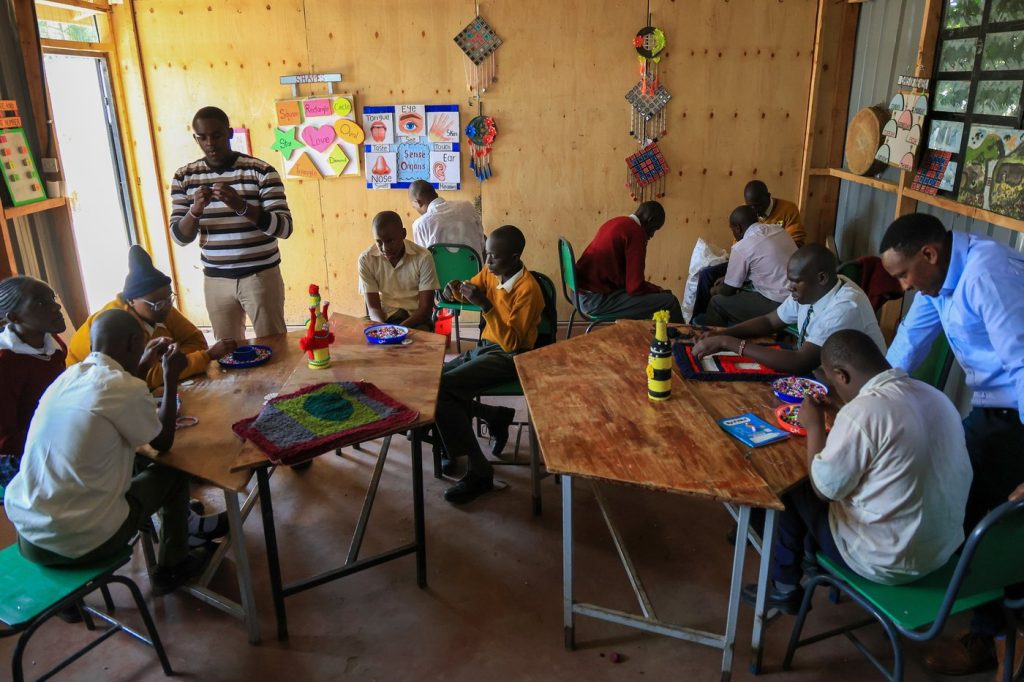
KITENGELA, Kenya (AP) – The Rare Gem Talent School in Kenya stands out from conventional educational institutions by offering a tailored approach to teaching students with dyslexia. Unlike traditional methods, where educators primarily lecture, Rare Gem employs hands-on, multi-sensorial lessons that engage students through sights, sounds, and feelings. This innovative approach focuses on the unique learning styles of students with dyslexia and other learning challenges.
Despite advancements in public education access in Kenya, children with learning disabilities often remain marginalized. Dyslexia affects approximately 10% of learners and poses significant obstacles to literacy. The lack of appropriate accommodations risk leaving a significant portion of Kenya's burgeoning youth population behind.
Jason Malak Atati, a student at Rare Gem, shared his experiences, noting that at his previous school, teachers failed to understand his needs. In contrast, he finds a more supportive environment at Rare Gem, which has customized its curriculum to accommodate learners with dyslexia. Dennis Omari, a special needs educator, explained that common difficulties for dyslexic children include mixing up letters or numbers, indicating early signs such as challenges with phonological awareness and reading.
The school's methodology focuses on a multi-sensorial approach to reading, utilizing various teaching techniques, including visual aids, auditory learning through songs, and tactile activities that involve objects for word construction. Dorothy Kioko, a teacher at Rare Gem, elaborated on the individualized approach taken: "You teach step by step until the learner gets what you’re teaching, not a lecture method where the teacher stands in front." This strategy requires patience and a deep understanding of each child’s needs.
Established in 2012 by the Dyslexia Organisation Kenya, Rare Gem initially opened with less than ten students but has grown significantly, now enrolling around 210 learners — many of whom have dyslexia, while others face different learning challenges such as autism. Phyllis Munyi, the founder, emphasized the importance of early identification and intervention for students with learning difficulties, as it can foster skill development and enable them to discover their talents.
The school charges tuition fees of $180 per term, which although lower than many high-end private schools, remains substantially higher than the costs associated with government education institutes most Kenyan children attend.
Stigmas and a lack of awareness remain substantial barriers preventing parents from seeking alternative education for their children at an early stage. Bullying and discrimination experienced in traditional school settings have further discouraged students from pursuing specialized education. Geoffrey Karani, a former Rare Gem student and now an art teacher, recalls the significant challenges he faced, stating, "In other, normal schools, there was a lot of discrimination, a lot of bullying." He has embraced his role as a mentor to demonstrate to students that overcoming similar struggles is possible.
While Kenya has made strides in expanding access to education, with primary school enrollment rising from 5.9 million in 2002 to 10.2 million in 2023, those with disabilities still face significant challenges. Approximately 11.4% of Kenyan children are reported to have special needs, but only 250,000 are enrolled in educational institutions, according to So They Can, a nonprofit working to improve educational access across Africa.
Rare Gem Talent School may serve as a model for enhancing educational access for children with learning disabilities without necessitating sweeping curriculum changes. The school’s curriculum is an adaptation of Kenya's core educational framework designed to meet the specific needs of students with dyslexia and other difficulties, as stated by Munyi, who clarified that it is not a standalone program specifically for dyslexia, but aims to include a broader spectrum of learning challenges.








