

BANGKOK (AP) — U.S. futures experienced a decline while most Asian markets showed an upward trend on Monday following a significant Supreme Court ruling that struck down the majority of President Donald Trump’s extensive tariffs. This decision has caused notable fluctuations within the financial markets.
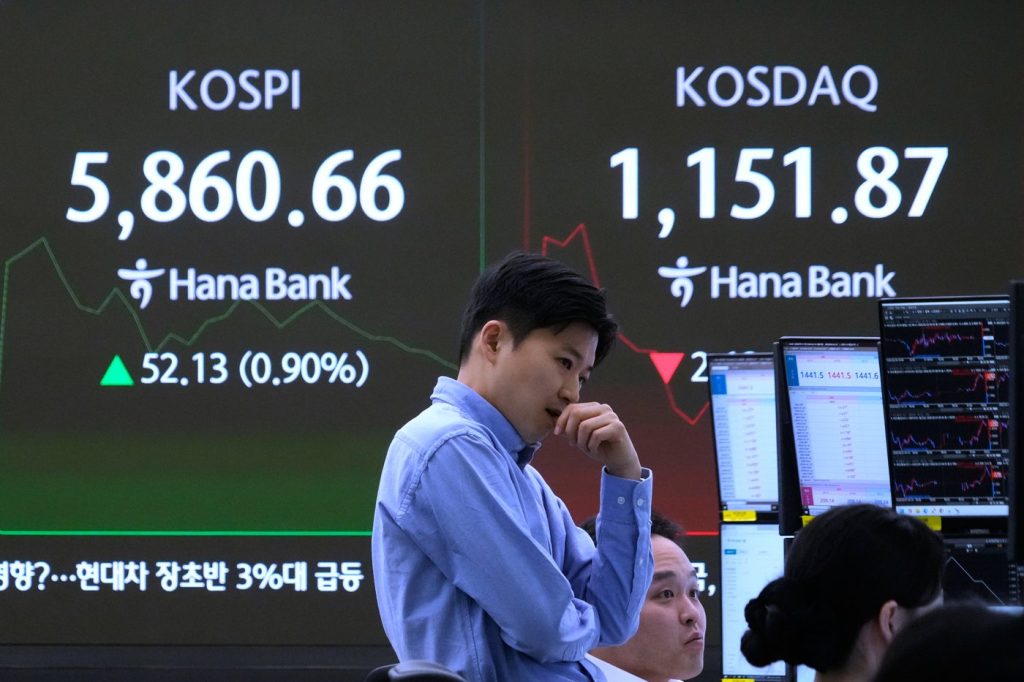
Notably, Tokyo’s markets were closed due to a national holiday. In the regional market, Hong Kong's Hang Seng index rose by 2.2% to reach 27,003.47. Contrasting this, the Shanghai Composite index dropped by 1.3% to 4,082.07. South Korea's Kospi index recorded an increase of 1.1%, hitting 5,873.07, while Australia’s S&P/ASX 200 index fell by 0.4% to 9,041.00. Taiwan experienced a surge with its Taiex index jumping by 1.4%.
The mixed market reactions illustrate the diverse effects that the tariff policy shifts have precipitated, benefiting countries that previously endured unfavorable deals. Benjamin Picton of Rabobank described this scenario, remarking on the uncertainty U.S. tariff policies continue to introduce to the market as traders assess the implications of evolving tariff strategies.
In futures trading, the S&P 500 lost 0.7%, while the Dow Jones Industrial Average declined by 0.6%. The Nasdaq composite index also saw a decrease of 0.8%. Despite the Supreme Court's ruling on Friday, which alleviated some market fears related to Trump's tariffs, Wall Street remained relatively calm. The S&P 500 increased by 0.7% to close at 6,909.51, fluctuating between slight gains and losses prior to the court's announcement. The ruling came amidst reports of slowing U.S. economic growth and rising inflation.
Meanwhile, the Dow Jones Industrial Average rose by 0.5% to 49,625.97, and the Nasdaq composite gained 0.9%, closing at 22,886.07. However, the tariffs are still a significant element of economic discourse, as Trump expressed his intent to explore alternative methods for imposing taxes on imports, labeling the court’s decision as “terrible.” He announced plans to sign an executive order instituting a 10% global tariff, which he later raised to 15%.
Trump’s commentary regarding tariffs emphasizes the uncertainty surrounding future economic policies, prompting caution among investors. On Wall Street, Akamai Technologies faced one of the day’s most significant losses, falling by 14.1%. The cybersecurity and cloud computing firm's earnings report hinted at stronger-than-expected results for the end of 2025. However, its profit forecasts for the upcoming year failed to meet analyst expectations, leading to a plunging stock price.
Akamai's decision to allocate a greater percentage of its revenue towards equipment and investments serves as a potential indicator of how the ongoing shortages in computer memory—exacerbated by the accelerated growth of artificial intelligence—are impacting businesses throughout the economy.
Despite reports indicating a slowdown in U.S. economic growth coupled with rising inflation, investor response remained relatively muted. These reports shed light on the challenges confronting the Federal Reserve as it contemplates interest rate adjustments. Nonetheless, traders maintain expectations that the Fed will lower rates at least twice this year. Lower interest rates can stimulate economic activity and increase investment prices but may also exacerbate inflationary pressures.
In commodity markets, U.S. benchmark crude oil prices fell by 53 cents to $65.95 per barrel, while Brent crude, the international standard, decreased by 51 cents to $70.79 per barrel. The U.S. dollar slipped against the Japanese yen, trading at 154.11 yen compared to the previous 154.99 yen. The euro also showed strength, rising to $1.1828 from $1.1780. Precious metal prices saw an increase as the price of gold climbed by 1.9%, and silver rose by 5.5%.








