

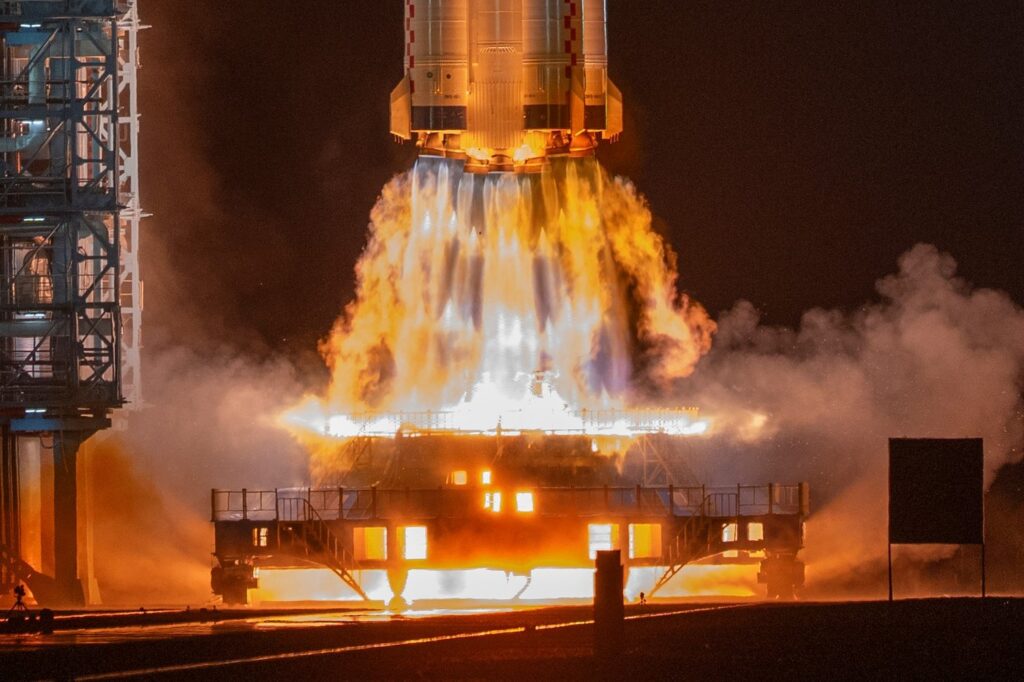
JIUQUAN, China (AP) — China successfully launched the Shenzhou 23 spacecraft on Sunday night, carrying a crew of three astronauts to its space station, including one astronaut scheduled to stay in orbit for an entire year. The launch took place at the Jiuquan Satellite Launch Center in northwestern China, marking another significant milestone in China’s rapidly advancing space program.
This highly anticipated mission coincides with China's ambitions to achieve its first crewed lunar landing by the year 2030. The crew of Shenzhou 23 includes Zhu Yangzhu as the commander, along with Zhang Zhiyuan and Lai Ka-ying, who is also referred to as Li Jiaying, reflecting the Mandarin transliteration of her name. Notably, Lai Ka-ying, who has a doctoral degree in computer forensics, has the distinction of being the first astronaut from Hong Kong to participate in a space mission.
During their time aboard the Tiangong space station, the astronauts are expected to execute a variety of scientific experiments and applications. Additionally, they will engage in an in-orbit rotation with the crew of Shenzhou 21, who have been residing at the space station for over 200 days, highlighting the ongoing collaboration and operational capability of the mission.
A significant aspect of the Shenzhou 23 mission is that one of the astronauts will remain at the space station for a full year. This duration represents one of the longest individual stays in space recorded around the globe. The primary objective of this extended mission is to investigate human adaptability and performance limits within long-duration spaceflight environments, an endeavor crucial for future deep space exploration.
As China amplifies its space exploration efforts, its astronauts have conducted multiple successful missions to the Tiangong space station, a facility developed in part due to China's exclusion from the International Space Station program, which was largely driven by U.S. national security concerns. The competitive landscape of space exploration sees the United States positioned as China's primary rival, with NASA planning to land astronauts on the lunar surface by 2028.
Launched as part of China’s ambitious space program, the Tiangong space station—translated as “Heavenly Palace”—first welcomed its crew back in 2021. In a notable incident from the previous year, a Shenzhou emergency mission successfully retrieved a group of astronauts who had become stranded aboard the space station due to a malfunctioning spacecraft. Such developments illustrate the critical importance and growing capability of China’s national space initiatives.
In summary, the launch of the Shenzhou 23 spacecraft not only represents a significant step forward in China's space exploration efforts but also highlights the commitment to conducting extensive scientific research and addressing the challenges posed by long-duration space missions. As China continues to pursue its space ambitions, the world watches closely, noting the implications of its achievements for the future of international space exploration.








