

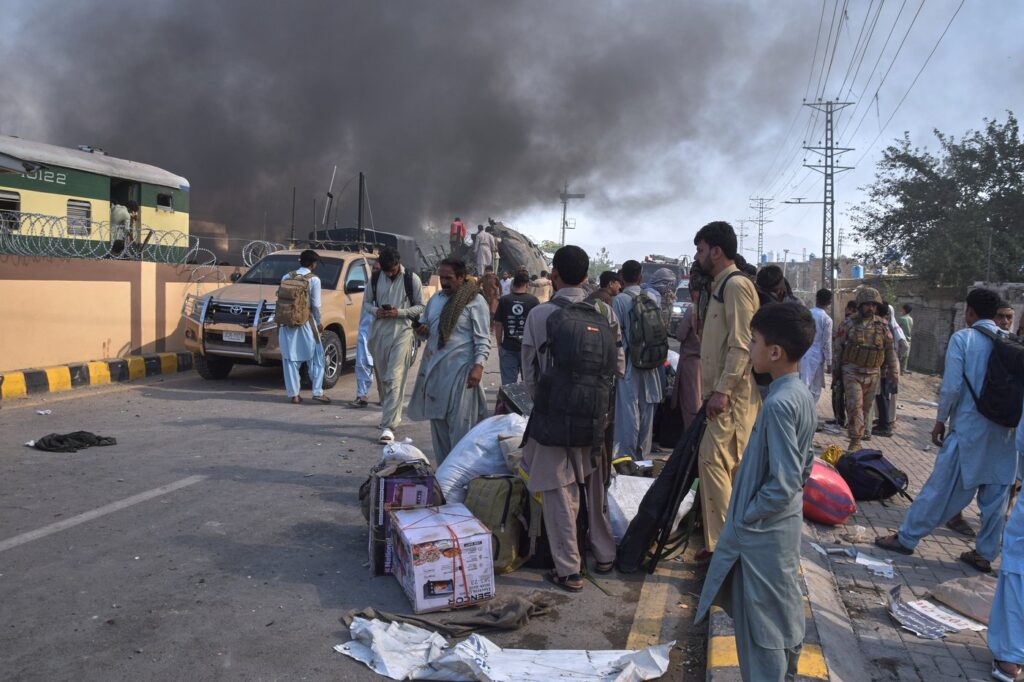
QUETTA, Pakistan (AP) – On Sunday, a devastating attack occurred in Quetta, the capital of Balochistan province, when a suicide bomber detonated an explosives-laden vehicle near a railway track as a passenger train was passing. The explosion resulted in the deaths of at least 23 people and wounded over 70 others, as reported by officials.
The explosive force was so immense that it caused two of the train cars to overturn and ignite, sending plumes of black smoke billowing into the sky. Eyewitnesses and videos circulating on social media depicted the chaotic aftermath, with significant damage to several nearby buildings and numerous vehicles parked along the roadside.
Local hospitals were quickly overwhelmed as doctors treated casualties, noting that 20 of the injured were in critical condition. Three security officials indicated that the bodies of the deceased had been transported to hospitals following the attack, speaking on the condition of anonymity due to the sensitive nature of the incident.
The outlawed militant group, the Baloch Liberation Army (BLA), which seeks independence for Balochistan from Pakistan’s central government, claimed responsibility for the bombing. In a statement, the BLA confirmed that the attack was aimed at a train transporting security personnel.
Balochistan province has a history of insurgency, with Quetta being a frequent site for attacks primarily targeting security forces, governmental establishments, and civilians. Shahid Rind, a spokesman for the Balochistan provincial government, expressed strong condemnation of the violence, labeling it an assault on innocent civilians and expressing sorrow over the tragic loss of life. Following the bombing, a medical emergency was declared across hospitals in Quetta, and an investigation was promptly initiated.
Prime Minister Shehbaz Sharif condemned the attack, labeling it a "cowardly act of terrorism" via a post on social media platform X. He extended his condolences to the families of the victims, emphasizing the need for resilience against such violent acts. Chief Minister of Balochistan, Sarfraz Bugti, also condemned the attack, lamenting the targeting of innocent civilians, including women and children, and assured a dedicated effort to pursue those responsible.
The provincial and federal governments often refer to the BLA using the term “Fitna al-Hindustan,” suggesting Indian backing for the insurgent group, a claim that New Delhi refutes. President Asif Ali Zardari also condemned the bombing, stating that militants and their supporters aim to disrupt Pakistan’s role in fostering regional and global peace initiatives.
The attack coincided with a pivotal moment, as Pakistan had recently indicated that the United States and Iran were nearing an agreement to resolve the ongoing conflict in the Middle East, which had begun following military actions from the U.S. and Israel against Iran on February 28. This conflict has significantly impacted global travel and raised concerns over rising oil prices. Zardari vowed in a statement that Pakistan would ensure the defeat of terrorists, their supporters, and those who provide them safe havens.
Despite claims from Pakistani authorities asserting that the insurgency has been subdued, violence in Balochistan continues to persist. This incident followed a prior attack in the region, where an assault on a train station in 2024 resulted in the deaths of 26 individuals, including military personnel.








