

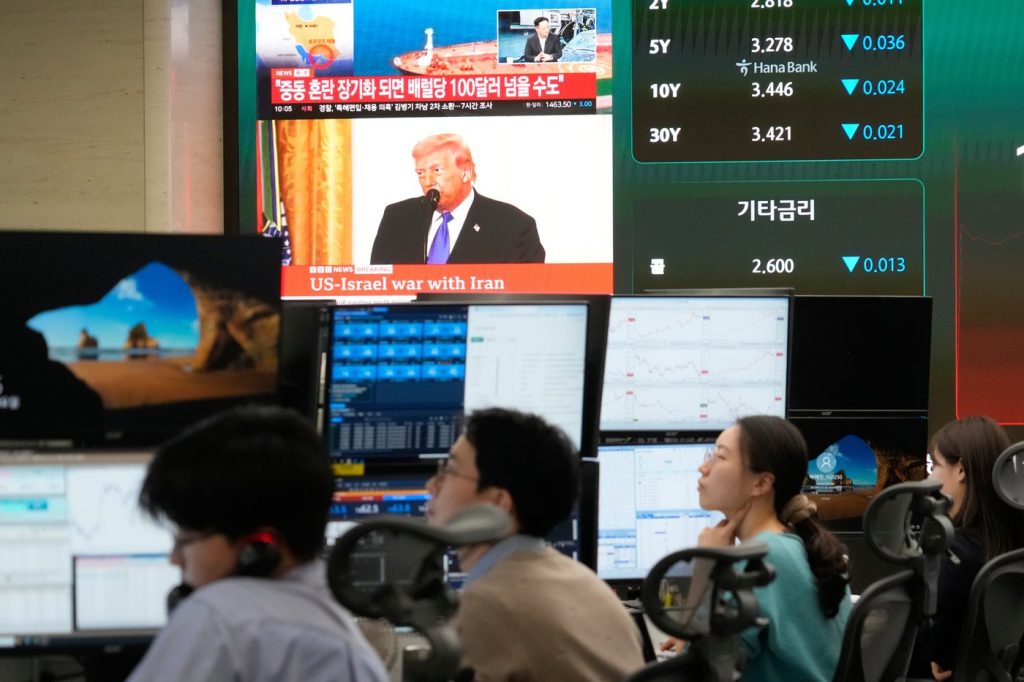
TOKYO (AP) - Asian shares generally faced declines on Tuesday, while oil prices experienced a significant surge as investors became increasingly cautious about energy supply risks in the region due to the ongoing Iran war. South Korean shares plummeted by 4.8% as markets reopened following a holiday, with the KOSPI index settling at 5,946.06.
Benchmark U.S. crude oil jumped by 77 cents to reach $72.00 per barrel, while Brent crude, the international standard, increased by $1.10, hitting $78.84 per barrel. The prices bounced back on Monday before retracting slightly, but the overall market remains anxious about potential disruptions in global crude transportation linked to the conflict.
The Nikkei 225, Japan's primary stock index, fell by 2.1% to 56,853.48. Similar to other countries in the region that lack substantial resources, Japan is particularly vulnerable to energy supply disruptions, especially as a significant portion of its oil and natural gas imports pass through the Strait of Hormuz. Nevertheless, analysts point out that Japan's energy reserves are robust, spanning over 200 days, which mitigates immediate concerns.
Japanese energy stocks took a hit, with Eneos Corp. dropping nearly 6% and Idemitsu Kosan declining nearly 4%. Stocks related to defense have fluctuated as traders reacted to expectations of heightened military spending from Prime Minister Sanae Takaichi, leading to sell-offs that locked in prior gains. Mitsubishi Heavy Industries saw a 5% plunge, while IHI lost 4%.
In broader regional movements, Australia's S&P/ASX 200 index slid by 1.2% to 9,089.50, Hong Kong's Hang Seng index dipped 0.1% to 26,038.29, and the Shanghai Composite index dropped 0.3% to 4,170.63.
On Wall Street on Monday, airline stocks were among the largest losers, including major carriers like American Airlines, United, and Delta, as escalating oil prices threatened to worsen their fuel expenditures. Concurrently, disturbances in the Middle East have resulted in airport closures and stranded travelers. Consequently, in Asia, ANA holdings declined by 2.4%, Japan Airlines fell by 5.2%, Korean Air declined by 8.9%, and Qantas Airways lost 2.9% of its value.
Market responses to the ongoing conflict have been relatively subdued thus far. Historically, military conflicts in the Middle East have not led to prolonged downturns in U.S. markets. Experts, including strategists from Morgan Stanley led by Michael Wilson, suggest that for the ongoing war to significantly depress U.S. stock values, oil prices would likely need to surpass $100 per barrel.
“Since 2000, there have been 22 instances of oil price spikes exceeding 10% in a single day,” noted Stephen Innes, managing partner at SPI Asset Management. “Energy shocks do not typically derail equity markets unless they are both severe and sustained. The market has learned to adapt to such scenarios.”
In terms of U.S. market performance on Monday, the S&P 500 initially dipped by 1.2% but ultimately closed with a marginal gain of less than 0.1% at 6,881.62. The Dow Jones Industrial Average saw a slight drop of 0.1% to 48,904.78, while the Nasdaq composite managed a rise of 0.4% to settle at 22,748.86 after recovering from earlier losses.
As investors sought safe-haven assets, gold prices rose by 1.2%. U.S. officials attempted to allay fears about the conflict's duration, bolstering investor confidence. U.S. oil companies witnessed gains from rising crude prices, with Exxon Mobil climbing 1.1% and Marathon Petroleum rising by 5.9%. Stocks of military equipment manufacturers also strengthened, with Northrop Grumman and RTX climbing 5.9% and 4.7%, respectively. Technology stocks also saw an uptick, led by Nvidia, which increased by 2.9%, as it emerged as a major contributor to the S&P 500's recovery.
In the bond market, the yield on the 10-year Treasury increased from 3.97% on Friday to 4.04%, influenced by a positive report indicating better-than-expected growth in U.S. manufacturing.
In currency exchanges, the U.S. dollar slightly decreased to 157.32 Japanese yen from 157.47 yen. Meanwhile, the euro moved upward from $1.1690 to $1.1693.








