

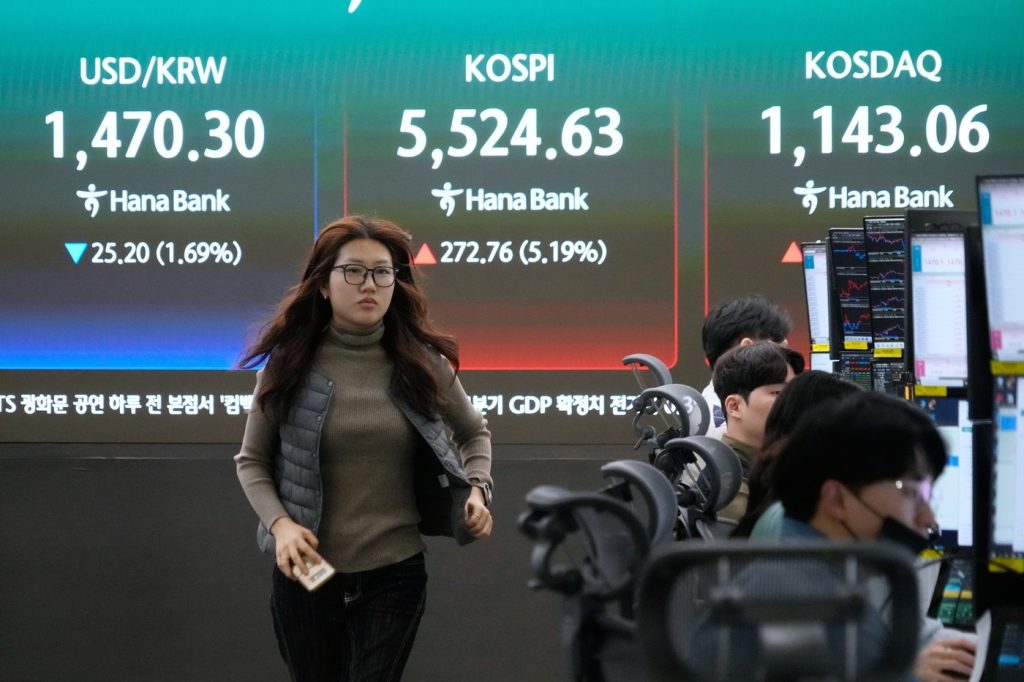
Asian shares saw a rebound from the significant declines of the previous day, spurred by a rally on Wall Street as investors remained hopeful that the conflict in Iran would not be prolonged. However, the early gains on Tuesday, March 10, 2026, did not compensate for the losses experienced earlier, with oil prices having surged to nearly $120 per barrel before stabilizing around $90.
U.S. futures exhibited a decline of about 0.4%, even as investors digested comments from U.S. President Donald Trump, who suggested during an interview with CBS News that the war was largely "complete." Nevertheless, he raised concerns by indicating potential for intensified military action against Iran if the nation attempts to disrupt global oil supplies.
In Japan, the benchmark Nikkei 225 index surged by 3.2%, closing at 54,399.08 after the government released revised economic data indicating faster-than-expected growth in Japan's economy in the last quarter of the previous year, driven by robust business investments. The economy expanded at an annual rate of 1.3%, significantly better than the initial estimate of 0.2%.
Neil Newman, a managing director at Astris Advisory Japan, commented on the day's positive developments, noting, "Today is the rebound. Obviously, positive comments from President Trump overnight. We're starting to see the light at the end of the tunnel for the war." Despite the optimistic sentiment, he acknowledged that volatility would persist.
Other Asian markets also showed promising recovery, with Australia's S&P/ASX 200 index increasing by 0.8% to 8,669.50, and South Korea's Kospi jumping by 3.6% to 5,453.45. Hong Kong's Hang Seng rose 1.6% to 25,804.70, while the Shanghai Composite index gained 0.4% to reach 4,119.29.
The fluctuations in share prices are closely linked to oil prices, which have been volatile amid the escalating conflict in the Middle East. Early Tuesday saw benchmark U.S. crude oil prices fall by $4.70 to $90.07 per barrel, while Brent crude, the international benchmark, dipped by $5.13 to $93.83 per barrel.
The previous day witnessed a dramatic swing in stock prices, with the S&P 500 initially dropping as much as 1.5% before recovering to close with a modest gain of 0.8% at 6,795.99. The Dow Jones Industrial Average rebounded from a loss of nearly 900 points, ultimately rising by 239 points, or 0.5%, to close at 47,740.80. The Nasdaq composite increased by 1.4% to finish at 22,695.95.
Investors remain anxious about the potential for high oil prices to persist, as this could strain already tight budgets for households dealing with high inflation, and also result in significant cost increases for companies. This situation raises concerns about a potential "stagflation" scenario, characterized by stagnant economic growth coupled with high inflation rates.
Particular attention is directed toward the Strait of Hormuz, a critical waterway through which approximately one-fifth of the world's oil passes daily. Iran has threatened to target ships traversing this strait, intensifying worries about oil supply disruptions.
Should the strait be blocked for merely a few weeks, oil prices could potentially escalate to $150 per barrel or higher, according to analysts at Macquarie Research. President Trump mentioned considering the takeover of the Strait of Hormuz in light of these developments.
In the bond market, the yield on the 10-year Treasury fell to 4.10% from 4.15% as of late Friday. The climate of high inflation and fluctuating oil prices has led to upward pressure on Treasury yields, which briefly surpassed 4.20% early on Monday but retreated as oil prices eased.
In currency trading, the U.S. dollar slightly increased to 157.85 Japanese yen, up from 157.67 yen, while the euro traded at $1.1611, down from $1.1638.








