

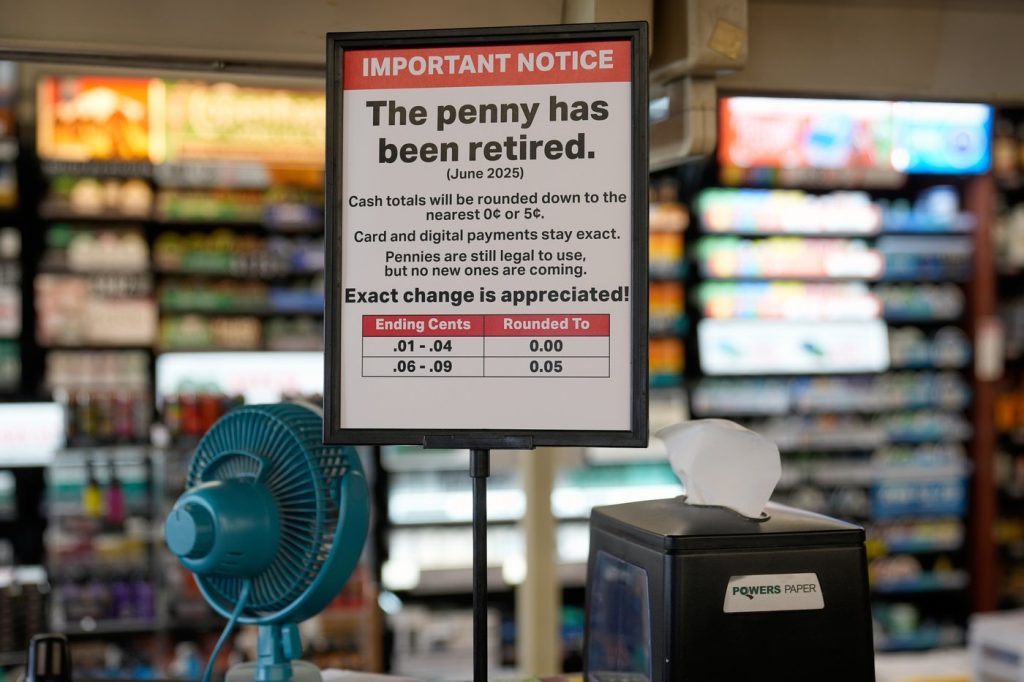
Months after the United States ceased production of its 1-cent coins, some states have begun to address the challenges of cash transactions without pennies by establishing rounding guidelines for cash purchases. President Donald Trump announced the end of penny production early last year, citing the coin’s costliness, as it required 3.7 cents to manufacture each penny in 2024. This decision resulted in a notable shortage of pennies in cash registers, leading consumers and businesses to cope with difficulties in making exact change.
The U.S. Treasury Department has indicated that it will continue to circulate the approximately 114 billion existing pennies “for as long as possible,” assuring that pennies must still be accepted as a form of payment. One proposed solution to the issues arising from the absence of pennies is a practice called symmetrical rounding, which rounds cash payments to the nearest nickel. For instance, if a price after taxes ends in one, two, six, or seven cents, it will round down to the nearest nickel. Conversely, if it ends in three, four, eight, or nine cents, it will round up.
A bill that would implement symmetrical rounding nationwide has been introduced in Congress and has made it out of the House financial services committee. U.S. Representative Lisa McClain, a Republican from Michigan, emphasized in an email that establishing a federal law is essential to avoid a "confusing patchwork of state policies." However, the bill has yet to be voted on in the House and must pass through the U.S. Senate before it can reach the President’s desk.
In the interim, several states, including Arizona, Florida, Oregon, Tennessee, Virginia, and Washington, have seen bills pass both legislative chambers, awaiting the governor's signature. Some states are considering allowing businesses to round cash purchases, while others may mandate the practice. Indiana’s recently signed legislation by Republican Governor Mike Braun originally required businesses to round cash transactions but was later revised to make rounding optional. Businesses are granted the flexibility to choose how they round cash payments.
Tennessee has enacted legislation that exempts symmetrical rounding from legal claims under state consumer protection laws, providing businesses with legal protection regarding their rounding practices. Rounding bills have emerged in roughly two dozen states since late last year, demonstrating a widespread exploration of solutions to the penny problem. Meanwhile, some state agencies have released guidelines indicating that rounding should occur after tax calculations, ensuring that the full taxed amount remains payable to the state.
Despite the reduced use of cash due to the prevalence of electronic payments, a 2024 survey by the Federal Reserve found that about 80% of U.S. adults recently utilized cash. Cash remains more common among older adults and individuals from lower-income households. The Treasury has communicated that rounding would occur in both directions—down and up—thus claiming there would be no overall impact on consumer prices. However, research from the Federal Reserve Bank of Richmond suggests that prices that do not end in zero or five are likely to finish with an eight or nine, indicating that rounding might lead to more instances of price increases, collectively costing consumers millions of dollars over time.
Public sentiment on rounding practices is mixed. Many Americans express concerns over perceived unfairness. For example, Nikki Capozzo-Hennessy, a 50-year-old resident of Trumbull, Connecticut, shared her experience online after noticing a rounding adjustment on a grocery receipt that saved her three cents. While she understands the practicality of uniform rounding policies, she acknowledges that minor rounding can accumulate to significant amounts over time.
Washington State Representative April Berg, who sponsored a rounding bill, recognizes the frustration of consumers losing pennies but points out that the discontinuation of pennies leaves few options. The Treasury claims halting penny production could save $56 million a year, but there are concerns that increased rounding could elevate the demand for nickels, which cost nearly 14 cents to produce each in 2024. Proposed federal legislation includes a cost-saving measure that would allow the Treasury to alter the coin's composition to utilize cheaper metals.








