

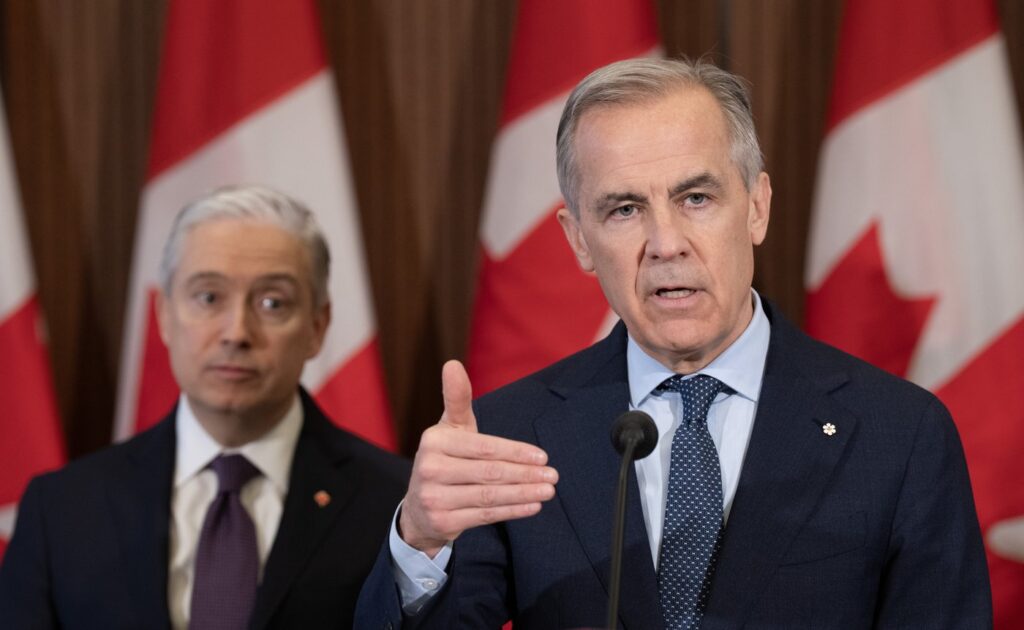
OTTAWA - Prime Minister Mark Carney is facing increasing pressure to deliver results from his economic agenda as his government prepares to release an update to its fiscal outlook on Tuesday. This spring economic statement coincides with the anniversary of the Liberals securing a minority mandate in the federal election, marking their fourth consecutive win, although this is Carney's first term in charge.
The timing is significant as it comes during the week when three new Liberal MPs are expected to be sworn into office, officially granting Carney's administration majority status for the first time. The previous fall budget had posed a major challenge for the Liberals, who had to rely on support or abstentions from members outside their party to pass the spending plan. The budget implementation act, which underwent months of deliberation, was eventually passed into law last month, incorporating amendments proposed by opposition MPs.
Up to this point, the Liberal agenda under Carney has primarily focused on increased spending in defense and infrastructure, alongside efforts to expand export markets and attract foreign investment. These initiatives are framed as part of a broader strategy to reduce Canada’s economic dependency on the United States, especially in light of President Donald Trump’s tariff policies.
At a recent press conference, Carney expressed confidence that Canadians are receiving "good value" from the government's efforts. He encouraged citizens to look for positive indicators in the upcoming economic statement, affirming, "We’re starting to shift things but we’re in no way satisfied. We’re just getting started."
Former parliamentary budget officer Kevin Page emphasized the need for the Liberals to demonstrate tangible results in the spending update. Page called for transparency, seeking clear explanations on how the government's commitments to NATO spending targets and acceleration of nation-building projects are influencing the fiscal outlook. "What is the plan? How is it changing the overall fiscal picture? Are we getting value for money?" he questioned.
The spring update is expected to reveal the financial impact of new spending initiatives, including an increase to the Goods and Services Tax (GST) benefit and the economic effects stemming from the ongoing war in Iran. Earlier budget forecasts had projected a deficit of $78.3 billion for the last fiscal year, nearly double previous projections made under former Prime Minister Justin Trudeau.
Statistics Canada has recently revised past economic data, resulting in an upward adjustment of the nominal level of the gross domestic product (GDP) over the last three years. Randall Bartlett, deputy chief economist at Desjardins, noted that these changes provide the federal government with a more favorable starting point for its fiscal targets. However, he added that these revisions are not the result of government actions but rather beneficial luck.
The conflict in Iran might also contribute positively to federal revenues, as rising global oil prices typically increase tax revenues. Oil-producing provinces like Alberta and Saskatchewan could see a GDP boost. To mitigate the impact of rising costs, Ottawa has introduced affordability measures, including an increase to the GST benefit for low-income families and a suspension of the excise fuel tax until the end of summer.
Despite these potential economic boosts, uncertainty regarding the duration of the conflict in Iran looms over Ottawa's projections. Bartlett anticipates that the government will present several scenarios illustrating how varying outcomes of the war could influence federal finances. Both he and Page do not foresee significant changes in the federal budget's deficits and overall fiscal status since the last budget, as the government has utilized much of its fiscal buffer in recent years, leaving it in a precarious position.
Conservative Leader Pierre Poilievre has criticized the Liberal government's increased spending, attributing it to rising inflation and advocating for lower taxes, expedited permits, and international free trade. He emphasized the need for the government to reverse its deficit trajectory, pointing to a recent report from the C.D. Howe Institute, which claims that Canada can no longer take pride in its fiscal discipline.
Amid these domestic concerns, the Liberal government has received praise from the International Monetary Fund (IMF) for its fiscal management. In its spring World Economic Outlook, the IMF projected that Canada's economy would grow at the second-fastest rate among G7 nations, trailing only the United States. An IMF official highlighted Canada's strong fiscal position compared to its peers, although Finance Minister François-Philippe Champagne stated that reestablishing a declining debt-to-GDP ratio was not the focus of discussions during his recent meetings in Washington.
Bartlett acknowledged that while Canada stands out positively in terms of fiscal responsibility, this distinction is more a reflection of the poor fiscal management of other advanced economies, describing Canada as one of the "cleanest fiscal dirty shirts." Page affirmed that despite the IMF's commendations, there are significant political benefits for the government in receiving such endorsements. He notes that Canada's current fiscal situation enables it to run higher deficits as it aims to stabilize the economy, but the federal budget will remain under scrutiny until its initiatives yield visible outcomes.








