

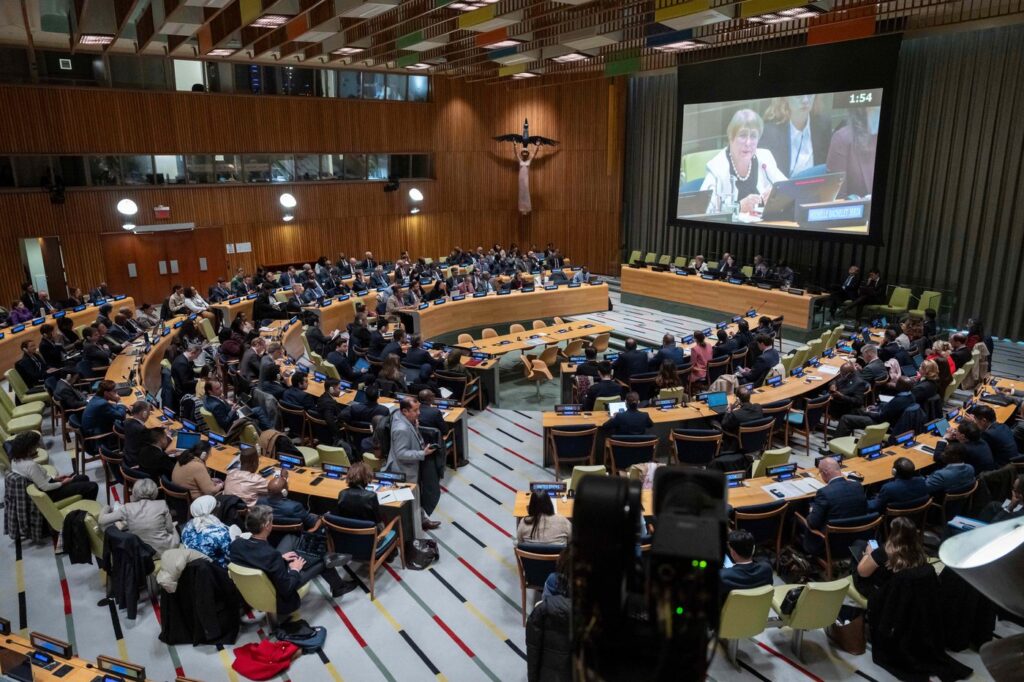
UNITED NATIONS (AP) – Four candidates are competing to lead the United Nations, each facing rigorous questioning regarding their views on critical global issues such as restoring peace and combating rising poverty. The U.N. General Assembly President, Annalena Baerbock, referred to the event as one of the toughest job interviews globally.
There was no decisive front-runner after candidate Michelle Bachelet of Chile, Rafael Grossi of Argentina, Rebeca Grynspan of Costa Rica, and Macky Sall of Senegal answered questions from U.N. ambassadors during the sessions held this past week. Additionally, other candidates may enter the race following these initial auditions for the position of U.N. Secretary-General António Guterres, whose term concludes on January 1.
Baerbock emphasized the significance of the secretary-general’s role, stating, "This role matters. The secretary-general is not only the head of the U.N. and the world’s top diplomat – she or he also represents all 8 billion of us, defending the U.N. Charter and leading on peace, development, and human rights."
All four candidates expressed their commitment to the U.N.'s foundational goals of ensuring international peace and security, especially in light of contemporary global crises such as those in Iran, Gaza, Ukraine, and Sudan. They pledged to advocate for necessary reforms within the long-established institution.
Bachelet, 74, a former two-time president of Chile and U.N. human rights chief, argued that the U.N. should proactively prevent crises and asserted her leadership capabilities. She stressed the importance of dialogue, encouraging the U.N. to “anticipate, prevent, and unite,” while also advocating for the need for the secretary-general to be "physically present in the field" to address pressing issues.
Grossi, 65, the current director-general of the International Atomic Energy Agency, acknowledged the extreme polarization in the world and the corresponding skepticism about the U.N.’s ability to effectively address global challenges. He insisted that robust leadership and international cooperation are essential for the organization to regain its relevance.
Grynspan, 65, former vice president of Costa Rica and now the secretary-general of the U.N. trade and development agency, expressed her commitment to remain an impartial advocate for principles under pressure while calling for the U.N. to embrace a more risk-taking approach. "The U.N. has become a risk-conservative organization," she remarked, asserting her readiness to embrace failures as part of the effort to innovate.
Sall, 64, who has served as president of Senegal for the last 12 years, highlighted the U.N.'s need to restore its position in global discussions. Describing himself as a "bridge-builder," he outlined his vision of fostering trust and cooperation among nations to rejuvenate collective action.
Some candidates are encountering obstacles in their paths. In response to criticism from 28 U.S. Republican lawmakers labeling her as a "pro-abortion zealot," Bachelet affirmed her stance as a proponent of women’s rights and emphasized her commitment to promote gender equality within the U.N.
The tradition of regional rotation for the secretary-general's position, which this year favors Latin America, complicates Sall's candidacy as he is the only candidate from outside the region. He maintained that the U.N. Charter does not prohibit any candidate, stressing the importance of selecting a leader from the Global South after Guterres, who hails from the Global North.
As the selection process moves forward, the focus will shift to the 15-member U.N. Security Council, particularly its five permanent members with veto power: the United States, Russia, China, the United Kingdom, and France. The final approval will require consensus from the 193-member General Assembly.
Observers have noted a growing desire for a secretary-general willing to take risks and proactively engage in peace promotion. Experts like Minh-Thu Pham have remarked that the U.N. struggles to play an essential role in addressing major crises due to its hesitance to undertake bold actions. Former Argentine foreign minister Susana Malcorra emphasized the urgent need for new leadership and vitality within the organization, calling attention to campaigns advocating for the next U.N. chief to be a woman.








