

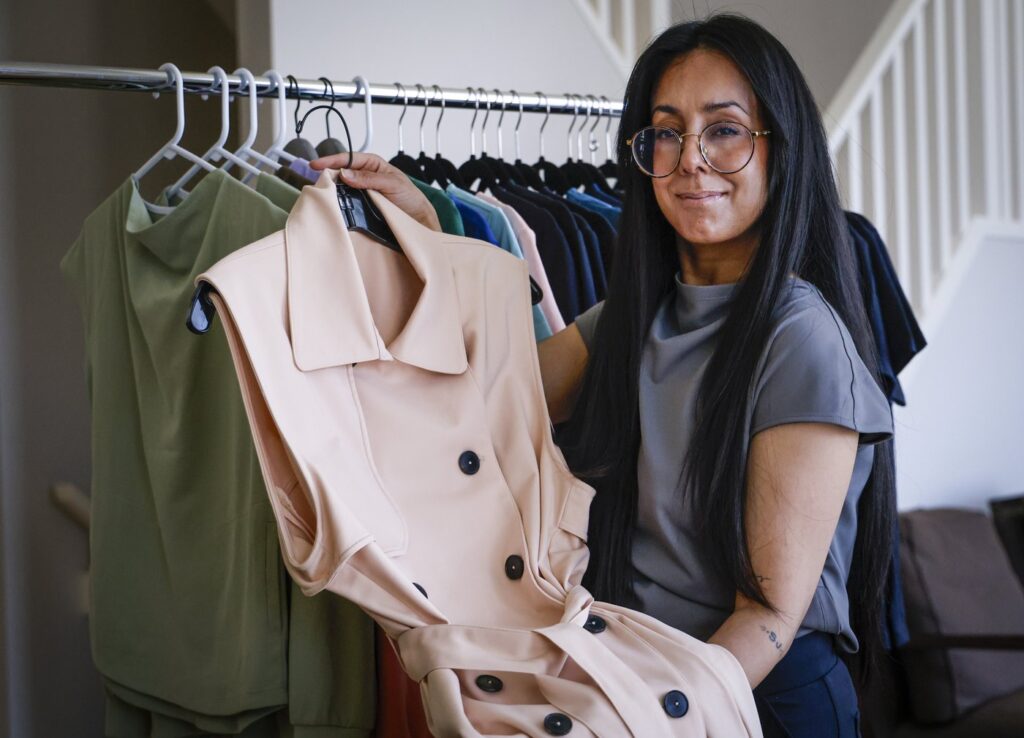
Calgary designer Nina Kharey has faced challenges with her fashion designs being copied, highlighting a growing issue in the industry. Despite initially viewing the imitation of her $1,085 sleeveless trench coat, worn by Meghan, the Duchess of Sussex, as flattery, her perspective changed with subsequent knock-offs. When a red and pink silk wrap dress from her brand Nonie was copied, Kharey found it hard to accept, especially without a celebrity endorsement to back her original design.
Following her experiences, Kharey consulted a fashion lawyer, who informed her that stopping copycats would be nearly impossible due to the limitations of copyright law in Canada and the United States. Christopher Sprigman, co-author of "The Knockoff Economy," noted that while brand names are protected, designs are often not, allowing for significant copying within the fashion industry. This legal environment has enabled trends, styles, and designs to cascade down from high-end runways to mainstream retailers, complicating the battle against imitation.
Kharey expressed frustration over competitors reproducing distinct features of her designs for cheaper prices, leading to confusion among consumers. A notable case involved Lululemon Athletica, which took legal action against Costco after discovering cheap imitations of its clothing lines. Despite the absence of Lululemon's branding, the retailer argued that the look-alikes were close enough to cause potential brand confusion.
The reality of pursuing legal action against copycats is often disheartening; litigation is costly and slow, with trends frequently shifting by the time cases are resolved. Erin McEwen, a trademark agent, underscored that while it can be hard to win such cases, registering an industrial design with the Canadian Intellectual Property Office can provide some level of protection. This registration secures protection for novel visual elements for 15 years, making it more challenging for imitators to copy designs.
Some companies, including Lululemon and Aritzia, have taken an innovative approach by trademarking phrases such as "Lululemon dupe" to prohibit the marketing of replica products with their brand names. However, experts argue that this strategy may be ineffective since most copycats avoid direct associations with established brands.
As a designer, Kharey has adopted a pragmatic approach, choosing to view imitation as validation of her successful designs. Instead of becoming overly distressed, she believes that maintaining a focus on quality and originality ultimately prevails. Kharey stated, “It’s stressful like that, but at the end of the day… if you’re making a superior product, you would hope that the customer would be able to recognize who the original brand is and feel the difference as well.”
The ongoing struggle against copying in the fashion industry exemplifies the complexities designers face in protecting their creativity and intellectual property. With evolving strategies and legal frameworks, many in the industry remain hopeful for a future where originality is better safeguarded.








