

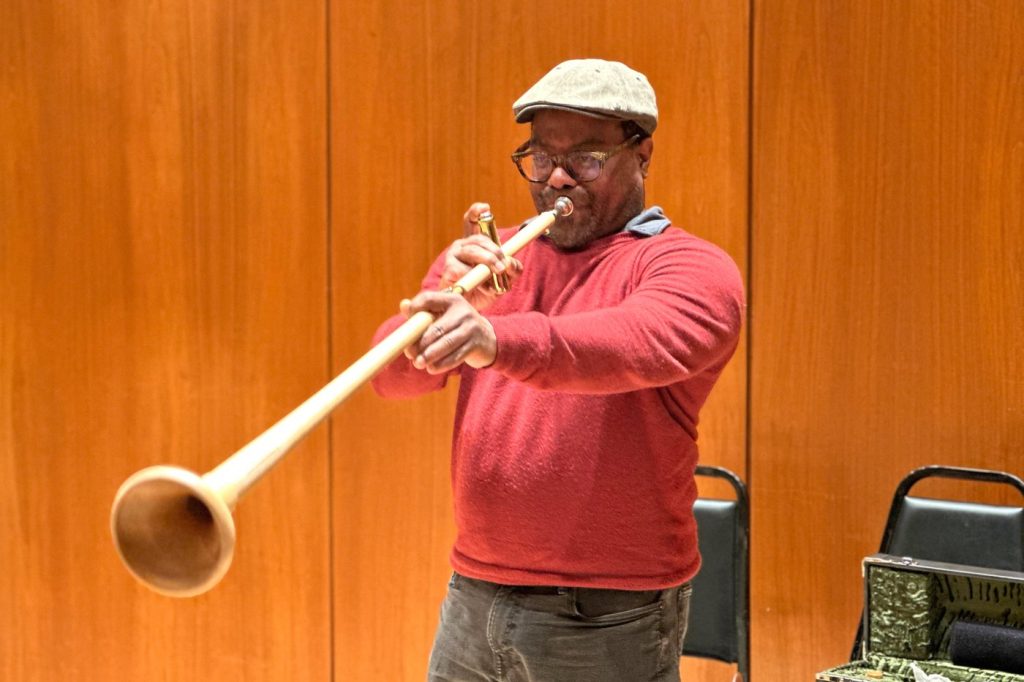
NEW YORK (AP) Approximately four and a half hours into Wagner's "Tristan und Isolde," a unique and rare sound punctuates the performance, one that many audience members may not have encountered before. This sound comes from a nearly 4-foot wooden horn called the holztrompete, which was specifically constructed following the composer's somewhat ambiguous directions. This instrument marks the arrival of Isolde and King Marke's ship to Brittany, encouraging a mortally wounded Tristan to hold onto life for just a few more moments.
Billy R. Hunter Jr., the principal trumpet of the Metropolitan Opera, plays this wooden horn from stage left. "Joyous," he describes the experience. The new production directed by Yuval Sharon and starring Lise Davidsen, which opened recently to largely positive reviews, features a holztrompete that measures a minimum of 46.5 inches and slightly extends if the tuning slide is used.
Ryan Speedo Green, the bass-baritone who portrays Marke alongside Davidsen's Isolde and Michael Spyres' Tristan, commented on the distinctiveness of the holztrompete. "You listen to the sound of the holztrompete and the imitation, it’s a clear difference," he said. "It blows my mind to think that Wagner created it himself. How many humans have created an instrument? It really sounds like victory."
Wagner's contributions to the realm of music extended beyond his compositions. While he invented the Wagner Tuba in the 1850s for the Ring Cycle, the specifics of the holztrompete are less clear. Although Wagner penned notes for an English horn, he mentioned in a footnote that it should evoke "the effect of a very powerful natural instrument, such as the alphorn." Research by Daniël Vernooij highlights that in a letter dated June 15, 1861, Wagner specified that the instrument should be "at least three feet long, made of wood, almost trumpet-like, and slightly curved downwards." Over the years, various instruments have been used in performances of "Tristan und Isolde," with the tárogató, a woodwind commonly linked to Hungarian folk music, being the most recent before the return of the holztrompete.
Mitch Weiss, a clarinetist at the Met for 38 years, recalls taking over the tárogató from Roger Hiller in the 1980s. "One day he said, 'I’m sick and tired of playing this. You play it,' and he handed me the tárogató," Weiss reminisced. Later, he had to audition for renowned conductor James Levine alongside the principal trumpet. "I played it on a tárogató and the first trumpet played it on a low horn. And Jimmy said: 'Tárogató plays it.'" Dean LeBlanc, another member of the Met orchestra, also played the tárogató in a 2016 production conducted by Simon Rattle, noting its significance in Hungarian musical tradition.
The modern introduction of the wooden horn at the Met occurred when Daniel Barenboim led the opera in 2008 and brought his holztrompete. Hunter recalls his surprise upon seeing the instrument for the first time, saying, "He pulled out this thing. I’m like: What in the world?" Barenboim mentioned it was the instrument used at Bayreuth and took it with him after the run. Subsequently, Thomas Lausmann, the Met’s director of music administration since 2019, ordered a new holztrompete manufactured by Thein Brass in Bremen, Germany, which replicated Wagner's original vision.
As Hunter explained, the holztrompete resembles a bugle, with only one valve that lowers the notes by a step, in contrast to a trumpet that typically has three valves. “On a regular trumpet, there are slides that can adjust the pitch, but with this, there is no adjustment,” he clarified. To prepare for the ongoing performances, Hunter practiced for a month at home in his Upper West Side apartment, with his family as his audience. “If the kids like it, then I know it’s OK,” he said, likening it to cooking, where if they eat the food, it means he did a good job.
Hunter's role culminates as he finishes playing the first act six stories above the stage in The Domes, announcing Tristan’s ship's arrival in Cornwall, before he leaves to fulfill family duties. “I left to put my daughters to sleep, relieve grandpa, and wait for my wife to return from work,” Hunter said, highlighting the delicate balance between his professional and personal life, all while contributing to the legacy of Wagner's innovative instrumentation.








