

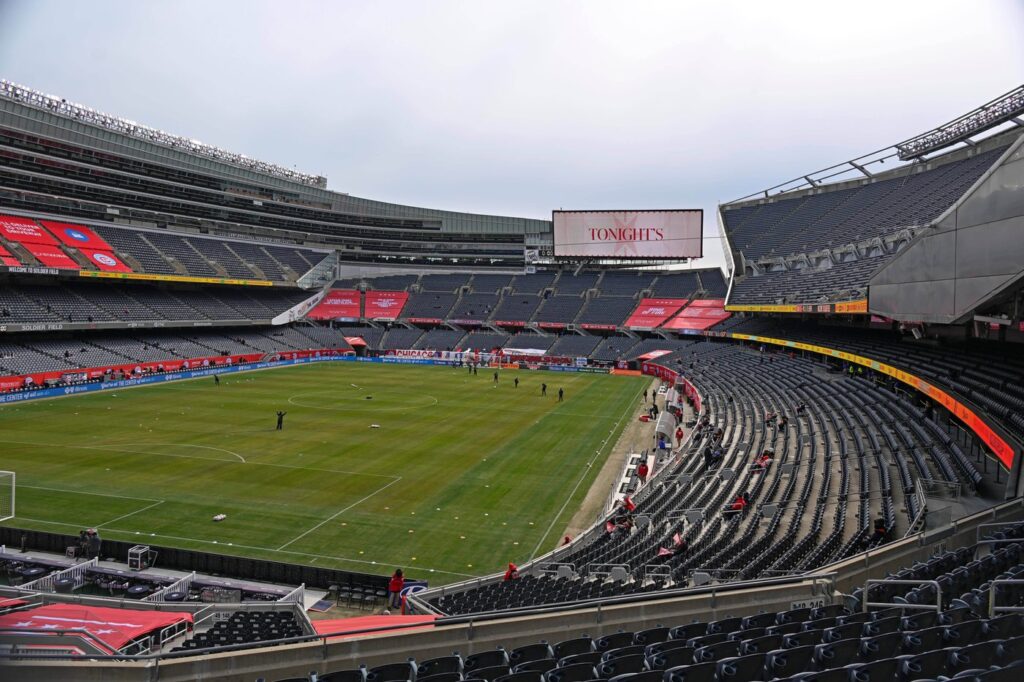
SPRINGFIELD, Ill. (AP) — A competition is brewing between Illinois and Indiana over the future home of the Chicago Bears, a storied franchise that has been a cornerstone of NFL history since its founding in 1920. The Bears are currently looking to leave Soldier Field, their home for over 50 years, as Indiana lawmakers propose a plan to attract them to a new domed stadium in Hammond, Indiana, approximately 25 miles from their current location on the shores of Lake Michigan.
In response to this potential loss, Illinois is considering legislation that would offer tax breaks for megaprojects costing at least $100 million, aimed directly at facilitating the Bears' proposal to construct a new stadium complex in Arlington Heights, which is similarly distanced from Soldier Field as Hammond.
Critics of the plan in Illinois argue that it could be detrimental to the state, which already has one of the highest property tax burdens in the nation. They highlight the ongoing financial obligations related to a significant renovation of Soldier Field that was completed two decades ago, leaving taxpayers responsible for hundreds of millions still owed on that investment.
The Bears franchise, valued at approximately $8.9 billion according to Forbes, is among the most valuable in the NFL. The team has won nine championships—second only to the Green Bay Packers—but has faced a challenging few decades, making their potential departure from Chicago a cause for concern among fans and community leaders. Having called Chicago home for 105 years, a relocation to Indiana would represent a significant cultural shift.
Soldier Field, with its capacity of 61,500 seats, is the smallest stadium in the NFL. The Bears historically rent their venues, having occupied both Wrigley Field and Soldier Field, and they seek to own their facilities in order to exert full control over operations, event scheduling, and revenue from various streams like ticket sales and concessions. An enclosed facility would also allow the Bears to host high-profile events, such as Super Bowls or NCAA Final Fours, which are impossible with an open-air stadium.
The rivalry between Illinois and Indiana has intensified, stemming from both states’ political dynamics and cultural differences, particularly with the growing divide between Democrat-led Chicago and the more conservative region of Indiana. The situation escalated when Indiana initiated a commission to explore altering state boundaries to include Illinois counties that have expressed a desire to secede from Chicago culture.
The Bears' interest in relocating has been longstanding. They had previously considered moving in 1975, but then-mayor Richard J. Daley firmly opposed the idea. However, in 2023, the Bears made a substantial investment of approximately $200 million to acquire a 326-acre piece of land in Arlington Heights, with plans for a $5 billion development that includes a domed stadium, housing, hotels, and entertainment venues.
In early 2024, the Bears proposed an extensive $5 billion plan for an enclosed venue next to Soldier Field, which did not receive political support in Chicago, leading the team to turn toward Indiana for potential relocation. Indiana's plan includes the establishment of the Northwest Indiana Stadium Authority, which would oversee the financing and construction of the new stadium in Hammond. Indiana Governor Mike Braun approved this plan, which includes a 35-year lease for the Bears, funded through borrowed state money to be repaid via increased local hospitality taxes.
Conversely, in Illinois, Democratic lawmakers have advocated for legislation that would provide incentives for megaprojects ranging from $100 million to $500 million. This plan allows developers to pay taxes based on land values pre-construction for up to 45 years, theoretically benefitting local governments financially. However, critics argue that this proposal would shift the tax burden to homeowners and small businesses in the long term.
Governor JB Pritzker has defended the initiative, contending that it would spur development on underutilized land, ultimately generating added tax revenue for local municipalities. There remains a considerable debt on Soldier Field, where taxpayers financed $399 million of the $587 million renovation in 2001, with the outstanding amount now at approximately $467 million. Additionally, the Bears are currently locked into a $7 million annual lease at Soldier Field that extends through 2033, with termination penalties reaching $10.5 million for each remaining year on the agreement.








