

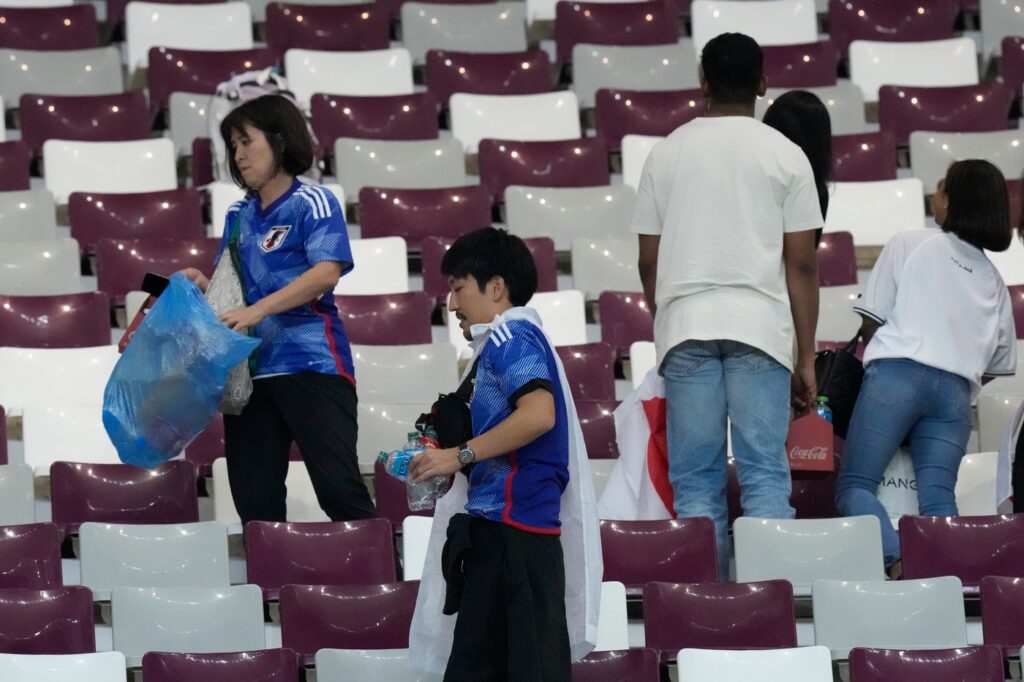
TOKYO (AP) — Japan has established a noteworthy tradition at the FIFA World Cup, renowned for the behavior of its soccer fans who actively participate in cleaning stadiums after matches. This practice first gained international attention during Japan's inaugural World Cup appearance in France in 1998.
Continuing this tradition, Japanese fans participated in post-match cleanups at the 2022 World Cup held in Qatar, and they are set to do the same in June when Japan plays group matches in Arlington, Texas, and Monterrey, Mexico. Observers often find it astonishing as crowds typically leave stadiums littered with leftover food, shredded paper, and discarded cups.
The clean-up tradition transcends mere fan behavior; it stems from a culture of cleanliness ingrained from a young age. In Japan, elementary school students are taught to take responsibility for their environment, which extends into adulthood. Koichi Nakano, a political and history professor at Sophia University, notes that the discipline fans exhibit at international sporting events is reflective of the lessons they learned early in life.
A Japanese phrase, "Tatsu tori ato wo nigosazu," translates to "A bird leaves nothing behind," encapsulating this cultural ethos. Its underlying message encourages individuals to "return it the way you found it." Many schools in Japan operate without janitors, placing the responsibility of maintaining cleanliness on students, while office workers also dedicate time to keeping their workspaces tidy.
In addition, Japan's relatively few public trash receptacles encourage citizens to take their waste home, promoting communal cleanliness while minimizing the costs associated with waste management. Barbara Holthus, deputy director of the German Institute for Japanese Studies, emphasizes the social conditioning that equips Japanese individuals to uphold such standards in public spaces, contrasting it with Western approaches that often presume public services will manage cleanliness.
The concept of "meiwaku," which implies not causing inconvenience to others, plays a significant role in this behavioral norm. Holthus explains that leaving trash in public would be a disturbance to others, a sentiment that resonates in Japan's densely populated urban environments, such as Tokyo, which houses approximately 35 million residents. This cultural focus on the collective experience is often juxtaposed against Western values that prioritize individualism.
Recognition of their clean-up efforts by the media has further solidified these values among Japanese fans, who take pride in their reputation for cleanliness. Jeff Kingston, a history professor at Temple University in Japan, observes that the portrayal of Japanese fans in the media has transformed the cleaning behavior into a symbol of national identity.
This commitment to cleanliness is not solely isolated to high-profile events like the World Cup; similar displays were observed during the Under-20 World Cup in Chile and more recently at Wembley Stadium in London after a friendly match where Japan faced England. Toshi Yoshizawa, who was part of the cleanup in Chile, expressed that such actions are embedded in Japanese culture, underscoring a long-standing ethos to leave places cleaner than found.
William Kelly, an emeritus anthropology professor at Yale University, highlights that this clean-up tradition is particularly associated with soccer over other sports, linking it to the rise of Japan's professional football league over three decades ago, which aimed to cultivate a sense of community among soccer fans and their connection to their teams.








