

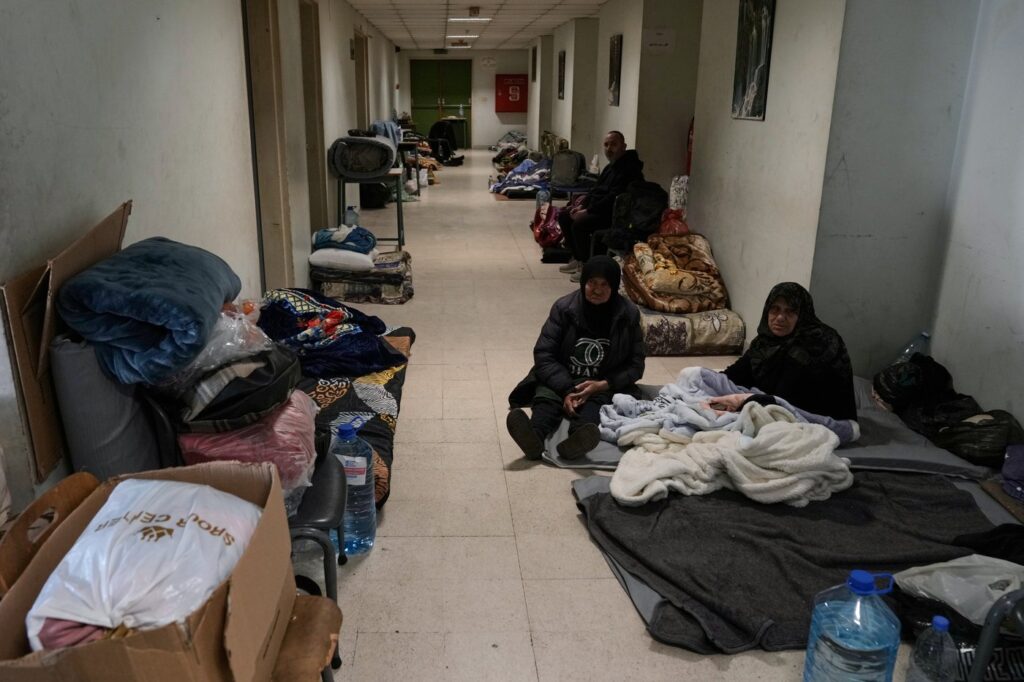
BEIRUT (AP) – Fatima Nazha, a resident of Beirut's southern suburbs, endured two days of sleeping on the streets after fleeing her home due to an Israeli mass evacuation order. With all government shelters full and her family unable to afford a hotel or apartment, Nazha and her husband found refuge in a tent at the Camille Chamoun Sports City Stadium, while their children and grandchildren sought shelter near Sidon, a coastal city in southern Lebanon.
In a mere 10 days, the ongoing conflict has displaced over 800,000 people in Lebanon, dramatically impacting nearly one in every seven residents, according to the Norwegian Refugee Council. Many individuals lack adequate shelter, and the financially strained Lebanese government managed to accommodate only approximately 120,000 of those displaced, hastily working to open more shelters and secure additional supplies.
Nazha, who relies on a wheelchair, expressed the heightened difficulties of this displacement compared to previous conflicts with Israel and Hezbollah. She noted that the recent strikes have been more intense and unpredictable, and the evacuation order was issued abruptly, preventing her from gathering her belongings. “The strikes used to target specific areas, but now they’re hitting all areas,” she lamented, highlighting the escalating violence, which has claimed over 700 lives, including 103 children, according to Lebanon's Health Ministry.
The crisis escalated following Hezbollah's rocket attacks in response to the killing of Iran's Supreme Leader Ali Khamenei, prompting Israel to increase its military strikes. Many Lebanese hoped Hezbollah would refrain from retaliating against the Israeli strikes, especially given the group’s involvement with Hamas, which resulted in Israeli aggressions toward Hezbollah. This situation has fueled growing resentment towards Hezbollah and its allies within Lebanon, causing internal tensions to rise.
In the face of fear and uncertainty, landlords have raised rents in a bid to deter potential new tenants, while hotels have tightened vetting protocols following Israeli drone strikes targeting supposed Iranian Revolutionary Guard members in Beirut hotels. Those without family or resources have resorted to sleeping in their cars or on the streets of central Beirut, seeking safety yet facing increasing danger, notably after an Israeli strike in the Ramlet el-Bayda neighborhood killed at least eight people and inflicted injuries on over 30 others.
Faced with a growing humanitarian crisis, groups like the International Organization for Migration warn that the needs of displaced individuals are surpassing their capacity to respond. Mathieu Luciano, the agency’s head in Lebanon, remarked during a press briefing on the urgent necessity for aid, stating that “the needs are escalating much faster than our capacity to respond.”
The Lebanese government has repurposed its largest stadium into a makeshift shelter, where Nazha, her husband, and over 800 others sleep in semi-open corridors. While meals are provided, the basic provisions include just tins of sardines or loaves of bread, far from sufficient for the growing number of desperate individuals. The stadium, typically home to athletic events, is now a refuge where children play while Israeli drones hover ominously overhead, a reminder of the daily bombings nearby.
The rapid pace of displacement this time contrasts sharply with the previous conflict, where mass evacuations occurred toward the end of a prolonged engagement. The initial attacks and subsequent Israeli bombardments took Lebanese residents by surprise, as evacuation notices spread from southern Lebanon to the densely populated Dahiyeh suburbs on Beirut's southern edge. Chaos ensued on the main roads leading to the capital as families desperately sought safety.
Seganish Gogamo, an Ethiopian migrant worker who fled Nabatieh, recounted the two-day journey to find refuge in a church in Beirut. The uncertainty of the fighting’s resolution looms large as speculation arises regarding a potential Israeli ground invasion, given the amassed troops along the U.N.-mandated Blue Line that separates the two nations. Many fear the continuation of hostilities beyond the current phase of the Israel-Hezbollah conflict.
Joe Sayyah, a resident of the border village Alma al-Shaab, was among those who initially stayed behind in hopes of riding out the conflict. However, after a friend was killed in an Israeli drone strike, Sayyah and his neighbors realized they could no longer remain, ultimately departing for the capital under United Nations protection. Arriving at a church for a funeral, the reality of the ongoing war's potential permanence and the risk of never returning to their homes began to settle in.








