

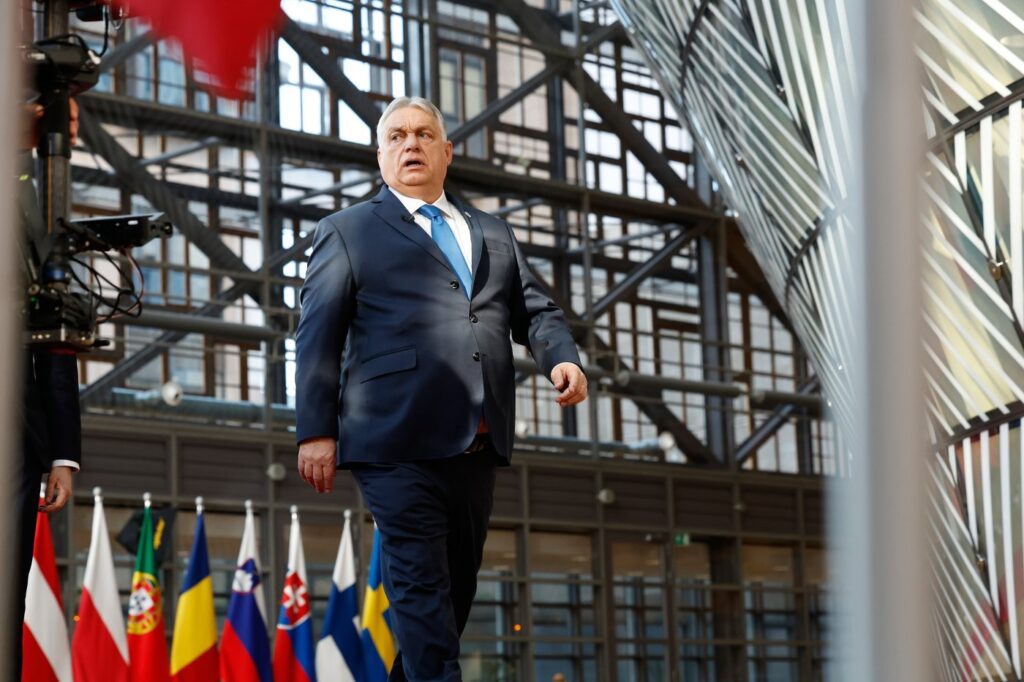
BRUSSELS - European Union leaders expressed their frustration with Hungarian Prime Minister Viktor Orbán during a summit on Thursday, accusing him of undermining essential financial aid for Ukraine. This criticism emerged as they believe Orbán is using the situation to bolster his electoral campaign ahead of Hungary's elections on April 12.
Leaders emphasized the need for Orbán to adhere to the EU's previously established plan to allocate significant funding for Ukraine’s armed forces and economy, which is suffering due to the ongoing conflict. Finnish Prime Minister Petteri Orpo noted that Orbán's actions have compromised a previously agreed-upon deal, stating, “He’s using Ukraine as a weapon in his election campaigning, and it’s not good. We had a deal, and I think that he betrayed us.”
Ukraine's economic conditions are dire, with officials indicating that the country requires a substantial portion of the projected €90 billion ($103 billion) loan by May. For this assistance to materialize, progress must be made in the EU agreement in the next few weeks.
Orbán, who is viewed as a close ally of Russian President Vladimir Putin, has been trailing in opinion polls ahead of the upcoming elections. As part of his campaign, he has labeled Ukrainian President Volodymyr Zelenskyy an existential threat to Hungary. Orbán has accused both Zelenskyy and European Commission President Ursula von der Leyen of attempting to pull Hungary into the war initiated by Russia.
In this political climate, Orbán has asserted that his reelection is crucial for maintaining peace and security in Hungary. His fellow EU leaders have countered these assertions, stating that EU institutions are not against him as he claims. Belgian Prime Minister Bart De Wever remarked, “It’s unacceptable to decide with the leaders and then after say, ‘but I’m not ready to execute what I decided.’”
Austrian Chancellor Christian Stocker reiterated the importance of sticking to the agreed-upon decisions, arguing that if Orbán uses electoral circumstances as justification, it does not hold considering the critical situation in Ukraine.
This confrontation lays bare vulnerabilities within the EU's decision-making process, which requires consensus among its 27 member states. Hungary represents a small demographic fraction within the bloc, housing roughly 10 million of the EU's 450 million population.
Relations between Ukraine and Hungary have been escalating, particularly following the disruption of Russian oil deliveries to Hungary and Slovakia due to damage to the Druzhba pipeline, which runs through Ukrainian territory. Ukrainian officials attribute the damage to Russian drone strikes, whereas Orbán accuses Zelenskyy of deliberately obstructing oil supplies. Hungary’s opposition has extended beyond delaying the loan package to also impeding new EU sanctions against Russia.
In a bid to resolve the stalemate, von der Leyen and European Council President António Costa have proposed to finance repairs to the oil pipeline, with an EU technical team awaiting clearance in Kyiv to assess the damage. However, Orbán has stated he will maintain his position against the loan until oil deliveries to Hungary resume.
Orbán emphasized the dire nature of the situation for Hungary, asserting, "To get the oil is existential for the Hungarians. It’s not a joke, it’s not a political game. Zelenskyy should understand it.” As he seeks reelection for a fifth term, the future of EU-Hungary relations remains uncertain amid these tensions.








