

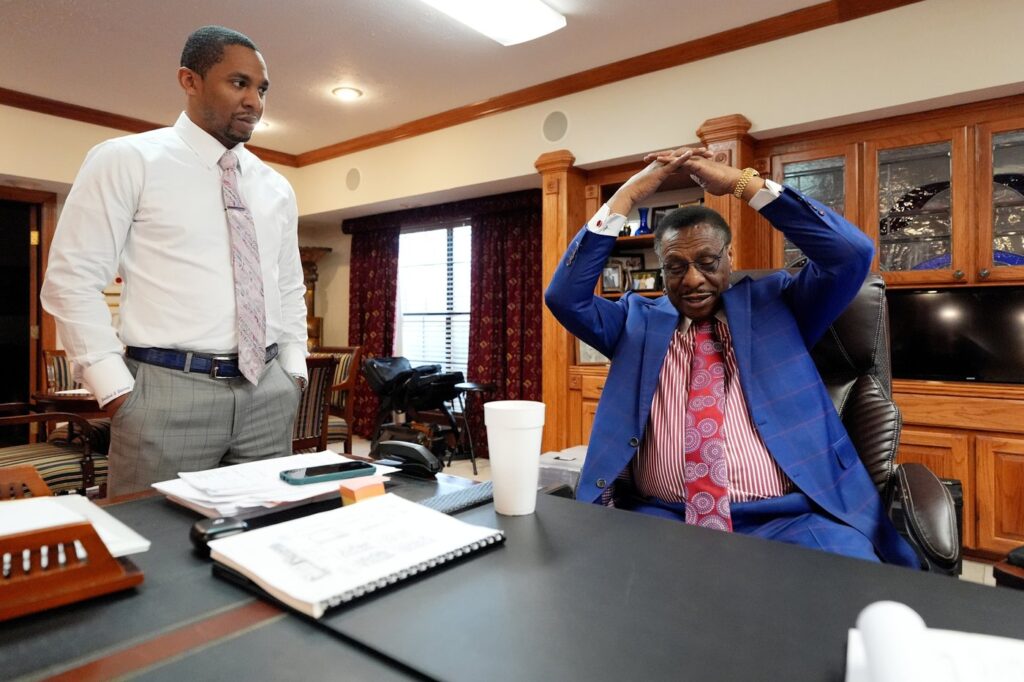
JACKSON, Miss. (AP) – The story of Edward Blackmon Jr. highlights the ongoing struggles for voting rights in Mississippi, where at the young age of 16, he was arrested during a protest for voting equality in his hometown. This experience, involving being confined in a truck and spending nights in an overcrowded jail, spurred his journey to become a civil rights lawyer and one of the first Black lawmakers elected in the state since Reconstruction.
Blackmon's experiences are reflective of a broader movement among Black Americans in the South, who fought against systemic barriers to voting and sought political representation after generations of oppression resulting from slavery and its aftermath. A significant milestone in this struggle, the Voting Rights Act, faced challenges recently after a ruling by the U.S. Supreme Court, which stated that states should not consider racial demographics when redistricting congressional districts. This ruling raises concerns about shifting political power distributions and the potential hindrance to minority electoral success.
The Supreme Court's conservative majority argued that racism was a problem of the past, while others criticized the decision, claiming it represented a revival of Jim Crow-like policies. Edward Blackmon's son, Bradford Blackmon, a current state senator, expressed that the way political districts are defined impacts not only voting outcomes but also the chances of minority candidates being viable contenders in elections.
For Edward Blackmon Jr., now 78, the recent Supreme Court ruling feels like a continuation of the challenges he faced in his youth. He lamented that the struggle for voting rights is ongoing, “an ongoing struggle without a foreseeable ending.” The case in Louisiana, which questioned the state's congressional map, significantly impacted the interpretation of the Voting Rights Act and its applicability in protecting Black voting power in those districts.
Many Black Americans view the ruling as a significant setback for the hard-earned victories achieved during the Civil Rights Movement, particularly for those who remember a time when Black voters in the Deep South lacked guaranteed access to the ballot. Within just a year of the Voting Rights Act's passage in 1965, over 250,000 Black Americans registered to vote, with estimates of nearly 22 million Black voters registered nationwide by 2024.
The current landscape showcases the regression of nearly a century of civil rights advocacy and the sacrifices made by countless individuals who fought for Black political empowerment. Figures such as Jonathan Jackson, the son of renowned civil rights leader Rev. Jesse Jackson, articulated the gravity of losing protections that were taken for granted in his generation. Similarly, Charles Mauldin, a veteran of Bloody Sunday, noted that the ongoing debates surrounding voting rights remain unresolved despite decades of progress.
Younger Black politicians in Louisiana are already anticipating the ramifications of the Supreme Court's ruling, which could redefine not only election outcomes but the ability of candidates to run viable campaigns. Davante Lewis, a Democratic member of the state's utility regulatory board, expressed concerns that district redraws may disadvantage candidates who represent predominantly Black communities, thereby stunting their representation in the political arena.
Jamie Davis, a Black farmer and U.S. Senate candidate, voiced a sentiment of disillusionment among voters, contributing to an atmosphere where civic participation may decline, especially given low turnout in recent elections. The urgency for new redistricting in states like Tennessee is coupled with an irony where individuals who once fought for the Voting Rights Act are now finding themselves reliving struggles they believed were settled decades ago.
Despite the bleak outlook, some, including State Rep. Justin Pearson of Tennessee, saw the possibility that the challenges presented by the Supreme Court's ruling could reinvigorate a civil rights movement focused on equity and justice. However, supporters of the ruling argue for a race-neutral approach to redistricting, asserting that political lines should not be drawn primarily based on race.
Amid these escalating tensions, Mississippi State Rep. Bryant Clark emphasized that the historical and current convergence of race and political party alignments in Mississippi necessitates acknowledgment of racially discriminatory practices in redistricting. Blackmon observed that current political maps maintain Black representation in certain districts but preserve Republican majorities elsewhere, reflecting a strategic balance lawmakers are reluctant to alter.
Edward Blackmon's journey from the Jim Crow South to a life dedicated to civil rights encapsulates the deeply entrenched struggles faced by communities of color. Drawing from his upbringing in Canton, where disparities were stark and oppressive, Blackmon’s resolve was forged in the warmth of community discussions, fostering the fight for equal rights. He articulates that without the Voting Rights Act, Mississippi would have an entirely different political landscape.








