

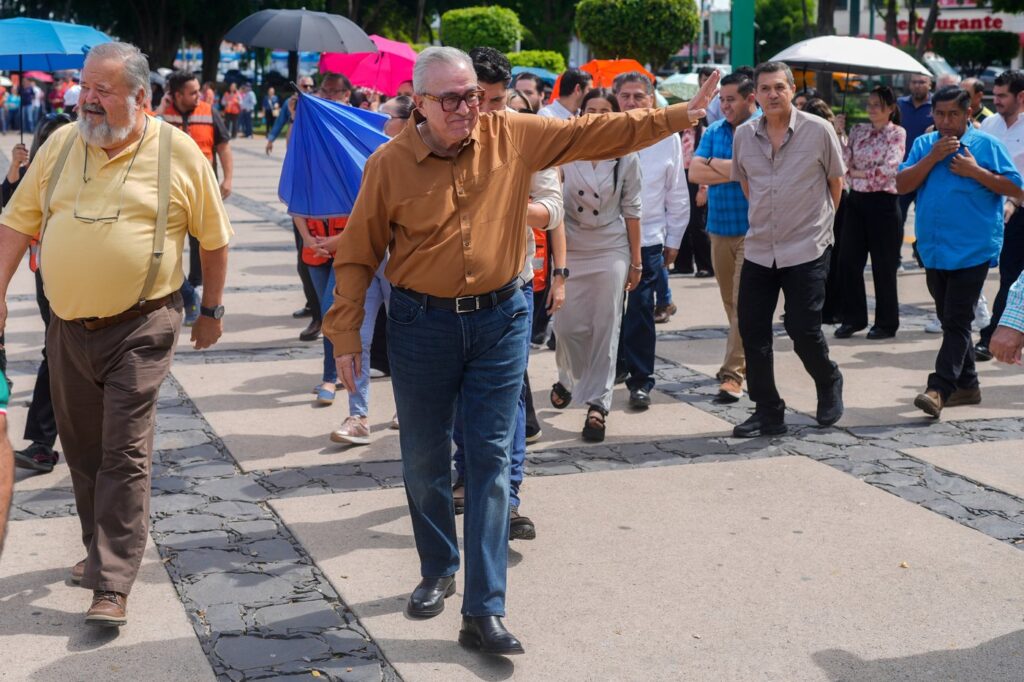
MEXICO CITY (AP) — In a significant political upheaval in Mexico, two members of President Claudia Sheinbaum's party from northwestern Sinaloa state have announced their intention to temporarily step down from their government positions. This decision comes after the United States charged them, along with eight other current and former politicians and security officials, with drug trafficking in an indictment that has sent shockwaves through Mexico's political establishment.
Governor Rubén Rocha Moya, the highest-ranking official implicated in this indictment, emphatically denied claims that he offered protection to the powerful Sinaloa cartel and assisted in smuggling drugs into the U.S. in exchange for substantial bribes. In a midnight video posted on Friday, Rocha asserted, "My conscience is clear," highlighting his commitment to transparency with both his constituents and family, maintaining that he has never betrayed them and never will.
Despite his denial, Rocha stated he would take a temporary leave of absence from his position, held for six years, to defend against what he characterized as "false and malicious" accusations. He has also committed to collaborating with the Mexican government's ongoing investigation. Alongside him, Juan de Dios Gámez Mendívil, the mayor of the state capital, Culiacán, announced his own leave of absence, also rejecting the charges leveled against him. Culiacán's interim mayor took over duties effective Saturday.
Currently, Rocha and Gámez Mendívil enjoy immunity from criminal prosecution as elected officials, meaning they cannot be charged unless Mexico's Congress initiates impeachment proceedings. By opting for a temporary leave rather than resigning, both officials maintain their legal protections.
President Sheinbaum expressed that she has not yet encountered credible evidence supporting the U.S. indictment against the ten implicated officials and has vowed that Mexican authorities would undertake their own investigation. She made it clear that if “irrefutable” evidence linking them to cartel-related crimes came to light, trials would be conducted in Mexico rather than in the U.S. This stance, however, carries the potential for backlash from the Biden administration, which has hinted at possible military action against cartels operating in Mexico.
In her address, Sheinbaum emphasized, "We will never subordinate ourselves because this is a matter of the dignity of the Mexican people." Amid this political crisis, the Mexican attorney general's office stated it would hold off on arresting Rocha and the other accused officials, despite requests from U.S. authorities.
Governor Rocha is a key figure in the "hugs, not bullets" approach to tackling organized crime, a strategy introduced by Sheinbaum's political mentor, former President Andrés Manuel López Obrador. He criticized the indictment as a politically motivated attack on the Morena party, asserting, "I will not allow myself to be used to harm the movement to which I belong — one that has improved the lives of millions of Mexican men and women."
Rocha's connection to the Sinaloa cartel has garnered attention in the past; he was previously named in a letter by a Sinaloa cartel member who had been kidnapped. That letter stated the individual was on his way to meet Rocha at the time of his abduction.








