

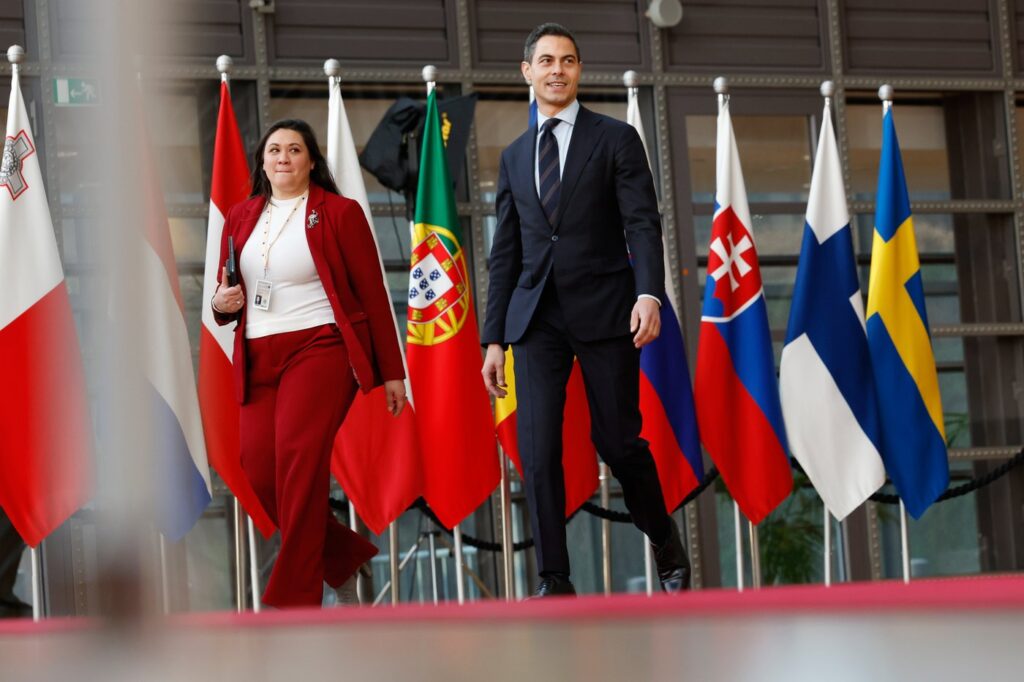
BRUSSELS (AP) — Leaders from the European Union convened on Thursday to address the escalating oil and gas prices significantly influenced by the ongoing conflict in the Middle East, which impacts vital energy producers and shipping routes. The summit comes at a time when rising energy costs have become a pressing concern amidst fears of a potential refugee crisis in Europe as a result of the unrest.
Many leaders have turned down requests from U.S. President Donald Trump to deploy military assets for securing the Strait of Hormuz, a crucial waterway that facilitates the global transport of oil, gas, and fertilizer. As the EU grapples with rising energy prices driven by the conflict, the necessity to prioritize the Middle East in their discussions has become increasingly apparent.
Belgian Prime Minister Bart De Wever expressed his concern regarding the energy crisis ahead of the European Council summit involving 27 EU member states. He remarked that even before the war, energy prices were exorbitantly high, and the current conflict has only exacerbated the situation. De Wever warned, "If that becomes structural, we’re in deep trouble," indicating the potential for long-term economic strain if these spikes in energy prices persist.
In response to the crisis, the European Commission informed leaders that it possesses a range of financial instruments that member nations can utilize to mitigate rising energy costs. However, it is likely that no single policy will be sufficient to shield the diverse markets across the bloc, which spread from Romania to Ireland, from the economic turbulence triggered by the war.
The European leaders have faced challenges in formulating a unified stance on the ongoing violence in Iran and Lebanon. While there has been vocal criticism of the Iranian government, the EU has refrained from supplying military aid to the region. Dutch Prime Minister Rob Jetten commented on the situation, stating, "This is a war that was started by the United States and Israel against Iran on reasons that I can understand because the Iranian regime is brutal not only for its own people, but also for the broader region and a security threat for Europe." He emphasized that while the EU disapproves of the Iranian regime's actions, it does not participate in the conflict, advocating instead for more sanctions against Iran and enhanced support for opposition factions.
The summit also serves as a platform for discussing collective European measures to counter the fallout from the energy crisis, explore potential collaborative strategies, and formulate a response to the complex geopolitical situation unfolding in the Middle East.








