

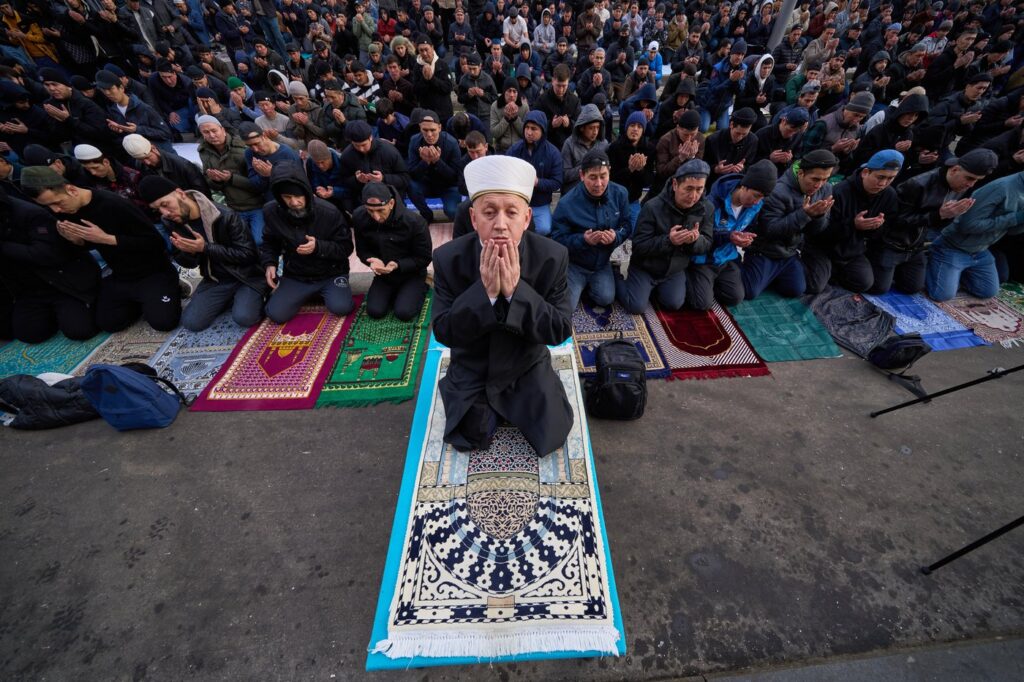
This year, Muslims around the world are celebrating Eid al-Fitr, marking the end of the holy month of Ramadan, amid various circumstances that reflect a mix of joy and adversity. From the celebrations taking place in the grand mosques of Istanbul to the heartfelt prayers uttered amidst the rubble of Gaza, the essence of this festival is palpable across regions. Eid al-Fitr is traditionally characterized by joy, excitement, communal prayers, family gatherings, and the donning of new clothes, with celebrations taking place not just in predominantly Muslim nations but also among Muslim communities in Greece, Russia, and other parts of the world.
On March 20, 2026, various cultural and religious observances were conducted in several major cities. In Moscow, Russia, Muslims participated in Eid al-Fitr prayers outside the Moscow Cathedral Mosque, fostering a sense of community in a location significant for many. Meanwhile, in Cairo, Egypt, thousands gathered outside al-Seddik Mosque to commemorate the occasion. Similarly, a large congregation of Muslims prayed in Baghdad, Iraq, at the Abdul-Qadir al-Gailani mosque, illustrating the widespread observance of this religious holiday across the Middle East and beyond.
However, the celebrations this year are overshadowed by the ongoing conflicts in the region, particularly the war in Iran and its implications for the wider Middle East. In Jerusalem, Palestinian Muslims held their prayers amid the restrictions imposed by the Israeli authorities, which included nationwide bans on large gatherings. The significance of prayers in such challenging contexts is amplified, with many seeking solace and community despite the turbulence surrounding them.
In Gaza, scenes of resilience were evident as Palestinian Muslims offered prayers amid the devastation of Jabaliya, where destroyed buildings served as a stark backdrop to the festive occasion. Photos from the region depicted moments of congregation and solidarity, as worshippers stood united in the face of adversity. Militants affiliated with Hamas and Islamic Jihad were also seen engaging with the community during the prayers, highlighting the intertwining of religious and political elements in the region's complex landscape.
The atmosphere during Eid al-Fitr extended beyond the Middle East, with celebrations being observed by Bosnian Muslims in Sarajevo, where children listened to sermons delivered in the historic Gazi Husrev-beg Mosque. Likewise, in Khartoum, Sudan, large crowds gathered for prayers, demonstrating the vibrant cultural expressions of faith prevalent in diverse countries. The sense of community was palpable as people came together to mark the end of Ramadan, forging connections through shared beliefs and traditions.
In Istanbul, Turkey, worshippers gathered outside mosques to partake in the Eid al-Fitr prayers, continuing a tradition that holds significant cultural and spiritual importance. The celebrations were a testament to the strength and perseverance of the Muslim community, uniting them in the face of global challenges. People in Athens, Greece, also joined in the festivities, showcasing the diasporic connections that bring Muslims together across geographical boundaries.
The images captured during this year's celebrations reflect a range of emotions, from joy and community to resilience amid hardship. As Muslims come together to celebrate Eid al-Fitr, they continue to navigate the complex realities of their environments, striving to uphold their traditions while facing contemporary challenges that test their faith and unity.








