

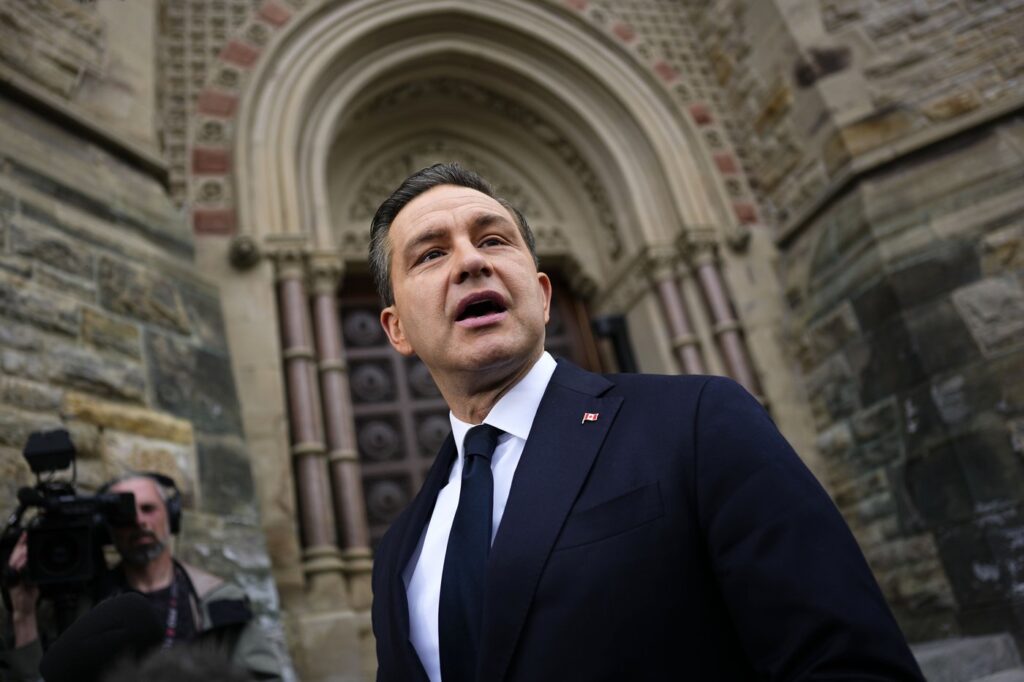
TORONTO – Conservative Leader Pierre Poilievre has called on Prime Minister Mark Carney to clarify what leverage Canada has in the upcoming trade negotiations with the United States. This demand comes after Carney rejected the idea of characterizing Canada’s energy and critical mineral resources as leverage in discussions aimed at renewing the Canada-United States-Mexico Agreement (CUSMA).
During a press conference in Toronto, Poilievre questioned Carney's strategy, stating, “If energy and minerals are not going to be leveraged for Canada in these negotiations, what leverage does Mr. Carney claim to have?” He emphasized the need for transparency regarding the government’s objectives, the tariffs they plan to tackle, and the overall legitimacy of their negotiation strategy.
In a recent interview, Carney articulated his perspective, viewing the energy and mineral sectors as potential avenues for future trade rather than tools of leverage. He stated, “Reclassifying that as leverage, I’m not sure that’s the way I look at that. I look at it as trade,” suggesting that the focus should be on mutual interests rather than on threats or demands.
Carney acknowledged that while Canada won't be discontinuing trade with the U.S., the potential for deeper integration in these sectors remains uncertain amidst a volatile trade relationship. He raised a critical question about whether further integration of energy markets is advisable, given the U.S.'s perception of leverage in the ongoing trade debates.
U.S. Trade Representative Jamieson Greer advised Canadian politicians against leveraging energy in these negotiations during a meeting in Washington. Greer noted that any collaboration on energy should not be predicated on the condition of concessions from the U.S., reiterating that the U.S. administration values the existing energy partnership with Canada.
Meanwhile, Natural Resources Minister Tim Hodgson asserted that Canada’s energy and natural resources represent “Canada’s strongest cards” in renegotiating CUSMA. In contrast, Poilievre advocated for a strategy that would involve building a significant reserve of energy and minerals to secure tariff-free access to the U.S. market.
The trade negotiations between Canada and the U.S. encountered a standstill last fall, due in part to rising tensions, including backlash from the Trump administration towards an Ontario advertising campaign that criticized tariffs. As CUSMA approaches its mandatory review period this summer, Greer has indicated that it is improbable that the U.S. will approve the deal in July, hinting at extended negotiations ahead.
During the first meeting of Carney's Canada-U.S. economic advisory council, the Canadian government affirmed that it would not make concessions before engaging in broader negotiations on CUSMA renewal. The Prime Minister noted that America’s sectoral tariffs on Canadian goods remain a significant trade irritant that must be resolved.
Carney elaborated that typically, there would be a broader discussion of several “technical” trade issues during this review period. However, he remarked that the current environment does not favor such discussions, particularly concerning regulatory harmonization on digital issues.
In closing, Carney emphasized the necessity of cautious approaches to further integration. Given the presence of tariffs that undermine economic sectors, there is an urgent need to reassess the reliability of the agreements and dispute settlement mechanisms in the current climate. He stated, “Can we really rely, ultimately, on what’s written in the agreement, what’s in a dispute settlement mechanism? That’s a very different environment than was there previously.”








