

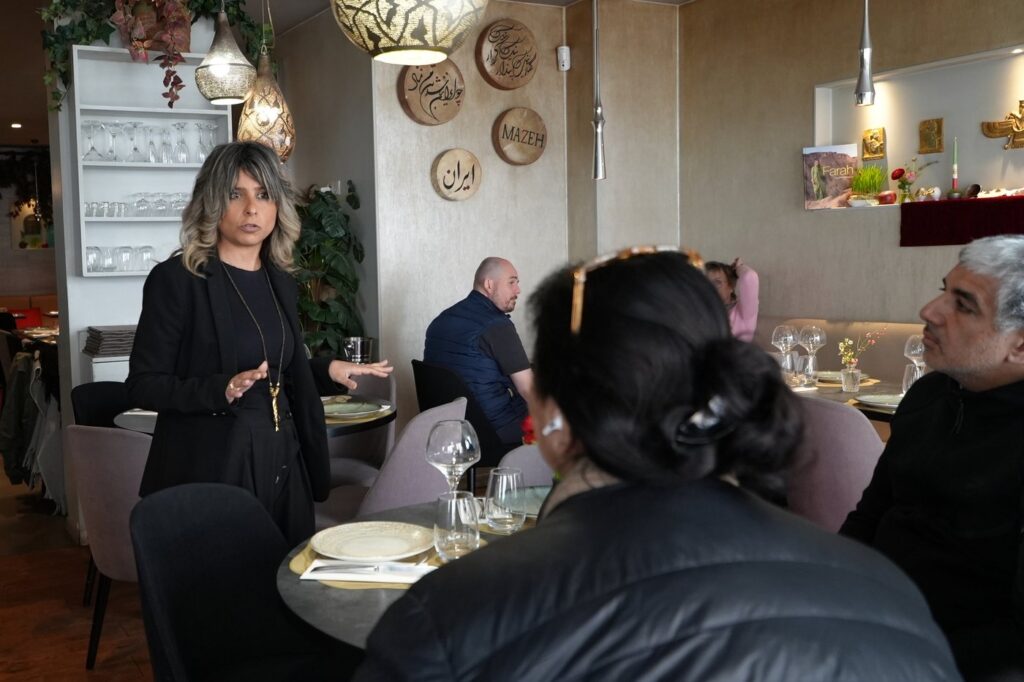
PARIS (AP) — When Iran erupted in nationwide protests at the end of 2025, Shayan Ghadimi's mother returned to Iran from Paris, eager to witness the uprising firsthand. This decision has since left a heavy emotional burden on the family, especially as they grapple with the separation exacerbated by the bloody crackdown that followed the protests and the ongoing Iran war.
As the Persian New Year, Nowruz, approaches, families like Ghadimi’s are left to mourn in silence. Ghadimi, 41, operates a spice-scented restaurant in Paris and prepares meals while reflecting on her mother’s well-being. “Now, she is all alone at home, with no way to stay in contact, watching the sky. I cannot imagine the state she is in,” Ghadimi expressed.
A cultural center for Iranians in Paris, which previously organized music events for Nowruz, has declared a period of mourning. In the United States, several Iranian American communities have similarly opted to cancel or scale back their celebrations. Nowruz, translating to "new day" in Farsi, aligns with the spring equinox and is celebrated widely from Afghanistan to Turkey, encompassing a diverse array of religious practices that date back millennia to Zoroastrian traditions, despite attempts by hard-liners to suppress it.
Shakiba Edighoffer, another Iranian expatriate, articulated the emotional turmoil many are facing: “It’s a kind of emotional roller coaster.” As the war escalates, with Israel and the United States targeting Iran’s military leaders, while Iran retaliates, the challenges of communication with family in Iran add to the distress. Edighoffer noted, “I had a friend who managed to connect very briefly on Instagram a few days ago,” but overall communication has become painfully scarce.
To cope with the overwhelming sense of loss and fear, many are turning to communal celebrations during Nowruz to find solace. Edighoffer remarked that coming together to celebrate “helps us cope, at least a little, with the psychological pressure.” She emphasized that the oppressors “want us to be sad, to forget our millennia-old Persian and Iranian traditions. We must not give them that victory.”
At Ghadimi's restaurant, patrons indulge in traditional cuisine like flame-grilled kebabs and spiced rice, reflecting a mix of emotions. Some express hope that the conflict may lead to positive change, while others mourn the destruction unfolding in their homeland. Ghadimi shared, “I have people in tears… Others say, ‘Our country is being destroyed.’”
Since Ghadimi's mother returned to Iran in January 2026, communication between them has dwindled to just two conversations. “Quite honestly, I don’t try anymore. Because it stresses me out, if I try calling and can’t get hold of her,” Ghadimi stated. She shared that her mother had initially intended to return for Nowruz but recently expressed a resolve to stay longer, stating, “I am staying here until the end,” influenced by her experiences living through the 1979 Islamic Revolution.
In the context of the ongoing conflict and upheaval, the spirit of Nowruz becomes a poignant symbol of resilience for the Iranian diaspora, highlighting their hope and connection to cultural traditions, even as they face significant challenges back home.








