

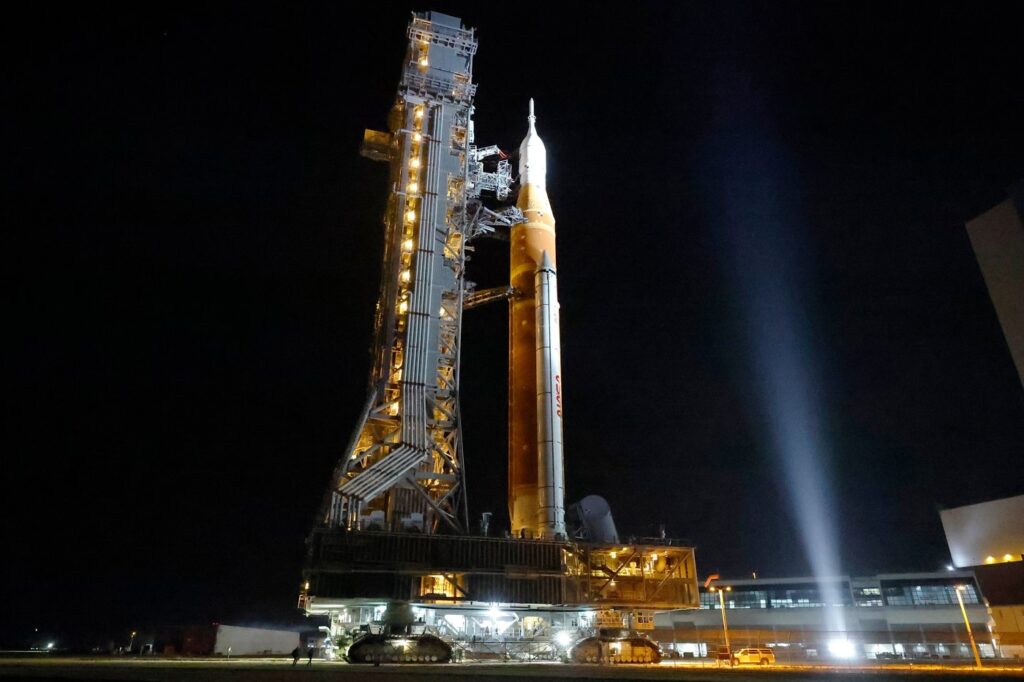
The Artemis II mission is making significant strides as NASA's rocket, designed to carry Canadian astronaut Jeremy Hansen on a historic journey around the moon, has begun its rollout. The launch vehicle is en route to the launch pad at the Kennedy Space Center located in Florida. Initial operations commenced early on Friday, March 20, 2026, although they faced brief delays due to high winds in the region.
The entire process of transporting the rocket to the launch pad is projected to take up to 12 hours. This carefully coordinated operation is a critical step in the lead-up to the mission's planned launch date on April 1, 2026. NASA officials have noted that the Artemis II mission has experienced several delays since February, largely attributed to technical challenges such as hydrogen fuel leaks and helium flow issues. Despite these setbacks, the mission's timeline remains focused on the upcoming launch.
One of the standout features of the Artemis II mission is its crew composition. Jeremy Hansen, a resident of London, Ontario, is set to serve as the mission specialist on this historic journey. His participation marks a milestone in space exploration, as he will become the first non-American astronaut to venture beyond low Earth orbit. This achievement highlights an evolving landscape in international collaboration in space travel.
The Artemis II mission itself is particularly significant as it represents the first crewed journey to the moon since the Apollo program, with the last crewed Apollo mission occurring in 1972. As part of NASA's Artemis program, the mission aims to establish a sustainable presence on the lunar surface, paving the way for future exploration efforts, including potential trips to Mars. The historical implications of this mission are profound, revitalizing interest in lunar exploration after decades and underscoring the importance of global participation in such initiatives.
The rollout of the Artemis II rocket is accompanied by considerable anticipation from both NASA and the scientific community. The successful execution of this mission could set the stage for a new era in human space exploration. As the rocket makes its way towards pad 39B at the Kennedy Space Center in Cape Canaveral, Florida, all eyes will be on this monumental endeavor that not only aims to return humans to the moon but also to engage international partnerships in the pursuit of further cosmic frontiers.
The detailed planning and execution that characterize the Artemis II mission reflect NASA's commitment to innovation and exploration. With the entire world watching, the launch of this mission is expected to reignite excitement about space exploration and inspire future generations to look beyond our planet.








