

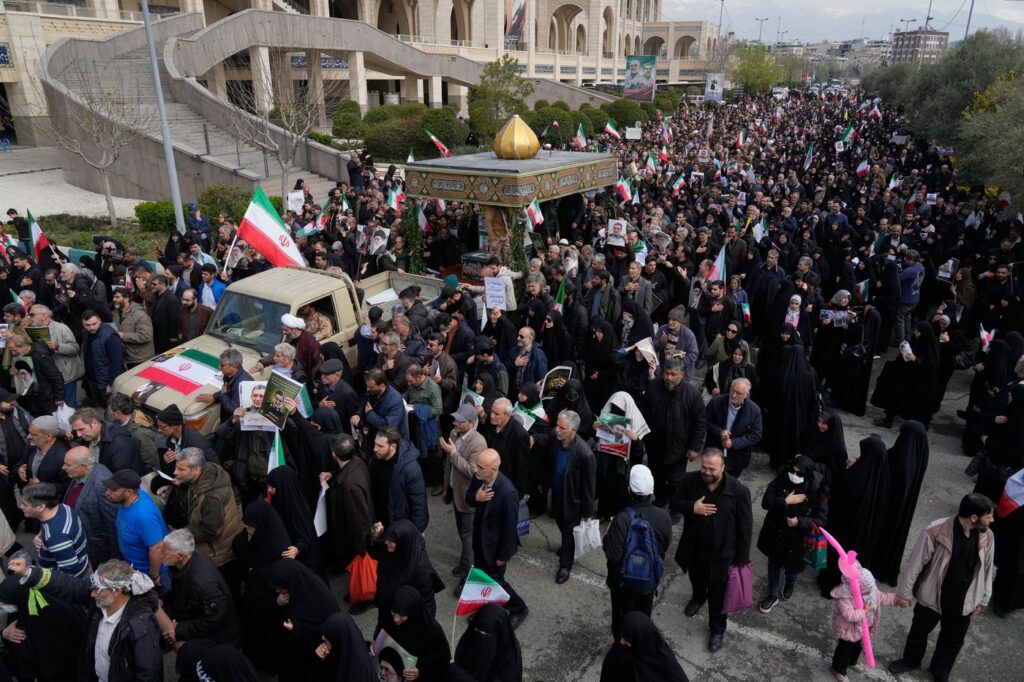
DUBAI, United Arab Emirates (AP) – As U.S. President Donald Trump's deadline for reopening the critical Strait of Hormuz approaches, Iran has issued a menacing statement threatening to strike Middle Eastern electrical plants that power American military bases. This warning came from the Iranian Revolutionary Guard Corps, which holds significant power in the country and indicates Iran’s increasing aggression in response to ongoing tensions with the United States.
The warning, broadcast by Iranian state television on Monday morning, provided details on Iran’s retaliatory possibilities. The statement emphasized that Iran would target the power plants of what it referred to as the "occupying regime," specifically addressing Israel, alongside the power facilities of regional nations that supply electricity to U.S. military installations in the area. Additionally, it highlighted a broader strategy to attack economic, industrial, and energy infrastructures that involve American investments.
In an unequivocal tone, the statement declared, "Do not doubt that we will do this," portraying Iran’s seriousness in its commitment to retaliate if its power infrastructure is attacked. This sharp increase in rhetoric serves as a clear signal of Iran’s intent to challenge U.S. interests in the region, particularly as the U.S. remains vigilant in monitoring Iran's military activities.
The backdrop of these hostile exchanges involves President Trump issuing a threat of his own. On Sunday morning, he warned that the United States would target Iranian power plants within 48 hours if Iran continues to obstruct shipping lanes through the Strait of Hormuz. This strait is a vital corridor for oil transport, and any disruption could have significant implications for global oil markets and regional stability.
The situation remains precarious, as both nations appear to be at a critical juncture that could escalate into military confrontations. The Strait of Hormuz is not just a geographical landmark, but a significant strategic point where one-fifth of the world’s oil supply passes. Control and security in this area are paramount to global energy security and economic stability.
In recent days, tensions have significantly heighted following a series of confrontations between Iranian forces and Gulf Arab nations, further complicating an already fraught geopolitical landscape. The warning issued by the Revolutionary Guard, coupled with the U.S. administration’s response, reflects the precarious balance of power in the Middle East. With both sides armed with threats and counter-threats, the potential for conflict looms large, posing risks not only to local but also international security.
The two nations’ ongoing hostilities echo the historical grievances that have characterized U.S.-Iran relations, marked by incidents ranging from nuclear negotiations to military engagements. As the crisis unfolds, global stakeholders, including allies in the region, watch closely to anticipate the implications of these escalating threats on wider geopolitical dynamics.
In conclusion, the stakes in this diplomatic standoff are alarmingly high, and both the U.S. and Iran must weigh their military posturing against the potential repercussions of further destabilization in the region.








