

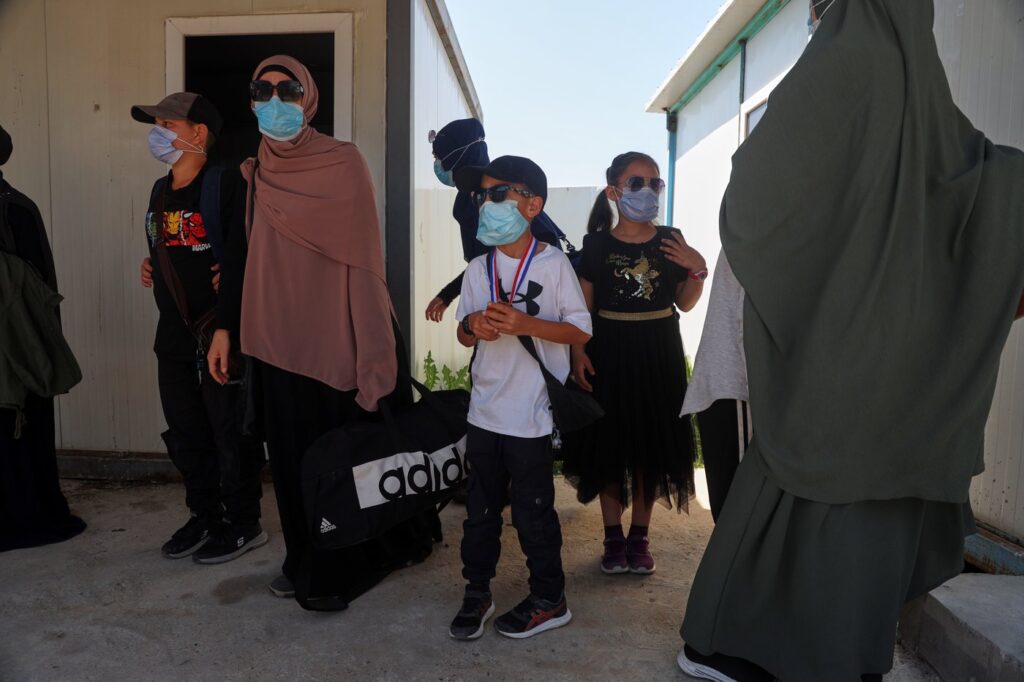
MELBOURNE, Australia (AP) — Australian authorities have announced that several women with alleged links to Islamic State militants will face criminal investigations and potential arrests upon their return from Syria. The information was disclosed by Home Affairs Minister Tony Burke, who stated that four women and nine children have made flight reservations from Damascus back to Australia, though no specific arrival date has been provided.
The Australian Federal Police (AFP) have been investigating the activities of Australians who traveled to the Islamic State’s so-called caliphate in Syria since 2015. According to Police Commissioner Krissy Barrett, these investigations include examining potential terrorism offenses and crimes against humanity, such as slave trading. Barrett indicated that while some individuals would be arrested and charged, others might be subject to ongoing investigations once they return to Australia.
The children accompanying the women will be enrolled in programs aimed at countering violent extremism, as stated by Barrett. While the Australian government is required to issue travel documents for the group, officials have emphasized that they are not aiding in the repatriation process. Minister Burke expressed the government’s firm stance: “There is a reason why the government has drawn a very hard line saying we will do nothing to assist.” He underscored that the lack of support is a reflection of the individuals’ choices to align themselves with a "horrific terrorist organization."
Currently, the women are held at Roj Camp, situated near Syria’s border with Iraq. They vacated the camp last week; however, the Syrian government informed the Associated Press that Australia had refused to accept them. Minister Burke acknowledged the limitations on the government’s capacity to block their return, stating, “There are very serious limits on what can be done with respect to preventing a citizen of a country returning to their country.”
A previous attempt in February to repatriate 34 women and children from the same camp was thwarted when Syrian authorities denied their return. During that instance, the Australian government issued a temporary exclusion order to prevent one woman from coming back, a measure created to bar high-risk citizens from returning for up to two years, following laws enacted in 2019 aimed at curbing the return of former Islamic State fighters.
The temporary exclusion orders cannot be applied to children under the age of 14, and the Australian government has ruled out the separation of children from their mothers. Minister Burke confirmed that the previous exclusion order banning the unidentified woman’s return remains intact. Under Australian law, traveling to Raqqa, the former stronghold of the Islamic State, without a legitimate reason was punishable by up to 10 years in prison from 2014 to 2017.
In the aftermath of the defeat of the Islamic State in 2019, former fighters from various countries, including their families, have been detained in camps and facilities in northeastern Syria. Although the Islamic State has lost significant territory, remnants of the group continue to pose a threat through attacks in both Syria and Iraq. The larger al-Hol camp has since been closed, with thousands of suspected Islamic State militants having been transferred by U.S. military forces to Iraq for trials.
Amid ongoing conflict between government forces and the Syrian Democratic Forces (SDF), many detainees have fled al-Hol, with additional escapees reported from detention centers. Australia's government has conducted repatriation efforts for Australian women and children from Syrian camps on two prior occasions, while some Australians have returned unassisted by the government.








