

COLUMBIA, S.C. (AP) — An election-year redistricting movement is underway in South Carolina as Republicans aim to redraw majority-Black congressional districts in response to a recent U.S. Supreme Court ruling that challenges protections for minority voters. Responding to encouragement from former President Donald Trump, South Carolina Republicans are set on redistricting a district traditionally held by Black Democratic lawmaker Jim Clyburn, in hopes of achieving a clean sweep of the state’s seven congressional seats.
Meanwhile, special sessions are already in progress in Alabama and Tennessee, where lawmakers are evaluating changes to their U.S. House districts. In Louisiana, following the Supreme Court's recent decision to invalidate the existing congressional map, lawmakers are also considering new district layouts. The ruling indicates that Louisiana's former map relied too much on race in creating a second majority-Black district, reshaping the decades-long interpretation of the Voting Rights Act and giving Republican lawmakers the opportunity to target majority-Black districts that typically elect Democrats.
This legal pivot has accelerated a broader national redistricting conflict ahead of the November midterm elections, which are crucial for determining control of the narrowly divided House of Representatives. Since Trump urged Texas to redraw its congressional districts last year, eight states have adopted new maps. Republicans anticipate potentially gaining up to 13 House seats, while Democrats foresee up to 10 gains. However, some newly formed districts are expected to be competitive, which could hinder their plans.
In South Carolina, Congressman Jim Clyburn has represented the 6th Congressional District since it was redesigned to benefit minority voters in 1992. As he seeks an 18th term, he faces increased challenges if Republicans move to redraw his district. State House and Senate leaders indicated that any successful redistricting effort would necessitate a two-thirds majority vote in both chambers. A decision could come as early as Wednesday, but the absence of support from just a few Republicans could thwart the initiative.
Senate Majority Leader Shane Massey expressed concerns that redistricting might inadvertently backfire due to the slim political margins, potentially resulting in the election of an additional Democrat in the House. Massey reported he had a constructive dialogue with Trump about the redistricting plans, each sharing their views on the subject. With the state’s primaries scheduled for June 9, early voting is set to commence in three weeks.
In Alabama, the House plans to deliberate on legislation that would allow for a special congressional primary if the Supreme Court permits changes to their congressional districts. Following the ruling regarding Louisiana, Alabama has asked courts to allow a revised U.S. House map without two districts that hold significant Black voter populations. Instead, Republicans seek to implement a map passed in 2023 that could help the GOP win at least one of those districts currently held by Democrats.
Alabama's primaries are slated for May 19. Should the Supreme Court approve the state's request close to the primary date, the new legislation would disregard the results of the initial primary and direct the governor to establish a new primary based on the altered district map. Critics, including Democrats, have condemned this legislation as a power grab reminiscent of Alabama's historical oppression of Black citizens and their rights.
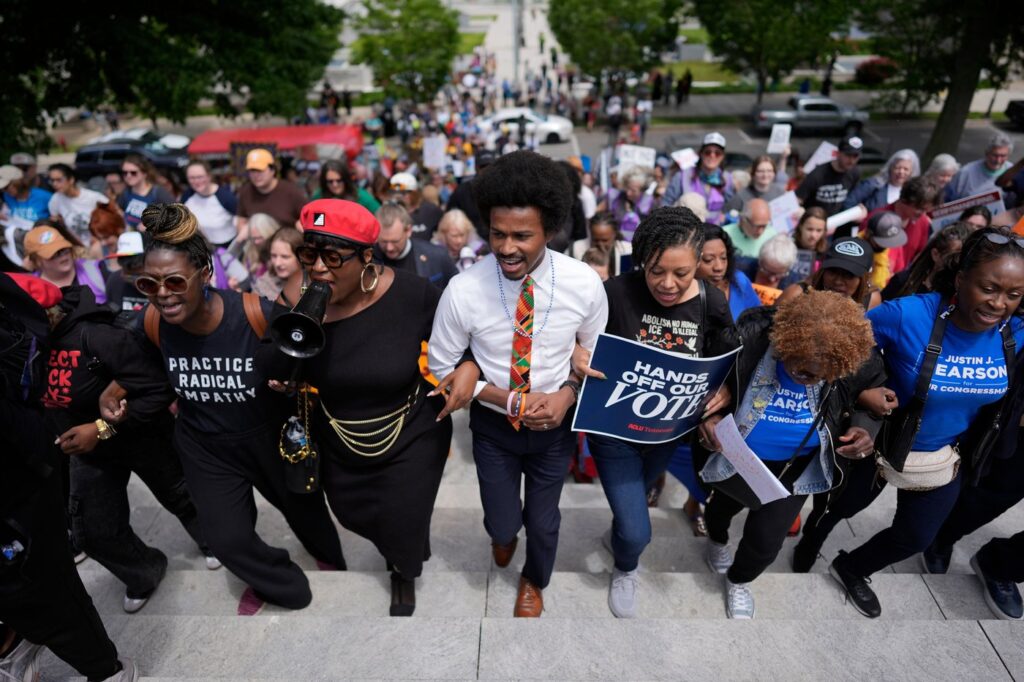
In Tennessee, Republican Governor Bill Lee has summoned lawmakers for a special session to consider a redistricting plan favored by Trump, which could dismantle the lone Democratic-held House district that includes Memphis. The details of the plan remain sparse, but there have already been protests against the proposed changes, with demonstrators voicing their opposition outside the Senate chamber. Black Democratic Senator Raumesh Akbari strongly criticized the redistricting plan, labeling it an "act of hate." Additionally, Martin Luther King III has expressed profound concern over the potential division of Memphis, invoking the legacy of his father regarding voting rights.
In Louisiana, Governor Mike Landry has postponed the state’s May 16 congressional primary to afford lawmakers the time needed to devise new district maps. The suspension comes as voters had already cast over 41,000 absentee ballots before the governor's announcement, highlighting the urgency of the situation. With approximately one third of the absentee ballots returned from registered Democrats and Republicans, tensions are escalating as both civil rights groups and Democrats challenge the decision to halt the primary process.
As the situation unfolds across these states, the redistricting initiatives are becoming a focal point for political strategy and voter representation, reflecting the complexities of American electoral politics.








