

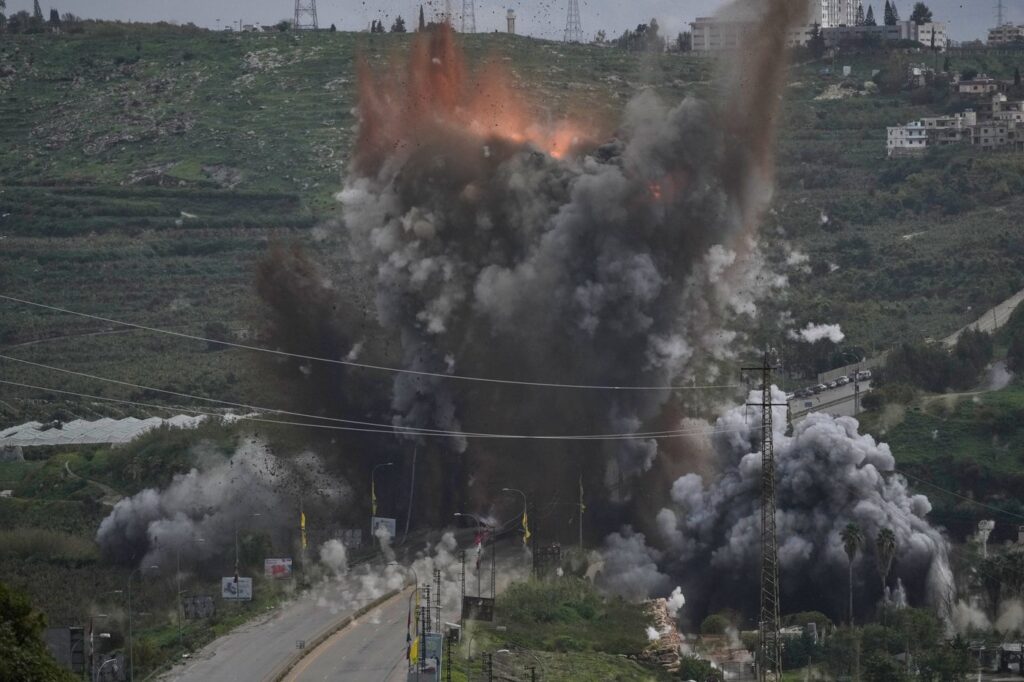
The top commander of the U.S. military's Central Command, U.S. Navy Adm. Brad Cooper, stated that the ongoing campaign against Iran is either "ahead or on plan." This remark came as the Israeli military initiated what it labeled as "a wide-scale wave of strikes targeting the Iranian terror regime infrastructure" early on Monday. In his first one-on-one interview regarding the conflict, Cooper spoke to the Farsi-language satellite network Iran International, with the broadcast airing on the same day. Iranian media reported on new airstrikes directed at Tehran, though specific locations were not disclosed.
On the preceding day, Tehran issued a warning that it could retaliate against U.S. and Israeli energy and infrastructure assets in light of President Donald Trump's threats to "obliterate" Iran's power plants unless the country complies with opening the Strait of Hormuz. Trump, under growing pressure domestically to secure the vital shipping route as oil prices surged, made this ultimatum via a social media post while spending the weekend at his Florida residence.
The escalating conflict has resulted in significant casualties, with reports indicating that more than 1,500 people have died in Iran, over 1,000 in Lebanon, 15 in Israel, and 13 U.S. military personnel. Civilians affected by the violence in the Gulf region further exacerbate the crisis, with millions displaced in Lebanon and Iran.
In a further commentary, President Trump emphasized his "peace through strength" slogan by posting on his Truth Social website on Monday morning: "PEACE THROUGH STRENGTH, TO PUT IT MILDLY!!!" This proclamation aligns with the wider strategies employed by the administration during the conflict.
Adm. Brad Cooper described Iran's recent actions as "operating in a sign of desperation," especially in targeting civilian sites amidst the war. In the interview with Iran International, he noted that Iran has conducted over 300 intentional attacks on civilian locations within recent weeks. He highlighted the decrease in Iranian missile and drone launches across the Middle East, indicating a shift from previously numerous strikes to isolated incidents. Cooper remarked, "At the beginning of the conflict, you saw large volumes in the dozens of drones and missiles. You no longer see that. It’s all one or two at a time."
Adm. Cooper affirmed that the U.S. military campaign against Iran is indeed progressing as planned, emphasizing the importance of targeting Iranian missile and drone manufacturing capabilities to mitigate potential future threats. "We're also going after the manufacturing," he stated, underscoring the dual strategy of countering current threats while aiming to eliminate future risks posed by Iranian military advancements.
Despite the ongoing conflict, Cooper advised the Iranian public to remain cautious and not take to the streets, even as speculation arises that U.S. and Israeli objectives may involve a hope for an uprising against the Iranian regime. He cautioned that civilians need to stay indoors as strikes continue in populated areas, indicating that a "clear signal" will eventually be communicated for them to safely come out.
The violence continues with reports of live fire incidents. An Indian national living in the UAE sustained injuries due to debris from a missile intercepted over an industrial area near Al Dhafra Air Base in Abu Dhabi. The Saudi Defense Ministry confirmed that a ballistic missile targeting Riyadh was intercepted, while another struck an "uninhabited area." Additionally, the UAE reported its air defenses were actively intercepting incoming missiles from Iran. Bahrain and Kuwait also activated missile alerts, though there is no immediate report of damages from these attacks.








