

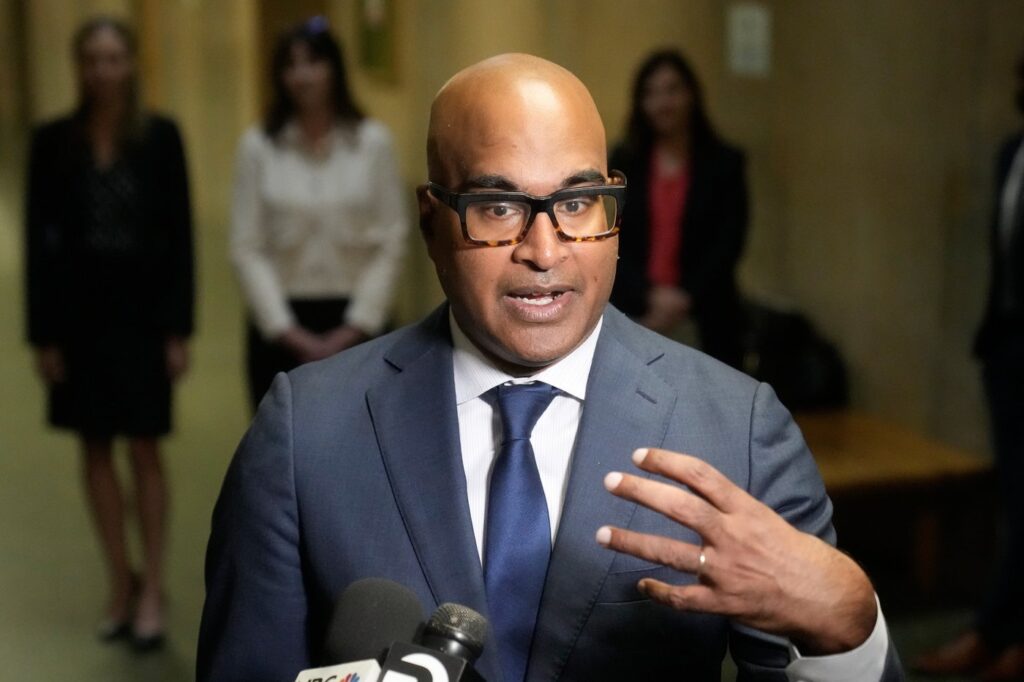
SAN FRANCISCO - A judge has imposed a $26,000 fine on San Francisco's Public Defender, Mano Raju, for failing to comply with a January order to stop rejecting cases. This ongoing situation is causing significant strain on the city’s justice system, with critics highlighting the implications for defendants and overall legal representation.
Mano Raju, who has been the Public Defender since May, began declining to represent certain defendants in new felony and misdemeanor cases, citing an overwhelming workload exacerbated by increased prosecutions and insufficient staffing. He advocates for additional funding for attorneys or requests the court to dismiss some of the cases brought forward by District Attorney Brooke Jenkins.
“Every member of my team could cut their workload in half, and they would still have more than a full-time job,” Raju stated to The Associated Press.
In January, San Francisco Superior Court Judge Harry Dorfman mandated Raju to cease declining cases. In March, after Raju continued to reject cases, Dorfman found him in contempt and fined him $1,000 for each of the 26 cases he refused since the ruling. A subsequent hearing is scheduled for April, during which additional fines may be imposed. Raju has expressed his intention to appeal this decision while maintaining his stance on rejecting certain new cases.
Supporters, including public defenders and staff from across California, filled the courtroom in solidarity with Raju. He emphasized that the excessive workload adversely affects the quality of legal representation provided to defendants, which constitutes a human rights violation and leads to detrimental impacts on his staff.
“People and their families get hurt when we can’t provide the representation we should, and our staff suffers the residual trauma,” Raju asserted. This ongoing conflict places Raju, who is a progressive figure and California's only elected public defender, in direct opposition to Jenkins. She has accused him of disrupting the justice system, suggesting his actions might lead to violent defendants leaving custody due to a lack of legal representation.
The shortage of public defenders has been an ongoing issue in various states, with courts from Oregon to Massachusetts grappling with a lack of timely legal representation for defendants. However, the current dispute among Raju, Jenkins, and Judge Dorfman is particularly contentious and politically charged.
This contention arises in the context of a broader public safety debate in San Francisco. Mayor Daniel Lurie, elected in 2024 to revitalize the city's image following years of negative press, has vowed to improve city safety. His election followed voter discontent that led to the recall of former prosecutor Chesa Boudin due to perceptions of leniency towards street crime. Jenkins, who succeeded Boudin, has since ramped up prosecutions, filing approximately 8,000 felony and misdemeanor cases in 2022 compared to roughly 5,600 in 2021.
Experts, such as Jason McDaniel, a political science professor at San Francisco State University, argue that Raju’s disruptive strategies are tactics to leverage resources rather than a genuine dispute over public safety policies. This situation becomes particularly significant as Lurie faces a $400 million budget deficit.
Despite San Francisco experiencing relatively low rates of violent crime, drug-related offenses and petty thefts remain prevalent, prompting Jenkins to assert that prosecution rates are returning to pre-pandemic norms. Raju contends that the increase in low-level crime prosecutions, alongside a growing volume of digital and video evidence, creates an unsustainable workload for his office. He accused Jenkins of exacerbating court congestion and noted that his attorneys are enduring long hours, skipping vacations, and suffering from health issues as a result.
According to a 2023 RAND Corporation study on public defender workload, excessive burdens violate ethical standards and harm defendants. Currently, Raju’s attorneys handle an average of 60 felony cases and 135 misdemeanor cases at a time, well above the recommended limits of up to 40 felony and 80 misdemeanor cases outlined in a 2025 study.
Judge Dorfman, however, found that Raju's office has sufficient staffing to manage the workload and suggested that supervising public defenders could take on additional cases. He also noted that the practice of assigning two attorneys to certain felony cases could be reconsidered. While he acknowledged the studies referenced by Raju, he stated they do not constitute California law. In his remarks, Dorfman emphasized that the court is compelled to appoint public defenders when needed, maintaining that the judicial system must not be passive in these matters.








