

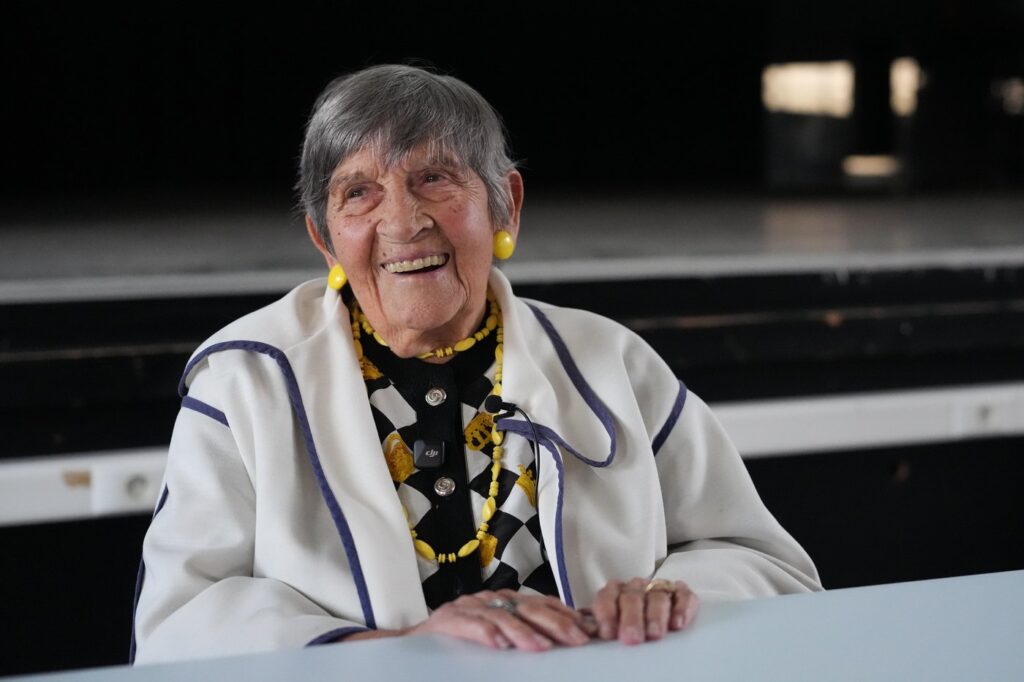
SAINT-MAUR-DES-FOSSÉS, France (AP) — Ginette Kolinka, a 101-year-old survivor of Auschwitz-Birkenau, has emerged as a prominent voice against antisemitism in France. Having lived a remarkable life, she now emphasizes the importance of sharing her harrowing experiences to ensure that the horrors of the Holocaust are not forgotten. Kolinka recalls developing a tough response to those who questioned her about her past: “If I had a child, well, I would prefer to strangle them with my own hands than make them go through what I went through.” This assertion encapsulates the depth of her trauma and the horrors faced at the Nazi death camp.
Kolinka credits filmmaker Steven Spielberg as a catalyst who inspired her to begin sharing her story three decades ago. Following the release of "Schindler's List" in 1993, Spielberg founded an organization dedicated to collecting testimonies from Holocaust survivors. Though initially hesitant to participate, Kolinka's emotions poured out during a nearly three-hour interview in 1997. She reflects on this experience in her memoir, "Return to Birkenau," noting that it forced her to confront memories she had buried for decades.
During World War II, the Nazi regime deported approximately 76,000 Jewish individuals from France, primarily to Auschwitz-Birkenau, with only around 2,500 surviving the ordeal. It wasn't until 1995 that France officially acknowledged its complicity in the Holocaust under then-President Jacques Chirac, marking an indelible stain on the nation. Through her writings, interviews, and school visits, Kolinka has become the most prominent remaining French survivor of Auschwitz-Birkenau. According to the Paris-based Union of Auschwitz Deportees, only a few dozen survivors remain today, possibly fewer than 30.
Recently, Kolinka visited the Marcelin Berthelot high school in Saint-Maur-des-Fossés to share her story. Even in a condensed 90-minute presentation, the weight of her experiences was palpable. She recounted her arrest in March 1944 and the agonizing journey to Auschwitz-Birkenau. Kolinka described the traumatic environment upon arrival: Jewish people crammed into animal transport wagons with no windows, and faced with hostility from Nazi guards at the camp. The first German word she learned, she recalled, was “Schnell!” — meaning “Move it!”
The students listened in silence as she detailed the abuse and humiliation they faced upon their arrival, including forced undress and the relentless stripping away of their dignity. Kolinka displayed the tattooed identification number 78599 on her forearm, pointing out, "Some people’s numbers cover their entire arm. But I have a nice little number." With a focus on survival, she recalled how she learned to shut off her emotions, referring to herself as a metaphorical “robot” during these horrific experiences.
After her talk, Kolinka received an enthusiastic response from the students, who were clearly moved and eager to engage further. Among them, Nour Benguella, 17, and Saratou Soumahoro, 19, described her as “extraordinary.” They expressed admiration for her resilience and commitment to ensuring that this vital history is not lost. Benguella stated, “Keeping this history alive is the only thing that will permit us to not make the same mistakes.” Kolinka’s dedication serves as an essential reminder of the responsibility to remember and educate future generations about the atrocities of the Holocaust.








