

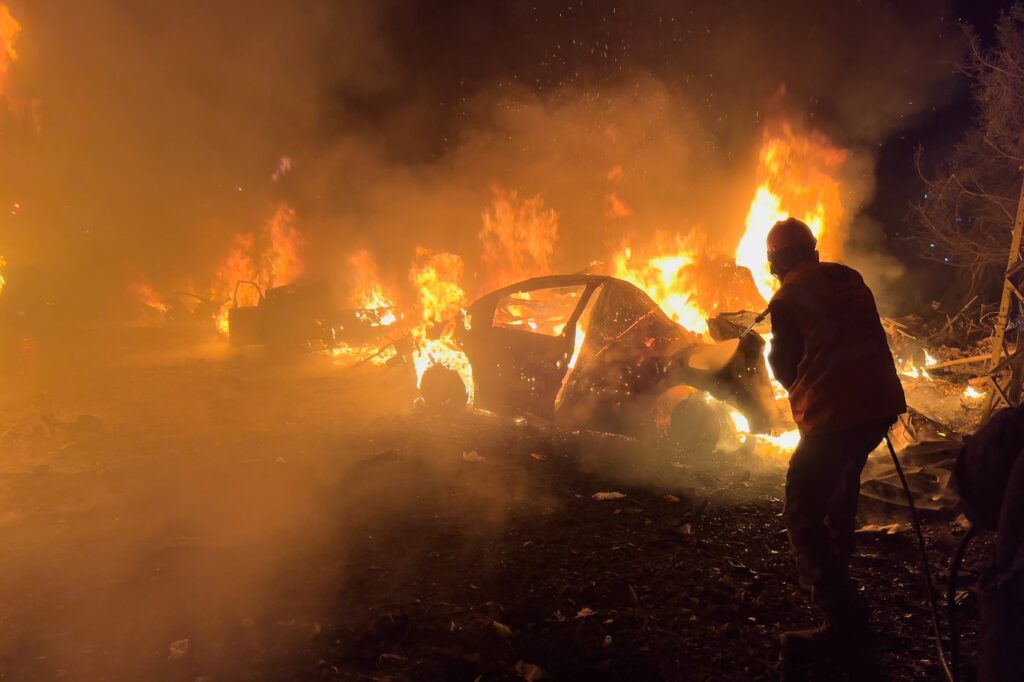
President Donald Trump stated that U.S. forces will intensify their assaults on Iran over the next two to three weeks, suggesting that the objective is to revert the nation "back to the Stone Ages." Despite emphasizing the success of ongoing U.S. military operations, he did not elaborate on any potential negotiations or diplomatic efforts involving Iran. His remarks come in the wake of an April 6 deadline he imposed for Iran to reopen the Strait of Hormuz, which is vital for global oil and gas transportation.
Trump’s comments did not indicate any plans to send U.S. ground troops into Iran or to bolster NATO assistance in securing the critical waterway. In the financial markets, oil prices experienced a significant increase following his address, with Brent crude, the international standard, rising by 4.9% to $106.16 per barrel, and benchmark U.S. crude climbing 4% to $104.15 a barrel. The surge in oil prices has also contributed to U.S. gas prices surpassing an average of $4 per gallon for the first time since 2022, subsequently pushing fuel costs higher worldwide.
According to analysts, the escalating energy prices could have broader implications, impacting grocery prices as transportation and packaging costs rise. Furthermore, the ongoing turmoil caused by the conflict is causing notable economic strain, particularly in areas reliant on energy exports. A New York-based think tank, the Soufan Center, criticized Trump for potentially abandoned the Strait of Hormuz, leaving Gulf Arab allies "in the lurch." It argued that Trump’s remarks signaled a belief that the U.S. can sustain its own economic needs while other nations will have to either secure the Strait themselves or depend on U.S. exports.
In response to Trump’s address, which many Democrats labeled “incoherent,” there has been sharp criticism regarding his failure to provide clear answers about the conflict and its ramifications on the American public. Senator Mark Warner, D-Va., highlighted that Americans deserve more information regarding the Iran conflict as rising fuel prices continue to propagate increased costs for essential goods. Senator Chris Murphy, D-Conn., remarked that the address did not clarify whether the U.S. was escalating or de-escalating its military actions.
Market reactions included a drop in Asian stocks following Trump's remarks. The Nikkei 225 index in Tokyo fell by 1.4%, South Korea's Kospi decreased by 3.4%, and Hong Kong's Hang Seng experienced a decline of 0.8%. U.S. futures also dropped by more than 0.7%. The rise in oil prices was attributed to Trump's declarations about escalating military engagements against Iran and the assertion that the U.S. would "finish the job" in the region, hinting that military operations could conclude relatively soon.
The geopolitical and economic ramifications of these events continue to unfold, with the situation remaining fluid and the potential for further escalation in the region. The U.S. government's stance on both military and diplomatic fronts remains pivotal as global markets react to Trump's strategies and statements.








