

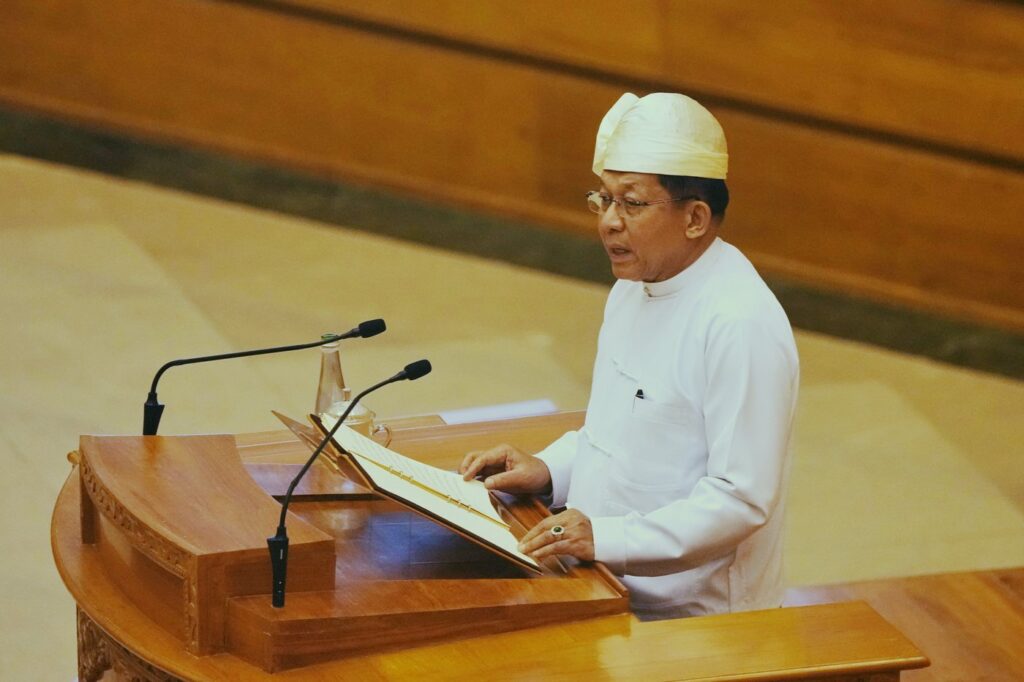
BANGKOK (AP) - Min Aung Hlaing, previously Myanmar's military commander who seized power from Aung San Suu Kyi's civilian government in 2021, was sworn in as the elected president on Friday. His inauguration followed a controversial general election deemed by U.N. experts and human rights organizations as neither free nor fair, with Suu Kyi's National League for Democracy (NLD) party among many who boycotted the process.
Min Aung Hlaing will face significant challenges, including the ongoing civil war that erupted after Suu Kyi's ouster, marked by armed resistance against the military. The transition to what is described as a nominally democratic government is perceived as an attempt to maintain military control while presenting an appearance of civilian rule. His rise to the presidency aligns with a historical pattern in Myanmar, where military leaders establish themselves at the helm through manipulated electoral processes.
His term, lasting five years, follows the parliamentary elections held on April 3. Notably, twenty-eight of the thirty new cabinet members sworn in alongside him have ties to the military, either as current or former generals, or as lawmakers from the military-backed Union Solidarity and Development Party (USDP). This pro-military faction occupies nearly 90% of the seats in Myanmar's two-chamber legislature.
In his inaugural speech, Min Aung Hlaing claimed, "Myanmar is back on the path to democracy and moving toward a better future." He also promised to pursue peace with ethnic rebels and restore normal relations with the Association of Southeast Asian Nations (ASEAN), which has expressed concerns regarding Myanmar's political instability.
The recent elections held in December and January sparked widespread criticism, particularly because significant areas of the country were excluded from voting due to the ongoing civil conflict. Reports indicated that the elections were held in only 42% of Myanmar's territory, under a restrictive framework designed to advantage the military-aligned USDP. A report by the Asian Network for Free Elections described the electoral management and system design as engineered for a predetermined outcome.
Previously holding the title of commander-in-chief, Min Aung Hlaing relinquished this military position last week in compliance with constitutional requirements that prevent the president from holding both roles concurrently. His close aide, Gen. Ye Win Oo, has since assumed the critical military command.
Min Aung Hlaing's history is also marked by his role in the Rohingya crisis; he oversaw a brutal counterinsurgency campaign in 2017 against the Rohingya Muslim minority, resulting in the exodus of hundreds of thousands to Bangladesh. This campaign faced severe international condemnation, with allegations of complicity in genocide against the army.
Since the military coup in 2021, reports indicate that nearly 8,000 civilians have been killed, and approximately 22,208 political detainees remain incarcerated, according to the Assistance Association for Political Prisoners, an organization that monitors human rights. The total death toll from the current conflict is believed to be significantly higher.
Aung San Suu Kyi, Myanmar's 80-year-old former leader, is currently serving a 27-year prison sentence on charges that many view as politically motivated and fabricated. Her party, which previously secured sweeping victories in the 2015 and 2020 elections, was compelled to dissolve in 2023 after refusing to comply with new military regulations.








