

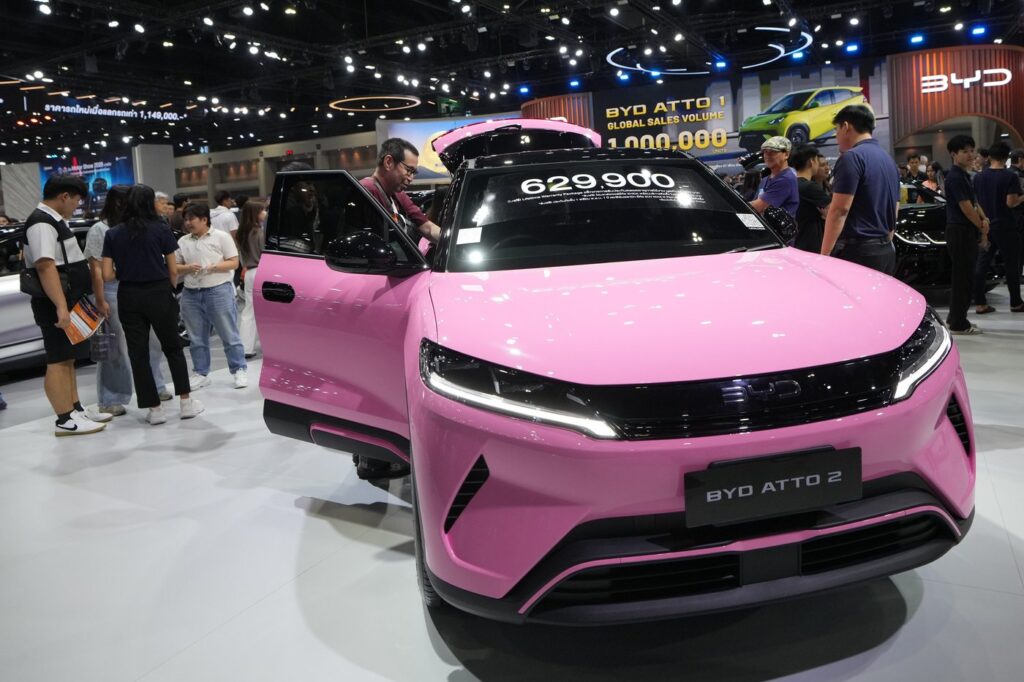
The China Association of Automobile Manufacturers reported significant growth in China's exports of passenger cars in March, with an impressive year-on-year increase of 82.4%. Approximately 748,000 vehicles were exported, a rise from the 586,000 cars exported in February. This surge reflects the accelerating efforts of Chinese automakers to expand their presence in international markets.
Exports of new energy passenger vehicles, which encompass battery electric vehicles and plug-in hybrids, experienced remarkable growth, soaring over 140% compared to the previous year, totaling 363,000 units in March. This was also a 31% increase from about 276,000 units exported in February. Major Chinese automakers such as BYD and Geely Auto are significantly ramping up their overseas sales efforts, including expanding production facilities beyond China’s borders.
The current global energy crisis, exacerbated by the ongoing conflict in Iran and heightened fuel prices, may influence consumer behaviors towards electric vehicles (EVs). Chris Liu, a Shanghai-based senior analyst at advisory group Omdia, noted that while the impacts of the Iran conflict had not yet fully materialized in March's data, it could act as a catalyst for change. He remarked that despite many markets being structurally favorable for EV adoption, consumer urgency has lagged, but increasing fuel prices may alter that dynamic.
Interestingly, Chinese car brands are making headway in diverse regions, including Europe, Latin America, and Southeast Asia. The push for exports comes at a time when domestic vehicle sales in China are facing challenges due to reduced government support aimed at encouraging new energy vehicle adoption this year. Additionally, stiff competition among car brands and a sluggish property sector have negatively impacted consumer sentiment regarding large purchases.
Domestic passenger car sales in China saw a significant decline of 19.2% last month, reaching nearly 1.7 million units. This marks the fifth consecutive month of year-on-year declines in domestic sales, according to the China Association of Automobile Manufacturers. In response to these downturns in the domestic market, UBS auto analyst Paul Gong expressed optimism, suggesting that the weak trend in domestic sales is unlikely to persist. He believes that the swell in overseas sales could compensate for diminishing demand at home.
Gong, who leads China autos research at UBS, estimates that the growth in overseas sales could surpass 20% this year compared to last year. He posits that the expansion in international markets is substantial enough to offset the decline observed in the domestic market over the course of the year.
Overall, the landscape for Chinese automakers appears to be shifting as they aggressively seek to capitalize on the growing global demand for electric vehicles while navigating the challenges present within the domestic market.








