

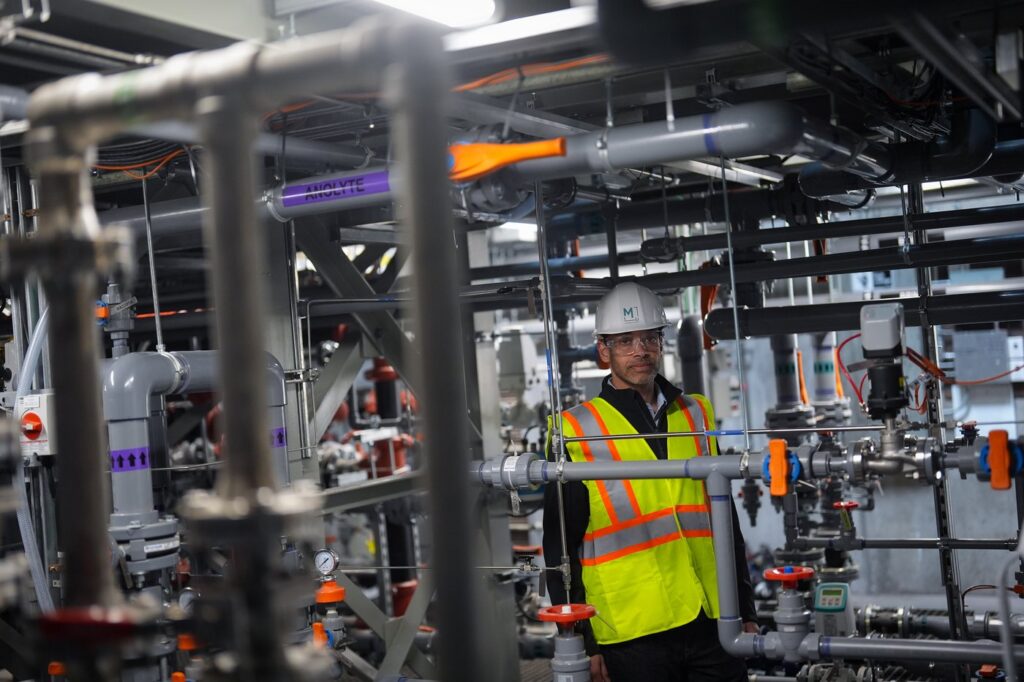
Mangrove Lithium has opened North America's first electrochemical lithium refining facility in Delta, B.C., a location surrounded by industrial buildings related to plumbing supplies and fitness equipment. This facility represents Canada's efforts to reduce its dependency on China, which dominates the lithium refining market. CEO Saad Dara humorously referred to the facility as a "clown building," emphasizing its expansive layout amid the din of machinery.
The official ribbon-cutting ceremony marked a significant milestone for the company, which originated from Dara's individual thesis project in 2013. He transformed this academic endeavor into a startup in 2018, with the aim of commercializing innovative technology in lithium refining. Currently employing around 75 individuals, the company anticipates producing its first natural-grade lithium materials over the summer and into the fall. Dara expressed optimism about reaching a fully operational status for their cutting-edge facility.
This development coincides with global concerns over securing supply chains for critical minerals like lithium, copper, and nickel, which are essential for electrification and defense. The Canadian federal government has classified lithium as a critical mineral due to its crucial role in battery manufacturing amid the renewable energy transition. Despite Canada possessing lithium mines in Manitoba and Quebec, about 75% of global lithium extraction occurs in South America and Australia, while China currently refines roughly 75% of this resource, including that sourced from Canada.
Dara explained that the lithium market encompasses six segments: mining, refining, active materials, battery assembly, electric vehicle (EV) assembly, and recycling. China controls all segments, having significantly invested over the past 15 years. While Canada is making strides in lithium production, it currently lacks infrastructure for EV assembly, active materials, and recycling. However, the establishment of Mangrove's facility marks a pivotal step toward developing a complete lithium supply chain within Canada.
Geoff McCarney, an associate professor at the University of Ottawa, highlighted the challenge of China's market dominance in critical mineral production, particularly lithium. He pointed out that China's control over refining capacity creates potential supply bottlenecks. The vulnerability of countries relying on China for refining was exemplified by a previous threat from China to impose export controls in response to U.S. trade tensions.
The opening of Mangrove's facility is seen as a substantial advancement toward enhancing Canada's resiliency in the lithium supply chain. It indicates progress in the availability of technologies and investments necessary for a self-sufficient battery supply chain that is crucial for energy security. Currently, the largest segment of lithium utilization derives from the production of rechargeable batteries, which accounts for 87% of total demand, primarily for electronics and electric vehicles.
Mangrove's facility, as articulated by Dara, has the capacity to produce enough battery-grade lithium for approximately 25,000 electric vehicles annually. The company's electrochemical refining technology promises a more sustainable method of converting extracted lithium into battery-grade material, contrasting with the traditional practices that tend to generate significant waste byproducts.
The British Columbia government's jobs and economic growth ministry affirmed that the new facility positions the province as a leader in clean technology while diminishing reliance on overseas refining processes. The government provided $3 million to support Mangrove Lithium's operations. Associate Minister of National Defence Jill McKnight noted the facility represents a turning point for Canada's critical minerals value chain, fostering energy security and creating jobs in the province.
Additionally, Mangrove has announced plans for another facility in Eastern Canada, which aims to produce enough lithium to support 500,000 electric vehicles annually. McCarney emphasized that while these plants will enhance resilience against market volatility, they also raise questions about raw material sourcing and mining approvals. Concerns about responsible sourcing, especially in collaboration with Indigenous rights, remain paramount as Canada seeks to expand its lithium supply.








