

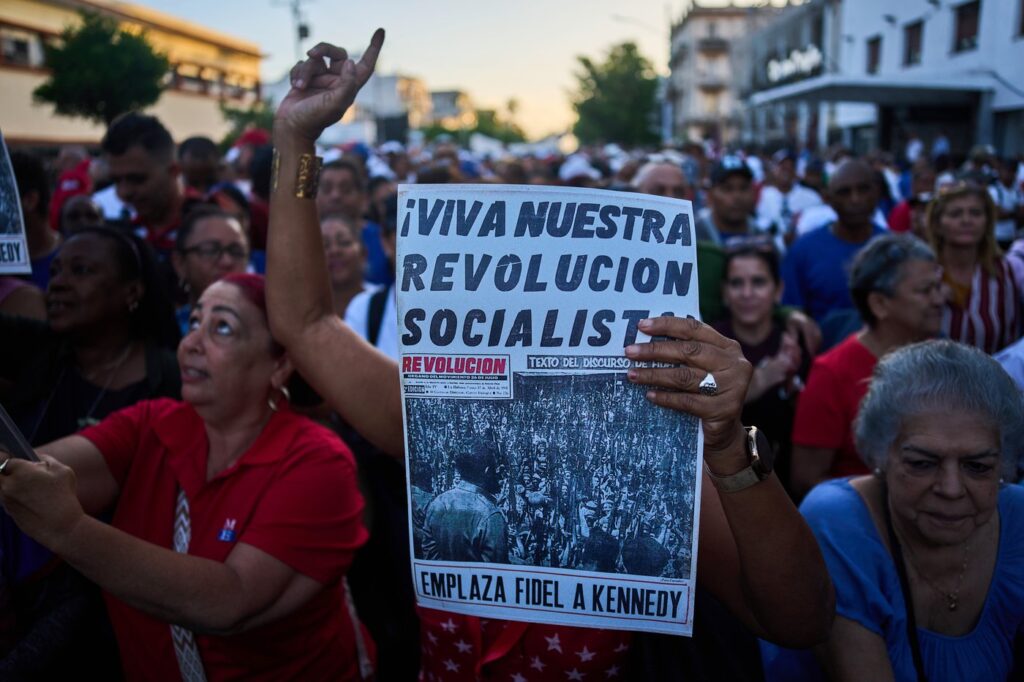
Havana recently witnessed a significant rally marking the 65th anniversary of the Cuban Revolution's declaration of socialism. Cuban President Miguel Díaz-Canel seized the occasion to address the tensions between Cuba and the United States, asserting that while Cuba does not seek military aggression, the country is prepared to defend itself if necessary. His remarks echoed a historic sentiment from April 16, 1961, a time when the nation faced serious threats.
Addressing a crowd of hundreds, Díaz-Canel emphasized, “The moment is extremely challenging and calls upon us once again to be ready to confront serious threats, including military aggression.” He articulated his country's stance, making it clear that while they do not desire conflict with the U.S., they have a duty to prepare for it and, if it becomes unavoidable, to overcome it.
The backdrop of Díaz-Canel's statements is characterized by soaring tensions between Cuba and the United States, exacerbated by the ongoing economic crises in Cuba, largely attributed to a stringent U.S. energy blockade. In a related development, former President Donald Trump had commented earlier in the week regarding potential U.S. focus on Cuba once the situation in Iran stabilizes, labeling Cuba as a “failing nation” and criticizing its long-standing governance.
Trump's administration had previously threatened military intervention in Cuba, mirroring actions taken in Venezuela earlier this year. He also indicated that tariffs could be imposed on countries supplying oil to Cuba, intensifying the already dire circumstances on the island. This rhetoric from Trump, along with remarks from U.S. Secretary of State Marco Rubio, has led to the description of Cuba's government as ineffective and abusive, prompting Díaz-Canel to counter these narratives vehemently.
Díaz-Canel stated, “Cuba is not a failed state. Cuba is a besieged state,” pointing out the multifaceted aggression faced by the country, which includes economic warfare and intensified blockades. He declared that Cuba, under socialism, continues to resist and innovate, pledging that the nation would prevail against these pressures.
Both countries have acknowledged the existence of talks aimed at alleviating the tensions, although specific details regarding these discussions remain undisclosed. During the rally, Díaz-Canel reflected on the social advancements attributed to the Cuban Revolution, such as free education that has cultivated numerous professional talents, although many have been compelled to emigrate amidst the ongoing crisis.
The energy embargo imposed by Trump has aggravated the severe economic conditions existing in Cuba for the past five years, worsened by the COVID-19 pandemic and tightened U.S. sanctions targeting Cuba’s political model. Experts have raised alarms regarding a potential humanitarian crisis, indicating that restrictions on oil supplies from Venezuela, Mexico, and Russia are leading to deteriorating living conditions, marked by prolonged blackouts and persistent fuel shortages.
The rally served not just as a commemoration of the Cuban Revolution's historical milestones but also as a reaffirmation of Cuba's sovereignty and its commitment to socialism in the face of adversity. Military readiness was pivotal in Díaz-Canel's address, reflecting the broader narrative that has defined Cuba's stance against what they perceive as U.S. imperialism and interventionism since the revolution. In summary, this event encapsulated Cuba's ongoing struggle and defiance against foreign pressures while celebrating its ideological legacy.








