

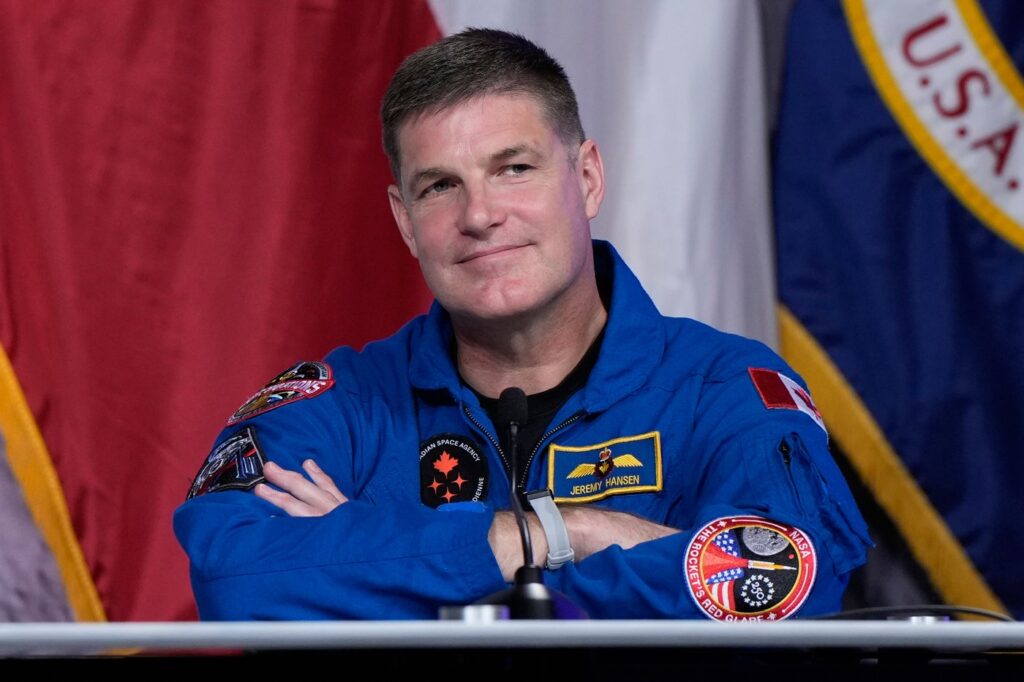
HOUSTON Canadian astronaut Jeremy Hansen described his extraordinary experience aboard the Orion capsule after its launch earlier this month. Upon floating to the window, he witnessed the spectacular view of the ocean, followed by the dusty red of Australia, all set against the vastness of space, with Earth’s atmosphere shimmering like a bubble of blue glass in the black void.
Reflecting on this unique perspective, Hansen shared his amazement with The Canadian Press at NASA's Johnson Space Center in Houston. The enormity of the experience is still settling in for Hansen and his Artemis II crewmates, who returned to Earth after a 10-day lunar fly-around, making history as the first humans to go to the moon in over 50 years.
The Artemis II crew, comprising commander Reid Wiseman, pilot Victor Glover, and mission specialists Hansen and Christina Koch, ventured farther from Earth's surface than anyone else before them. For Hansen, a 50-year-old from London, Ontario, this mission fulfilled a lifelong dream that began when he, like millions of children worldwide, craned his neck to the night sky.
Experiencing weightlessness in space, Hansen compared it to the flat images from planetariums he had anticipated. Instead, he found the view richly three-dimensional, with a palpable sense of boundless distances. He emphasized the unique human experience of seeing the moon and Earth closely together, noting how this mission marked a significant milestone for Canadian space exploration.
As the first non-American to travel beyond low Earth orbit and the first person to speak French en route to the moon, Hansen attributed Canada's longstanding investment in space technologies to the success of collaborations with NASA and other international partners within the Artemis project. Unlike the Apollo program, which ran from 1968 to 1972, Artemis aims for a more sustainable human presence on the moon and the eventual sending of astronauts to Mars.
Canada was the first nation to join the Artemis program, which utilizes the iconic Canadarm robotic manipulator system, a key tool for space missions since the early 1980s. Hansen highlighted that investing in these technologies not only advances space exploration but also addresses Earthly challenges. For instance, the robotics developed for space could enhance remote healthcare and improve food security in Canada’s northern regions, while innovations in energy production in space may influence technologies on Earth.
The Artemis mission also served a vital function of fostering global unity amidst geopolitical turmoil. Hansen noted that the crew's camaraderie and shared joy during their journey inspired people worldwide, an essential reminder that humanity needs to collaborate rather than divide. He commended NASA for leading this program, creating a platform for various nations to unite in achieving remarkable feats.
Hansen's background as a fighter pilot gave him a unique perspective, but he quickly realized that the thrust and acceleration of a rocket launch create a different, more intense sensation compared to flying a jet. He playfully remarked on how the powerful acceleration can make one "giggle" and emphasized the sheer fun of the experience.
Upon returning to Earth, Hansen celebrated not only the successful mission but also the chance to reunite with his wife Catherine for their 23rd wedding anniversary. He acknowledged the stress that space travel brings to families and expressed relief at returning safely to his wife and three children. Finally, after weeks of space cuisine, his crew eagerly anticipated indulging in a hamburger. The joy of that meal, he remarked, was nothing short of an "11 out of 10."








