

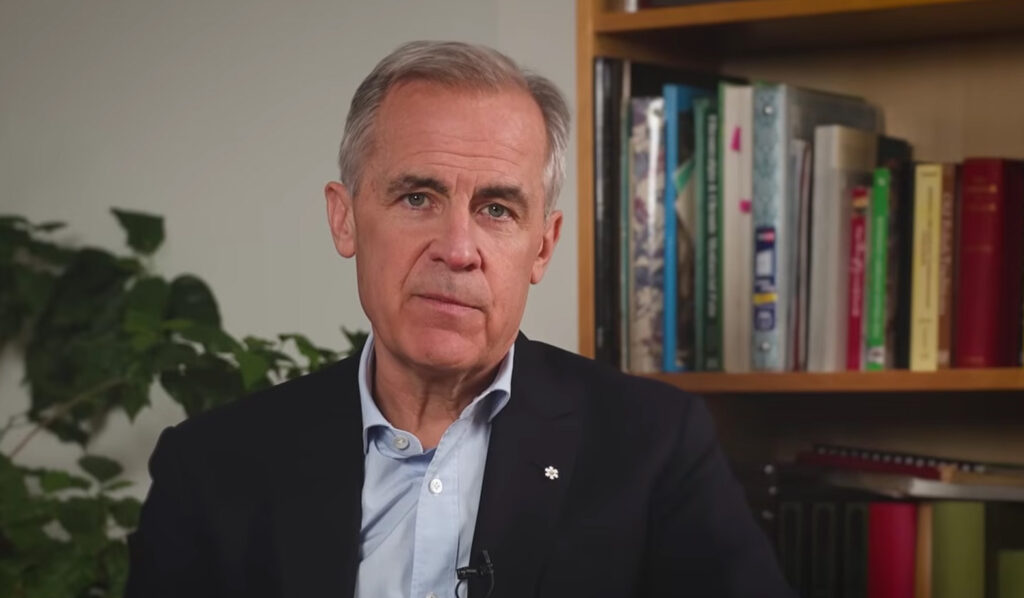
Prime Minister Mark Carney provided a candid evaluation of Canada's relationship with the United States during an address on social media on Sunday. He stated that what was once deemed a strength has now morphed into a vulnerability, emphasizing the urgency for Canada to reclaim control over its own future. Carney's address, titled "Forward Guidance with Prime Minister Mark Carney," highlighted the pervasive uncertainty stemming from U.S. policies and underscored that his government has a comprehensive plan to address these challenges.
In his remarks, Carney noted that the United States has drastically altered its trade policies, citing increased tariffs that have reached levels reminiscent of the Great Depression. He acknowledged that many of Canada's former advantages, due to its close ties with the U.S., have become current weaknesses. "We must correct these weaknesses," Carney stated, urging Canadians to take a proactive approach in safeguarding their economy. "We have to take care of ourselves because we can't rely on one foreign partner," he added, emphasizing the need to control domestic outcomes amidst external disruptions.
The Prime Minister articulated that the changing landscape of U.S. trade policies necessitates a strategic response from Canada. His government aims to attract new investments and develop partnerships to access alternative markets, showcasing impressive results with the signing of 20 new trade agreements across four continents in the past year. Recently, on Friday, Carney announced the upcoming "Canada Investment Summit" scheduled for this fall in Toronto, aimed at inviting investors, CEOs, and business leaders with a target of securing $1 trillion in investments over the next five years for nation-building initiatives.
During the address, Carney reiterated the importance of unifying Canada's economy, striving to create one economic framework out of its 13 provinces and territories, while also focusing on expanding energy corridors and doubling the country's clean energy capacity. He dismissed the notion of waiting for the U.S. to revert to a "normal" state of cooperation, stating explicitly, "Hope isn't a plan and nostalgia is not a strategy." This reflects a fundamental shift in the government's perspective on international relations and economic strategy.
Furthermore, Carney recognized that younger generations of Canadians have grown up during periods marked by instability, referencing critical events such as the U.S. invasion of Iraq in 2003, the 2008 financial crisis, and the COVID-19 pandemic. He drew inspiration from Canada's historical resilience, citing the opposition to American military actions during the War of 1812 and the leadership of Indigenous figures like Chief Tecumseh, showcasing Canada's capability to overcome adversity.
Closing his address, Carney noted that while the government’s plan is gaining traction, it will require time to fully materialize. He acknowledged potential setbacks, asserting the importance of unity and community in overcoming challenges. "We are not going to fix all our problems tomorrow, and there will be setbacks along the way," he stated, emphasizing that Canada’s strength lies in its people: "a country of tough, decent, caring individuals."
These remarks come in the wake of Carney’s party forming a majority in Parliament, as the Conservatives have been urging him to fulfill his commitment to negotiate a U.S. trade deal promised during last year’s election. Canada-U.S. Trade Minister Dominic LeBlanc reinforced this notion during a recent House of Commons international trade committee meeting, indicating that the Canadian government is ready to swiftly finalize a deal that aligns with the interests of the Canadian economy. "It is moving forward," LeBlanc noted in French, indicating that discussions are not limited to the United States but are also progressing with counterparts in Mexico.








