

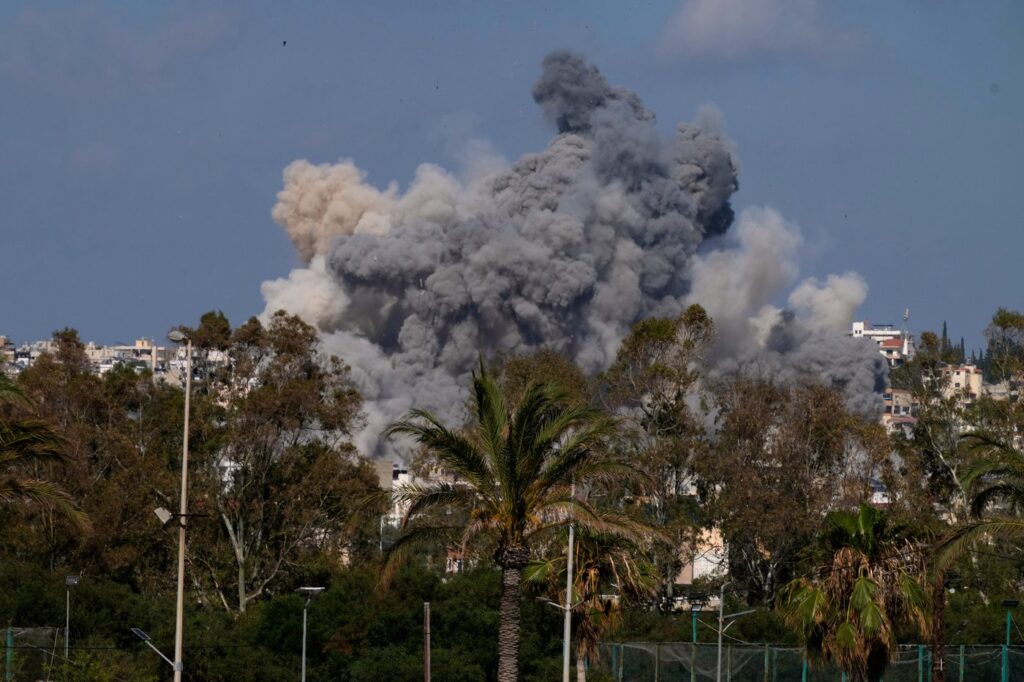
BEIRUT (AP) — An Israeli strike on Wednesday targeted a car on a busy highway just south of Beirut in Khaldeh, occurring just before the second day of talks between Lebanon and Israel set to take place in Washington. The attack came without warning, and it remains unclear if the individual in the car was killed. Historically, Israel has stated that it focuses its drone strikes on members of the Hezbollah militant group.
This strike follows a U.S.-brokered agreement reached on Monday, wherein Israel reportedly agreed to refrain from targeting Beirut's southern suburbs, while Hezbollah committed to ceasing its attacks on northern Israel. The agreement was established shortly after Israel announced intentions to initiate strikes in the urban neighborhoods of the Lebanese capital, marking a potential escalation of violence since a nominal ceasefire was implemented on April 17.
The U.S. State Department confirmed that significant progress was made during the first day of negotiations on Tuesday. Lebanon's primary objective is to expand the ceasefire to ensure it encompasses the entirety of the nation, whereas Israel insists on disarming Hezbollah before concluding its military operations in Lebanon and withdrawing its forces from numerous villages and towns.
Shortly after the strike in Khaldeh, the Israeli military announced it had intercepted what they described as a hostile aircraft originating from southern Lebanon, although no immediate blame was placed on Hezbollah. Since the new ceasefire agreement was affirmed, Hezbollah has not made any claims about cross-border attacks.
Simultaneously, Israeli airstrikes over southern Lebanon persisted, particularly around the cities of Tyre and Nabatiyeh, resulting in casualties. Two strikes near Tyre during the night reportedly killed four Syrians and two Palestinians. In response to Israeli warnings about the presence of Hezbollah members in Tyre's Christian neighborhoods, the Lebanese army was deployed in an effort to deter Israeli attacks and demonstrate that Hezbollah does not have an armed presence in that area.
Israel's military operations intensified after an invasion of southern Lebanon was initiated following earlier hostilities triggered on March 2, when Iran-backed Hezbollah launched rockets into northern Israel in solidarity with Iran. The Israeli military has advanced deeper into Lebanon in recent days, contending with ongoing claims of rocket and drone attacks by Hezbollah.
The ongoing conflict between Israel and Hezbollah has resulted in significant human losses, with reports indicating that 3,468 individuals have been killed in Lebanon, and 1.2 million people have been displaced. According to the office of Israeli Prime Minister Benjamin Netanyahu, at least 27 Israeli soldiers and a defense contractor have lost their lives in or near southern Lebanon, alongside two civilian casualties recorded in northern Israel.
Among the reported fatalities is a soldier whose death was confirmed late Monday by the Israeli military, which also noted that seven additional soldiers sustained injuries in the same incident, with three of those injuries classified as severe. Hezbollah's deployment of difficult-to-detect fiber-optic drones has posed significant challenges for the Israeli military, complicating their response efforts in the escalating conflict.








