

In a significant political shift, the newly appointed Prime Minister of the Solomon Islands, Matthew Wale, announced plans to review the controversial security treaty with China that was established in 2022 under the administration of former Prime Minister Manasseh Sogavare. This treaty has raised concerns from the United States and its allies, particularly Australia, over the possibility of China using the Solomon Islands as a base for its naval operations in the South Pacific.
Before his ascension to power in a parliamentary vote on May 15, 2026, Wale had been vocal about the need to disclose the details of the security pact. Shortly after taking office, he revealed that he had received a copy of the treaty just days prior. He noted that this information came after he had removed certain individuals from key positions in the government, although he refrained from naming them.
Wale expressed that he had begun to examine the treaty but had not yet conducted a thorough review. He mentioned that he had been engaging in prayer and fasting regarding the matter, highlighting the treaty's nondisclosure clause which prevents its public dissemination at this time. Nonetheless, he confirmed that a review of the treaty would take place alongside assessments of other security agreements with various countries.
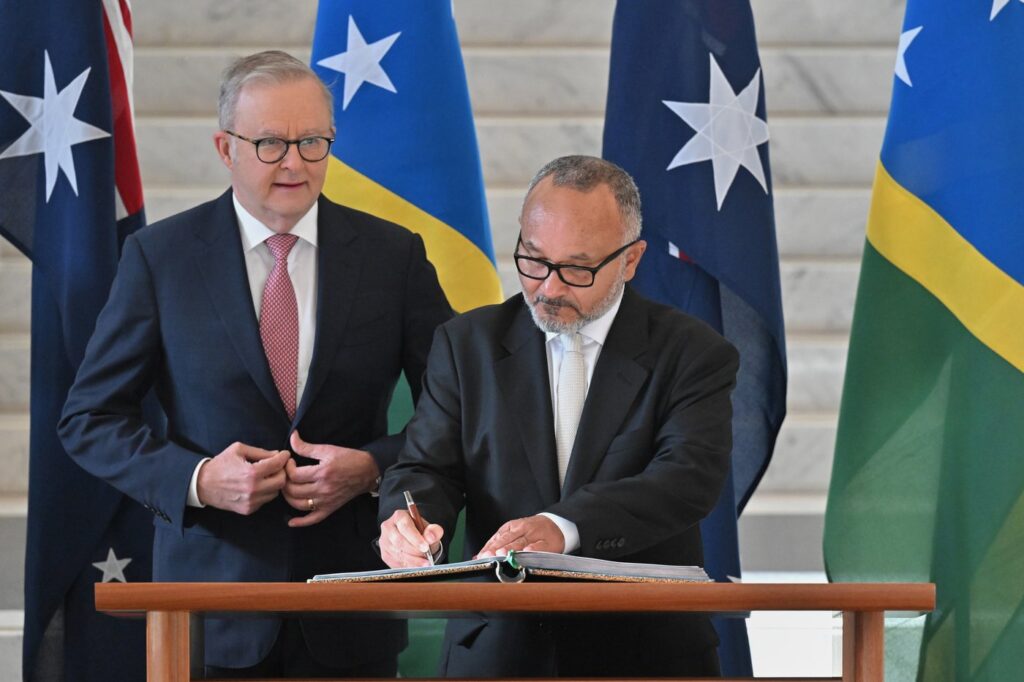
During his first overseas trip as Prime Minister, Wale visited Australia, where he met with Australian Prime Minister Anthony Albanese. The two leaders proposed negotiations for a comprehensive strategic treaty aimed at enhancing the bilateral relationship, focusing on both security and economic issues. Wale acknowledged past challenges between the two nations but emphasized a commitment to reset the relationship moving forward.
Wale voiced a desire for Australia to be the Solomon Islands' primary security partner instead of China, aligning with Albanese's assertion that Australia should be the partner of choice in the region. Wale articulated a vision for the Pacific Islands to collectively manage their own security, a sentiment echoed by Albanese.
The relationship with China has previously included the provision of police instructors to the Solomon Islands due to the absence of a formal military. As a result, the policing roles in the nation are significantly more pronounced compared to countries with armed forces. The Solomon Islands made headlines in 2019 when Sogavare’s government shifted diplomatic recognition from Taiwan, an entity China claims as its territory, over to Beijing, marking a critical geopolitical alignment in the region.
Wale's leadership indicates a potential pivot in the Solomon Islands' foreign policy, signaling a more cautious and transparent approach towards security partnerships while reaffirming close ties with Australia. The upcoming review of the treaty with China remains a focal point of Wale's agenda, reflecting broader implications for regional security dynamics in the South Pacific.








