

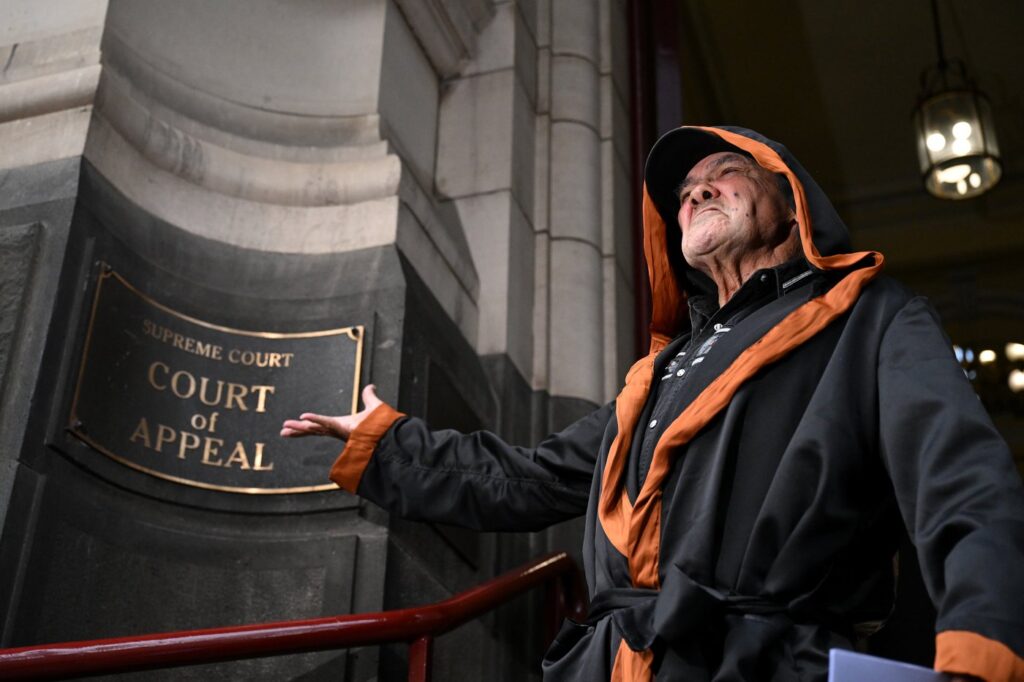
MELBOURNE, Australia (AP) — Three judges from the Australian appeals court reserved their decision on Wednesday concerning whether activist Uncle Robbie Thorpe can prosecute Britain's King Charles III for alleged genocide against Australia's Indigenous people.
Uncle Robbie Thorpe, a 68-year-old Indigenous activist, approached the Supreme Court of Appeal in Victoria state after his requests for a private prosecution against the king were declined by two lower courts in Melbourne. In Indigenous Australian culture, the titles "uncle" and "aunt" signify respect for community elders.
Thorpe's legal case alleges that King Charles, who serves as Australia's head of state, alongside the Australian government and its institutions, perpetuates genocide against Indigenous populations. He claims this is evident through systemic disadvantages that place Indigenous Australians at the bottom of socioeconomic hierarchies, making them the most disadvantaged minority in the nation.
Official statistics reveal that Indigenous Australians comprise approximately 4% of the country's population, yet they face significantly poorer health outcomes, shorter lifespans, higher rates of incarceration, and elevated unemployment levels compared to other demographic groups. Thorpe has expressed intentions that if he exhausts all legal avenues in Australia, he will escalate the case to the International Criminal Court in the Netherlands under the Genocide Convention.
Commenting on the Australian judiciary, Thorpe stated, "It’s clear that they’re unwilling, unable, [or] reluctant to deal with these international legal issues like genocide." He emphasized that the ongoing disadvantages faced by Indigenous people in Australia are contributing to their premature deaths.
Thorpe pointedly asserted, "The Crown is responsible for all this mess. Australia’s got away with genocide of Aboriginal people since they arrived here." The British colonization of Australia began in 1788, resulting in the violent seizure of Indigenous land without any treaty agreements.
During the hearing, Thorpe accused the British of failing to prevent genocide while knowing its implications, stating, "They totally failed to prevent [genocide]. That’s the crime here. They failed to prevent genocide knowingly and they failed to punish anyone for it." He provided context by mentioning how Indigenous cultural practices were systematically suppressed and generations of children removed from their families through discredited assimilation policies.
In court, Thorpe donned a traditional possum-skin coat and carried a feather from an Australian wedge-tailed eagle, a significant Indigenous totem. He requested to be addressed as either Uncle Robbie or by his tribal name, Djuran Bunjileenee. Justice Karin Emerton, who presided over the court, respected this request by referring to him as Uncle Robbie.
The court documents identified the king formally as Charles Philip Arthur George Windsor. Thorpe seeks to bring charges against the king under various legal frameworks, including Indigenous law that has persisted for over 65,000 years, as well as state common law and federal criminal law. However, a judge previously dismissed Thorpe's appeal, reasoning that magistrates were not permitted to acknowledge Indigenous law and that genocide is not categorized as an offense under common law. Additionally, any prosecution under federal law would require the approval of the federal attorney-general.
Following a two-hour hearing on Wednesday, Chief Justice Emerton indicated that the three judges would announce their decision at a later date. Should Thorpe lose this case, his last recourse would be to take the matter to Australia’s High Court before attempting to seek prosecution of the king in The Hague.








