

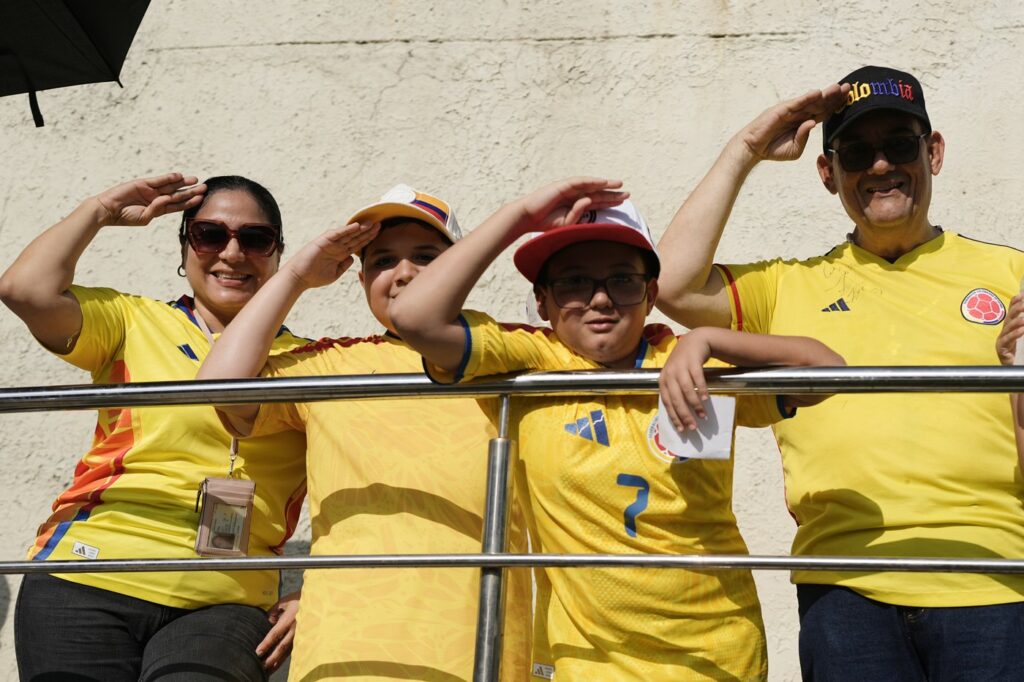
BOGOTA, Colombia (AP) — Colombia's national soccer jersey, a vibrant symbol of unity and pride as the team approaches the 2026 FIFA World Cup, has unexpectedly found itself at the center of a contentious political debate. The jersey, typically worn during soccer matches, national holidays, and significant events, is increasingly seen at political rallies, particularly by supporters of presidential candidate Abelardo de la Espriella, who garnered the most votes in the first round of Colombia's fiercely contested presidential election on Sunday.
De la Espriella, a flamboyant lawyer known for his polarizing rhetoric, has adopted the jersey as part of his campaign attire while addressing supporters from a stage often protected by bodyguards and bulletproof glass. In contrast, Sen. Iván Cepeda, who represents the ruling party and is aligned with President Gustavo Petro, criticized de la Espriella's use of the national jersey, accusing him of inappropriately co-opting a national symbol for political gain.
In a post on social media platform X, Cepeda labeled the practice as an "opportunistic act" and suggested that the legality of using the national team's jersey at political events should be scrutinized. "The national team belongs to all of us," he affirmed, advocating for a more inclusive approach to national symbols. Cepeda, who campaigned in dark cardigans and white mandarin-collared shirts, urged his followers to refrain from wearing Colombia's jersey or other national emblems at his rallies, stating, "Let’s run a clean, transparent campaign."
Despite Cepeda's comments, de la Espriella has not responded directly, yet his campaign team has started to motivate their supporters to wear the jersey prominently, seeing it as a symbol of defiance against Cepeda and the Petro administration. Daniel Briceño, a congressman supporting de la Espriella, asserted in a video that the jersey now represents a stand for freedoms they believe may be threatened by Cepeda's party.
This political tug-of-war over the jersey is reminiscent of events in Brazil, where supporters of former President Jair Bolsonaro adopted the Brazilian national jersey at political rallies. Bolsonaro, currently under house arrest for his involvement in a coup plot following his electoral defeat in 2022, had promoted wearing the Brazilian jersey at polling places. Presently, President Luiz Inácio Lula da Silva is actively encouraging a reclamation of the jersey, urging supporters to don it to ensure it is not monopolized by extremist factions.
Carlos Andrés Arias, a political marketing consultant based in Bogota, noted that politicians from Cepeda’s party, including President Petro, have previously worn Colombia's yellow jersey during campaigns, but with less frequency. He believes de la Espriella's use of the jersey evokes strong feelings of nationalism, which can significantly benefit his campaign, particularly as he advocates for stricter security measures and a halt to peace talks with rebel groups.
Arias remarked that Cepeda’s efforts to prevent the use of the jersey at political rallies may inadvertently strengthen the connection between de la Espriella’s campaign and the national symbol. "People will now think that wearing the jersey is a sure way to support de la Espriella," he stated.
The Colombia National Football Federation, which holds the marketing rights to the jerseys, expressed its inability to regulate uses of its shirts during non-commercial events, while voicing concerns about the jerseys being used for political purposes. Raúl Cardona, a volunteer for Cepeda’s campaign, shared that supporters have also started wearing the national team jersey at various rallies, underscoring the need for democratizing its usage and preventing a single campaign from claiming ownership of this national symbol.








